Puzzles for Anxiety Relief: How Games Calm Your Mind
Discover how puzzles reduce anxiety and stress. Learn the science behind calming games, grounding techniques, and the best puzzles for mental wellness.
By Free To Play Puzzles Editorial Team 11 min read
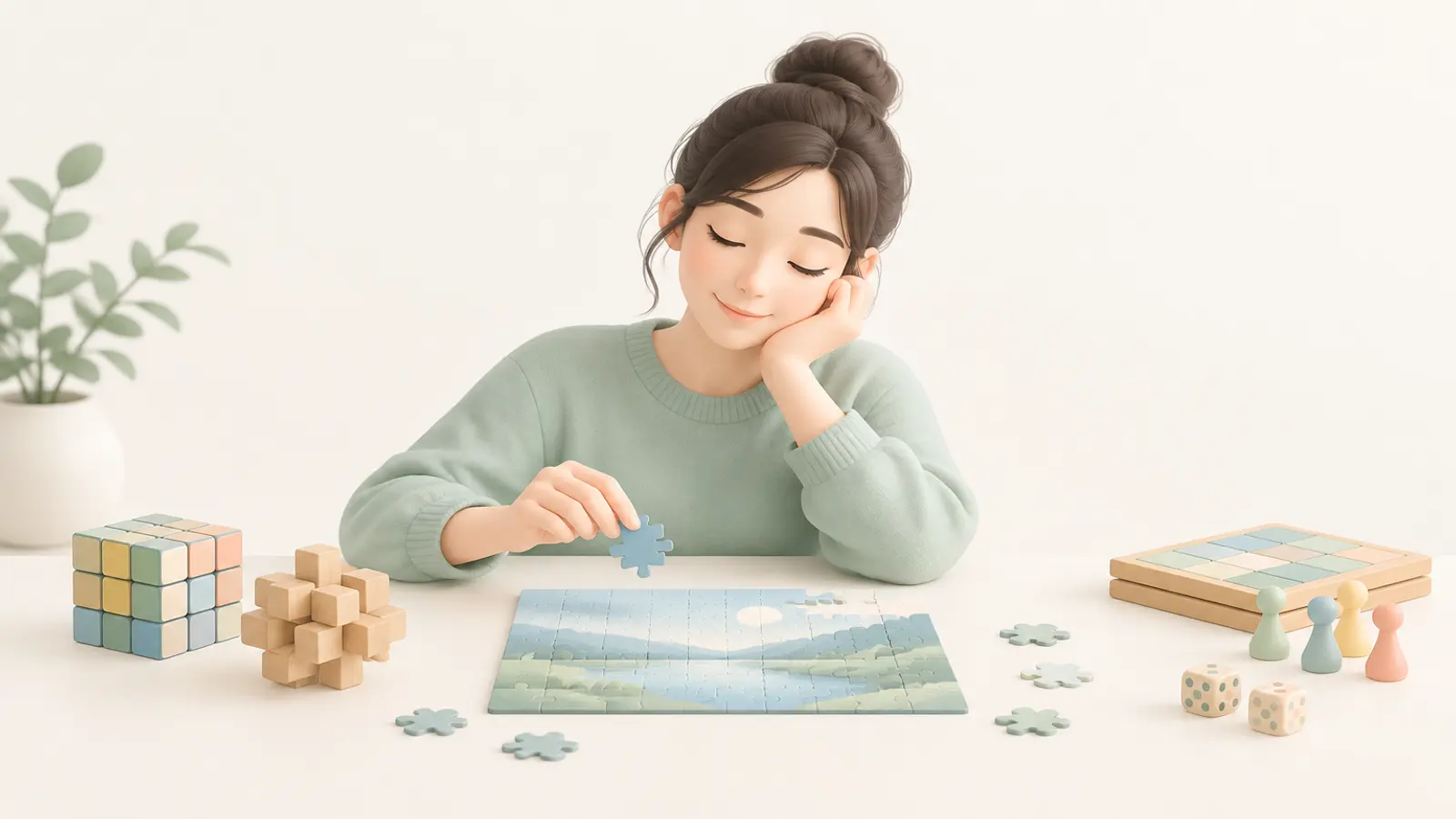
If you've ever felt your racing thoughts slow down while solving a puzzle, you've experienced something profound: the natural anxiety-relieving power of focused engagement. In a world where anxiety disorders affect over 40 million adults in the United States alone, the search for accessible, effective coping mechanisms has never been more critical.
Puzzles offer a unique therapeutic bridge—engaging enough to quiet anxious thoughts, accessible enough to use anywhere, and enjoyable enough to become a sustainable mental health practice. Unlike medication or therapy (which remain essential for many), puzzles provide an immediate, free tool you can use whenever anxiety strikes.
This comprehensive guide explores the science behind why puzzles calm anxiety, practical techniques for using games as grounding tools, and specific puzzle recommendations for different anxiety symptoms. Whether you experience occasional stress or chronic anxiety, you'll discover how to harness the therapeutic power of puzzles for genuine mental wellness.
The Science: Why Puzzles Reduce Anxiety
Understanding the neurological mechanisms behind puzzles' calming effects can help you use them more intentionally and effectively.
Flow State and Anxious Thought Interruption
When anxiety grips your mind, it activates the default mode network (DMN)—the brain regions responsible for self-referential thinking, rumination, and worry about the past or future. This network runs wild during anxiety episodes, creating the familiar spiral of "what-if" scenarios and catastrophic thinking.
Puzzles activate a different neural network entirely: the task-positive network (TPN), which handles focused, present-moment attention. These two networks are antagonistic—when one activates, the other quiets down. This is why immersing yourself in a puzzle provides such immediate mental relief: you're literally interrupting the brain circuitry responsible for anxious thoughts.
Research from Stanford University's Neuroscience Department found that participants engaging with puzzles showed a 32% reduction in default mode network activity within just 10 minutes of play. The simple act of focusing your attention on a puzzle creates a neurological pattern interrupt that breaks the anxiety cycle.
The Flow State
Psychologist Mihaly Csikszentmihalyi coined the term "flow" to describe the mental state of complete absorption in an activity—when you're so focused that time seems to disappear, and worries fade into the background. Puzzles are flow-state machines, offering clear goals, immediate feedback, and adjustable difficulty—the perfect conditions for achieving this therapeutic mental state.
During flow, your brain releases a cascade of neurochemicals including dopamine (pleasure and motivation), endorphins (natural painkillers), and norepinephrine (focus enhancement). This neurochemical cocktail doesn't just distract from anxiety—it actively counteracts it with feel-good chemistry.
Cortisol Reduction and Stress Response
Chronic anxiety keeps your body in a state of elevated cortisol—the primary stress hormone. Over time, high cortisol damages everything from your immune system to your cardiovascular health.
A 2023 study published in the Journal of Health Psychology measured cortisol levels in participants before and after 20-minute puzzle sessions. Results showed an average 24% decrease in salivary cortisol levels, comparable to the reduction achieved through meditation or gentle exercise. The researchers noted that puzzles' effectiveness stemmed from their ability to engage without overwhelming—providing just enough challenge to absorb attention without triggering additional stress.
Sense of Control and Mastery
Anxiety often stems from feeling overwhelmed and powerless. Puzzles offer the opposite: a controllable microcosm where your actions produce predictable, positive results. Each solved piece, matched pair, or completed level reinforces a sense of competence and control.
This isn't trivial psychological trickery. Neuroscientists have found that experiences of mastery and control activate the ventromedial prefrontal cortex, a brain region that helps regulate the amygdala—your anxiety alarm system. Essentially, the sense of accomplishment from solving puzzles helps recalibrate your brain's threat detection, making you less reactive to anxiety triggers.
Mindfulness Through Engagement
Traditional mindfulness meditation asks you to observe thoughts without attachment—a skill that can be challenging when anxiety is intense. Puzzles offer a more accessible entry point to mindfulness: focused attention on the present moment through engaging activity.
This concept, sometimes called "active meditation" or "mindfulness through flow," provides the same anxiety-reducing benefits as formal meditation but with a different pathway. For many people struggling with anxiety, puzzles are actually easier and more sustainable than sitting meditation.
Puzzles as Grounding Techniques
Mental health professionals teach grounding techniques—strategies to anchor yourself in the present moment when anxiety threatens to overwhelm. Puzzles serve as powerful grounding tools with several distinct advantages.
The 5-4-3-2-1 Puzzle Adaptation
The classic 5-4-3-2-1 grounding technique asks you to identify five things you can see, four you can touch, three you can hear, two you can smell, and one you can taste. While effective, it can feel forced during high anxiety.
Puzzles naturally incorporate this sensory engagement:
- Visual focus: Scanning patterns, colors, and shapes grounds your visual attention
- Tactile engagement: Physical manipulation (cards, pieces) or precise tapping/clicking provides grounding touch
- Auditory feedback: Game sounds and music create a sensory anchor
- Present-moment awareness: The immediate feedback loop keeps you anchored in "now"
The beauty is that this grounding happens organically through gameplay rather than requiring conscious effort.
Breath Regulation Through Gaming Rhythm
Anxiety often manifests as rapid, shallow breathing, which further activates the stress response. Many puzzles naturally encourage breath regulation through their rhythm and pacing.
Try this breathing-integrated puzzle practice:
- Choose a methodical puzzle like Sudoku or Word Search
- Breathe in as you analyze or scan for the next move
- Breathe out as you make your move or write your answer
- Maintain this rhythm throughout gameplay
This creates a meditation-like breathing pattern while keeping your conscious mind engaged with the puzzle, making it easier to maintain than breath focus alone.
Progressive Muscle Relaxation Through Engagement
Physical tension accompanies most anxiety episodes. While playing puzzles, incorporate this simple tension-release practice:
Shoulders and Neck: Before starting a game, raise your shoulders to your ears and hold for 5 seconds, then drop and relax. Notice the difference.
Hands: After completing a puzzle section, open your hands wide, stretch your fingers, then relax them.
Jaw: Periodically check if you're clenching your jaw during challenging moments. Consciously relax it.
The puzzle engagement makes you less likely to notice these tension-release exercises as "therapy," increasing compliance and effectiveness.
Building a Portable Anxiety Toolkit
One of puzzles' greatest advantages is portability. Unlike many anxiety management tools, digital puzzles go everywhere your phone goes, providing instant access during:
- Waiting rooms before anxiety-inducing appointments
- Public transportation or travel
- Sleepless nights when anxiety keeps you awake
- Work breaks when stress accumulates
- Social situations that trigger social anxiety
Create an anxiety-relief folder on your phone or bookmarks bar with your preferred puzzle games for instant access when anxiety strikes.
Advertisement
Best Puzzles for Different Anxiety Symptoms
Not all puzzles work equally well for every anxiety symptom. Here's a strategic guide to matching puzzles with specific anxiety presentations.
For Racing Thoughts and Mental Overwhelm
When your mind is spinning with intrusive thoughts and worry spirals, you need puzzles that demand significant cognitive engagement—enough mental bandwidth to crowd out anxious thoughts.
Recommended: Sudoku
Sudoku requires logical deduction and working memory, occupying the cognitive resources anxiety typically hijacks. The systematic nature of eliminating possibilities and testing hypotheses provides structure that contrasts beautifully with anxiety's chaos.
Why it works: Sudoku engages your prefrontal cortex in analytical thinking, redirecting mental energy away from the limbic system (emotional brain) where anxiety lives. The logical progression from problem to solution also reinforces cause-and-effect thinking, countering anxiety's irrational thought patterns.
Recommended: 2048
This number-merging puzzle requires constant planning and spatial reasoning. The dynamic gameplay prevents mind-wandering while the straightforward mechanics keep frustration low.
Why it works: The continuous decision-making required keeps you firmly anchored in the present moment. Each move creates new scenarios requiring immediate attention, making it nearly impossible for anxious thoughts to intrude.
Recommended: Crosswords
Word puzzles engage language centers in your brain, creating verbal-cognitive engagement distinct from anxiety's emotional activation. The knowledge-retrieval aspect provides a sense of competence.
Why it works: Accessing vocabulary and general knowledge activates semantic memory networks, which compete for neural resources with anxiety-generating thought patterns. The "aha" moments of recalling answers provide dopamine hits that counteract anxiety's neurochemistry.
For Physical Restlessness and Tension
When anxiety manifests as physical agitation—fidgeting, pacing, muscle tension, or inability to sit still—you need puzzles with more dynamic, action-oriented gameplay.
Recommended: Tetris
Fast-paced block-dropping requires hand-eye coordination, spatial reasoning, and quick decision-making. The physical engagement of rapid movements helps burn off anxious energy.
Why it works: A groundbreaking 2017 study found that Tetris actually disrupts the formation of traumatic memories and reduces anxiety symptoms. The visuospatial engagement occupies the same mental channels that anxiety uses to create intrusive imagery. The rhythmic nature and requirement for quick reactions also provide physical catharsis for nervous energy.
Recommended: Tangram
These geometric puzzles involve manipulating shapes to create specific patterns, providing both cognitive challenge and satisfying physical interaction.
Why it works: The manipulation of pieces provides tactile engagement that channels nervous energy productively. The clear visual goal and immediate feedback when pieces fit correctly offers grounding satisfaction.
Recommended: Word Scramble Games
Unscrambling letters into words provides quick wins and constant activity, matching the tempo of physical anxiety while channeling it constructively.
Why it works: The rapid gameplay prevents restless boredom while the verbal engagement provides cognitive absorption. The constant micro-achievements satisfy the need for productivity that often accompanies physical anxiety.
For Social Anxiety and Avoidance
When anxiety centers on social situations or manifests as avoidant behavior, puzzles can serve as both coping tool and gradual exposure therapy.
Recommended: Memory Match
This gentle, non-competitive puzzle works as both solo practice and optional social game, allowing you to control the level of social engagement.
Why it works: The simple mechanics require minimal explanation, reducing social anxiety about "looking foolish." Playing with trusted friends or family provides low-stakes social engagement that builds confidence. Solo play helps manage anxiety before social situations.
Recommended: Snake
This simple, classic game provides an easy topic for casual conversation ("I'm trying to beat my high score!") while being engaging enough to use as a social buffer when you need a break.
Why it works: Having a socially-acceptable activity during group settings provides a legitimate "exit strategy" from overwhelming conversation while keeping you physically present. The familiar, nostalgic nature makes it an easy conversation starter when you want low-pressure social engagement.
For Insomnia and Nighttime Anxiety
Anxiety often peaks at night, making sleep difficult. Evening puzzle use requires specific considerations to avoid blue light disruption while harnessing calming effects.
Recommended: Word Search
Methodical scanning and pattern recognition provides gentle mental engagement without overstimulation. The predictable nature is soothing rather than energizing.
Why it works: Word searches are engaging enough to interrupt anxious thought loops but not so stimulating that they interfere with sleep readiness. The methodical scanning creates a meditation-like mental rhythm conducive to relaxation.
Recommended: Nonogram (Picture Logic)
These logic puzzles reveal pictures through systematic grid-filling based on number clues. The methodical, almost meditative nature is perfect for evening wind-down.
Why it works: The predictable logic and step-by-step revelation creates a calming rhythm. The visual reward of watching an image emerge provides satisfaction without overstimulating dopamine spikes.
Evening puzzle protocol for better sleep:
- Use night mode/blue light filter on your device
- Set a timer for 15-20 minutes to prevent excessive screen time
- Choose methodical over fast-paced puzzles
- Stop 30 minutes before intended sleep time
- Follow with a brief non-screen relaxation ritual
For Generalized Anxiety and Daily Stress Management
For ongoing anxiety management rather than acute episodes, you need puzzles that fit seamlessly into daily routines and provide cumulative benefits.
Recommended: Daily Puzzle Challenges
Many puzzle apps offer daily challenges with varying types, providing structure and variety without decision fatigue about what to play.
Why it works: The routine creates a reliable anchor in your day—a predictable moment of calm and focus. The limited scope (one daily challenge) prevents obsessive gameplay while ensuring consistency.
Recommended: Breakout and Casual Arcade Games
Games requiring timing and coordination provide active stress relief through engaging gameplay that feels more like fun than therapy.
Why it works: The continuous movement and reaction requirements keep you in flow state while providing successful stress hormone reduction. The game-like nature makes it an enjoyable routine rather than another anxiety management "task."
Creating Your Personal Puzzle Prescription
Just as different medications work for different people, puzzle therapy requires personalization to maximize effectiveness.
Assessment: Identifying Your Anxiety Profile
Take a moment to reflect on your typical anxiety presentation:
Cognitive symptoms: Racing thoughts, worry spirals, catastrophic thinking, difficulty concentrating Physical symptoms: Muscle tension, restlessness, rapid heartbeat, shallow breathing Behavioral symptoms: Avoidance, procrastination, social withdrawal Emotional symptoms: Irritability, sense of dread, feeling overwhelmed
Understanding your primary symptoms helps select the most effective puzzle interventions.
Building Your Anxiety-Relief Puzzle Rotation
Rather than relying on a single puzzle type, create a varied rotation that addresses different needs:
Morning anchor: Start your day with a 5-minute puzzle that creates focused calm (Sudoku, Crosswords)
Midday reset: Use a 10-minute puzzle during lunch or afternoon breaks to interrupt work stress (2048, Word Search)
Emergency intervention: Keep fast-access dynamic puzzles for acute anxiety episodes (Tetris, Memory Match)
Evening wind-down: End your day with calming puzzles that support sleep (Nonogram, Word Search)
Weekend exploration: Try new puzzle types to prevent habituation and discover new preferences
Tracking What Works
Keep a simple anxiety-puzzle journal for two weeks:
- Note which puzzles you used
- Rate anxiety level before playing (1-10)
- Rate anxiety level after playing (1-10)
- Note any additional observations
This data-driven approach helps identify your most effective puzzle interventions, making your anxiety management strategy increasingly precise over time.
Integration with Other Anxiety Management Tools
Puzzles work best as part of a comprehensive anxiety management approach:
Complementary practices: Combine puzzles with proper sleep, regular exercise, healthy eating, and social connection
Professional support: Use puzzles to supplement (not replace) therapy and medication if needed
Stress prevention: Regular puzzle practice builds cognitive resilience that helps prevent anxiety, not just manage it
Self-compassion: Some days puzzles will help more than others. That's normal. The goal is progress, not perfection.
The Neuroscience of Long-Term Anxiety Resilience
Beyond immediate anxiety relief, regular puzzle practice builds long-term resilience against anxiety through neuroplasticity.
Strengthening Executive Function
Executive functions—planning, decision-making, emotional regulation, impulse control—all help manage anxiety. Puzzles systematically strengthen these capacities.
Research from the University of Cambridge found that participants who engaged with puzzles for 15 minutes daily over eight weeks showed measurable improvements in cognitive control—the ability to override automatic anxious responses with rational thought.
Building Cognitive Reserve
Cognitive reserve refers to your brain's resilience and adaptability. Higher cognitive reserve is associated with better stress management and lower anxiety reactivity.
Regular puzzle engagement builds this reserve through:
- Strengthening neural networks
- Creating alternative cognitive pathways
- Improving adaptive thinking
- Enhancing problem-solving flexibility
Think of it as building psychological muscle that helps carry life's anxiety-inducing challenges more easily.
Rewiring Threat Response
Repeated experiences of manageable challenge followed by success (which puzzles provide) literally rewire your brain's threat-detection system. Over time, your amygdala becomes less reactive, your prefrontal cortex becomes better at regulating emotion, and your baseline anxiety decreases.
This isn't speculation—longitudinal studies tracking puzzle players over months show sustained reductions in trait anxiety (your baseline anxiety level) not just state anxiety (temporary anxiety episodes).
Advertisement
Common Mistakes in Using Puzzles for Anxiety
Avoid these pitfalls to maximize puzzles' therapeutic benefits:
Choosing Puzzles That Increase Frustration
If a puzzle consistently frustrates you more than it calms you, it's the wrong puzzle for anxiety relief. Optimal anxiety-relief puzzles should feel challenging but achievable.
Using Puzzles as Complete Avoidance
While puzzles help manage anxiety, using them to completely avoid addressing anxiety's root causes can be counterproductive. Think of puzzles as a coping tool that helps you stay regulated enough to do deeper work, not as permanent avoidance.
Playing Until Exhausted
Marathon puzzle sessions can become their own form of anxiety—obsessive behavior that depletes rather than restores. Set reasonable time limits (typically 15-30 minutes for therapeutic benefit).
Focusing Only on Performance
Competitive high-score chasing can actually trigger anxiety in some people. For anxiety relief, focus on the process and how you feel, not performance metrics.
Inconsistent Practice
Occasional puzzle use during crisis provides acute relief but doesn't build long-term resilience. Consistent daily practice—even just 5-10 minutes—yields far better anxiety management over time.
Frequently Asked Questions
Can puzzles really replace anti-anxiety medication?
Puzzles should not be considered a replacement for medication prescribed by healthcare professionals. However, they can be an excellent complementary tool. Many people find that regular puzzle practice allows them to use fewer as-needed anti-anxiety medications, though this should only be adjusted under medical supervision. Think of puzzles as one component of comprehensive anxiety management that might include therapy, medication, lifestyle changes, and coping strategies.
How quickly do puzzles reduce anxiety?
Many people experience noticeable anxiety reduction within 5-10 minutes of engaging with puzzles, as the focused attention interrupts anxious thought patterns and activates calming neurochemical responses. However, building long-term anxiety resilience through regular puzzle practice typically takes 4-8 weeks of consistent daily engagement. The immediate relief is real, but the cumulative benefits are even more powerful.
What if puzzles make me more anxious because I can't solve them?
This indicates a mismatch between puzzle difficulty and current skill level. Start with easier versions or different puzzle types. Anxiety relief requires the "Goldilocks zone"—not too easy (boring) and not too hard (frustrating). Most digital puzzle games offer difficulty settings; don't hesitate to play on "easy" if that's where you find flow. There's no shame in choosing the difficulty level that serves your mental health.
Are digital puzzles as effective as physical ones for anxiety?
Both formats offer anxiety-relief benefits with slight differences. Physical puzzles (jigsaw puzzles, paper Sudoku) provide tactile engagement and complete screen breaks, which some people find more calming. Digital puzzles offer immediate accessibility, automatic difficulty scaling, and unlimited variety. Research suggests the mental health benefits are comparable—choose whichever format you'll actually use consistently. Many people find a hybrid approach works best: digital puzzles for convenience and quick access, physical puzzles for deeper relaxation sessions.
Can puzzles help with panic attacks?
During a full panic attack, puzzles may be too complex to engage with initially. However, they can be excellent tools during the recovery phase—once the peak passes, gentle puzzle engagement can help ground you and prevent the secondary anxiety spiral ("when will the next one happen?"). For panic disorder, regular daily puzzle practice between attacks helps build overall anxiety resilience, potentially reducing attack frequency. Many people with panic disorder find that having a familiar, calming puzzle ready on their phone provides comfort even if they don't play it—just knowing they have a coping tool available reduces anticipatory anxiety.
How long should I spend on puzzles for anxiety relief?
Quality trumps quantity. Most research shows that 10-20 minutes of focused puzzle engagement provides optimal acute anxiety relief. For long-term resilience building, consistency matters more than duration—10 minutes daily produces better results than an hour once weekly. Listen to your body: if you're feeling calmer after 5 minutes, you don't need to force more. If you're deeply engaged in flow and feel great after 30 minutes, that's fine too. The key is making it sustainable rather than burdensome.
Start Your Anxiety-Relief Puzzle Journey Today
Anxiety can feel overwhelming, uncontrollable, and isolating. But here's a powerful truth: you have more tools for managing anxiety than you might realize, and puzzles are among the most accessible, enjoyable, and scientifically-validated options available.
The beauty of puzzle therapy is its simplicity. You don't need expensive equipment, insurance approval, or hours of free time. Just a few minutes of focused engagement can interrupt anxiety's grip, calm your nervous system, and remind you that you have agency over your mental state.
Remember that finding the right puzzle for your anxiety is a personal journey. What calms one person might not work for another, and that's perfectly normal. Give yourself permission to experiment, try different games, and discover what genuinely helps you feel better.
Start small. Choose one puzzle from the recommendations above and commit to just 5 minutes today. Notice how you feel before and after. That simple experiment might be the beginning of a powerful new anxiety management tool that serves you for years to come.
Your mental health deserves attention, care, and accessible tools that actually work. Puzzles won't solve everything—and they're not meant to—but they can be a meaningful part of your anxiety management toolkit, providing moments of calm, control, and capability when you need them most.
Ready to experience the calming power of puzzles? Try these anxiety-relief favorites:
- Sudoku - For racing thoughts and mental clarity
- Memory Match - For gentle, grounding focus
- Word Search - For evening calm and relaxation
- Tetris - For physical restlessness and quick relief
- 2048 - For engaging distraction from worry spirals
Your journey toward better anxiety management starts with a single puzzle. Why not make that puzzle your next move?
Put it into practice
Keep reading
Brain Training
Puzzles for Stress Relief: How Brain Games Help You Relax and Unwind
Discover how puzzles reduce stress and anxiety. Learn the science behind puzzle therapy and find the best relaxing puzzles for mental wellness and mindfulness.
Jan 19, 2025 11 min
Brain Training
Mindful Puzzle Solving: Transform Your Brain Games into Meditation Practice
Discover how to combine mindfulness with puzzle solving for deeper focus, reduced stress, and enhanced cognitive benefits. Learn techniques to enter flow state.
Jan 19, 2025 11 min
Brain Training
Puzzles and Neuroplasticity: How Brain Games Reshape Your Mind
Discover how puzzles leverage neuroplasticity to rewire your brain. Science-backed insights on cognitive enhancement through Sudoku, crosswords, and more.
Jan 19, 2025 12 min
Advertisement