Mindfulness Puzzle Practice: A Scientist’s Guide to Meditative Solving
Discover how mindfulness puzzles reduce cortisol, boost cognitive health, and trigger dopamine. Learn expert strategies for meditative puzzle solving in 2025.
By Free To Play Puzzles Editorial Team 12 min read
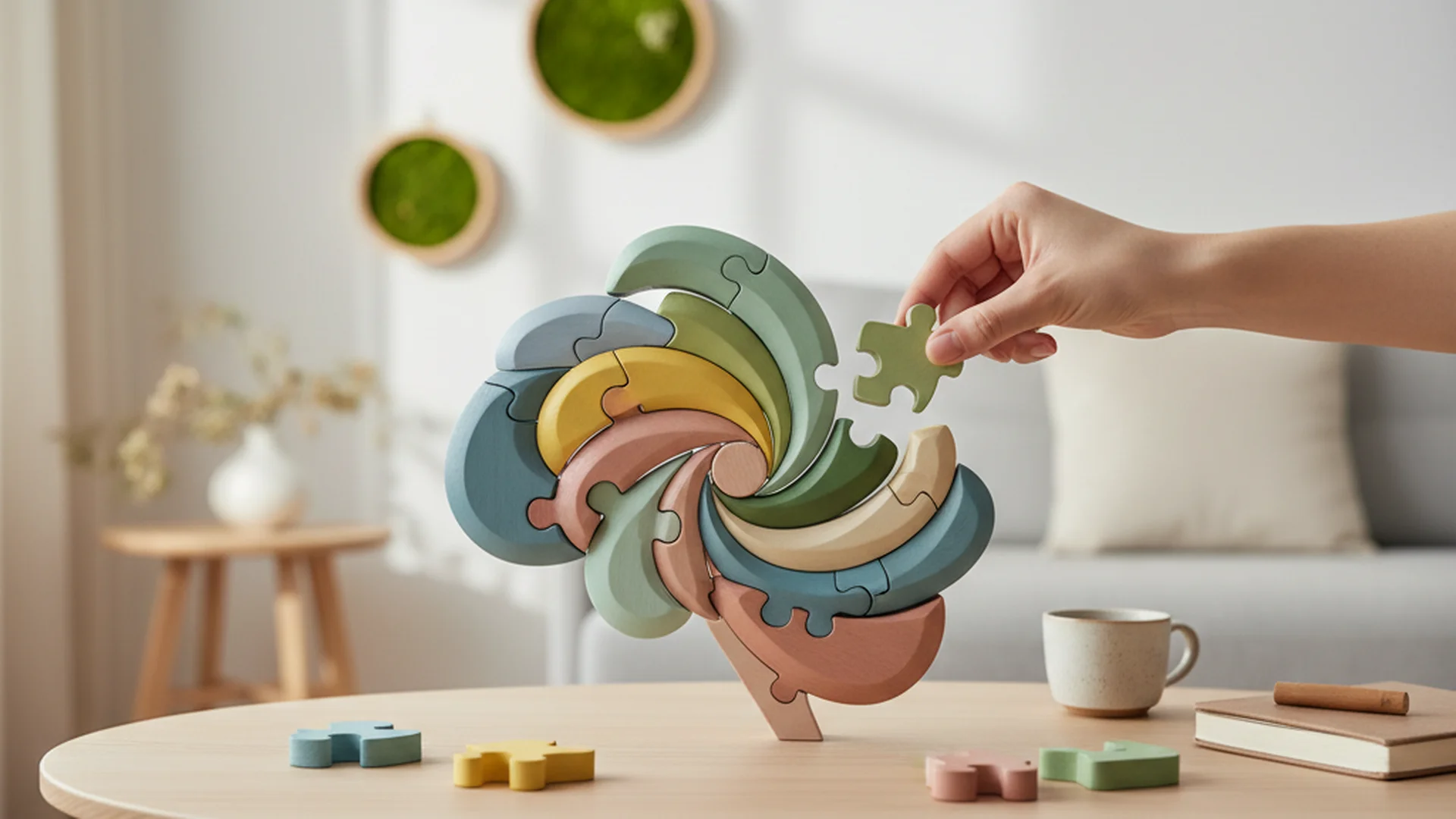
In our increasingly fragmented digital world, the search for mental clarity often leads us back to the most tactile of foundations. One of the most effective, yet frequently overlooked, tools in our cognitive arsenal is the engagement with mindfulness puzzles. This practice, often called meditative puzzle solving, is far more than a simple hobby; it is a sophisticated neurological exercise that bridges the gap between relaxation and active cognitive engagement.
When you sit down with a puzzle, you aren't just matching shapes or colors. You are entering a "flow state"—a mental zone where your brain is fully immersed in the present moment, effectively silencing the "monkey mind" that fuels anxiety and burnout. In 2025, as we witness an "analog revival," these tools have become essential pillars of modern mental hygiene.
The Neuroscience of Meditative Puzzle Solving
To understand why mindfulness puzzles are so effective, we must look at what happens inside the brain during a session. Unlike passive relaxation—such as watching television—puzzling requires "active mindfulness." This means your brain is working, but it is working in a way that is rhythmic, structured, and low-stakes.
The Power of the Flow State
When you engage in meditative puzzle solving, your brain waves transition from the frantic Beta state (associated with stress and multitasking) to the calmer Alpha and Theta states. This is the hallmark of the "flow state." In this zone, the prefrontal cortex—the part of the brain responsible for complex decision-making and worrying about the future—takes a back seat. This allows for a deep sense of presence.
The Dopamine Reward Loop
Every time you find a matching piece or solve a difficult clue in a crossword, your brain releases a small burst of dopamine. This neurotransmitter is responsible for feelings of pleasure and motivation. By providing a consistent stream of "micro-wins," puzzles help regulate mood and reinforce focus without the overstimulation common in high-speed video games.
Clinical Benefits for Brain Health
The therapeutic applications of puzzles are supported by a growing body of clinical research. Whether you are using Occupational Therapy Puzzles to recover from an injury or simply looking to preserve your memory, the benefits are profound.
Reducing Dementia Risk
A landmark study by the Alzheimer’s Association revealed that regular participation in mentally stimulating activities, such as puzzles, can reduce the risk of dementia by as much as 47%. By engaging up to eight cognitive functions simultaneously—including spatial reasoning, short-term memory, and logic—puzzles build "cognitive reserve."
Managing General Anxiety Disorder (GAD)
For those struggling with anxiety, the world can feel chaotic. Puzzles provide a controlled environment where problems have clear, tangible solutions. Research has shown that solving puzzles for just 30 minutes a day over an eight-week period significantly decreases anxiety levels in adults. This is because the focused attention required for puzzling prevents the brain from spiraling into "what-if" scenarios.
Support for ADHD and Neurodivergence
For individuals with ADHD, traditional "still" meditation can be frustrating. Puzzling offers a "moving meditation." It provides a structured, low-stakes challenge that organizes disorganized thoughts. To learn more about how this applies to specific conditions, you might explore Autism and Puzzles.
| Cognitive Function | Benefit of Puzzling |
|---|---|
| Spatial Reasoning | Improved mental rotation of objects |
| Short-Term Memory | Enhanced recall of shapes and colors |
| Pattern Recognition | Faster identification of visual trends |
| Fine Motor Skills | Maintenance of hand-eye coordination |
Advertisement
Best Practices for a Mindful Practice
To transform a casual game into a therapeutic mindfulness puzzle session, you must approach the activity with intention.
1. Create a "Sacred Space"
Your environment dictates your internal state. Choose a dedicated area for your practice with comfortable seating and "soft" lighting. Avoid harsh blue light, especially if you are puzzling in the evening, as this can interfere with your circadian rhythm.
2. The "No-Timer" Rule
Mindfulness is about the process, not the speed. Eliminate the competitive element by avoiding apps with ticking clocks or leaderboards. If you are using digital platforms, look for "Zen" modes that prioritize smooth animations and ambient soundscapes.
3. Habit Stacking
The best way to ensure consistency is through habit stacking. Tie your puzzle practice to an existing routine:
- Solve a Sudoku while drinking your morning tea.
- Work on a jigsaw for 15 minutes immediately after work to "transition" out of professional mode.
- Play Memory Games before bed to wind down from screen time.
Recent Trends in the Puzzling Renaissance (2025–2026)
The world of puzzles has evolved significantly. In 2025, we are seeing a shift toward high-quality, sustainable, and technologically integrated experiences.
- Sustainable & Tactile Materials: Many practitioners now prefer wooden puzzles made from bamboo or recycled materials. These offer a satisfying "thunk" when pieces connect and often feature natural scents that enhance the sensory experience.
- Non-Linear Shapes: "Round" puzzles or those with irregular, "whimsical" pieces are trending. These force the brain to abandon traditional edge-first strategies, deepening the state of presence.
- Social Mindfulness: "Puzzle Circles" are becoming common in urban wellness centers. These events allow for "low-pressure social connection," where people can interact while focusing on a shared task.
- AR/VR Meditative Puzzles: For those who enjoy technology, 2025 has introduced virtual "sanctuaries" where you can solve 3D puzzles in an immersive environment, often combined with sound baths.
Common Mistakes to Avoid
Even with the best intentions, certain habits can turn a relaxing activity into a source of stress.
Over-Focusing on Completion
The goal of meditative puzzle solving is the act of solving, not the final image. Many people rush to finish, which induces the very stress they are trying to avoid. If you find yourself frustrated, take a break.
Choosing Overwhelming Themes
Avoid puzzles with massive areas of a single color (e.g., an all-white sky or a solid black background). These often lead to frustration. Instead, look for varied patterns and vibrant colors that provide frequent "easy wins" to keep the dopamine flowing.
The Productivity Guilt
In a society obsessed with "hustle culture," many feel guilty for "wasting time" on a game. We encourage you to reframe this: puzzling is a cognitive "sharpening" tool. By preventing burnout, it actually increases your long-term productivity and mental clarity. For more on the clinical side of this, see Cognitive Rehabilitation Puzzles.
Advertisement
Frequently Asked Questions
Is puzzling actually a form of meditation?
Yes. It is considered "active mindfulness" or "moving meditation." It provides a single-point focus that quietens the "monkey mind" without requiring the physical stillness that many find difficult in traditional meditation.
Are digital puzzles as effective as physical ones?
While digital puzzles offer convenience, tactile puzzles provide a sensory experience that grounds the practitioner. However, "minimalist" digital platforms designed specifically for relaxation (no timers or ads) are highly effective for those on the go.
How long should a session last?
Experts recommend 15–30 minutes as a sweet spot for stress relief. This is long enough to enter a flow state but short enough to avoid physical strain or mental fatigue.
How does it help with ADHD?
For those with ADHD, the structured, low-stakes nature of a puzzle can help organize thoughts. It provides a "calm challenge" that doesn't trigger executive function overwhelm, making it an excellent brain training tool.
Can I puzzle with other people?
Absolutely. "Social mindfulness" through group puzzling is a great way to foster connection without the pressure of constant conversation. It’s a shared journey toward a common goal.
Conclusion: Fitting the Pieces Together
Mindfulness puzzle practice is a testament to the fact that sometimes, the best way to move forward is to slow down. By engaging in meditative puzzle solving, you are giving your brain the gift of "structured rest." You are lowering your cortisol, building your cognitive reserve, and finding a moment of peace in a noisy world.
Whether you prefer the tactile snap of a wooden jigsaw or the logic of a daily Sudoku, the key is consistency and intention. Start small, create your space, and let the pieces fall into place.
Ready to Start?
Begin your mindfulness journey with our collection of daily challenges.
Put it into practice
Keep reading
Logic Puzzles
Mastering the IQ Puzzle: The Ultimate Guide to Logic and SmartGames (2025-2026)
Discover the cognitive benefits and expert strategies for solving the IQ puzzle. Learn about 2025 trends, SmartGames, and how to sharpen your mind effectively.
Jun 20, 2026 12 min
Sudoku
Mini Sudoku: The Ultimate Quick Puzzle for Fast Brain Training
Explore the science behind Mini Sudoku and 4x4 puzzles. Learn how these 'brain snacks' improve memory by 18% and discover expert strategies for 60-second solves.
Mar 8, 2026 10 min
Brain Health
Mastering Mental Rotation Games: The Ultimate Guide to Spatial Intelligence
Unlock your cognitive potential with mental rotation games. Learn how spatial rotation training boosts STEM success, closes gender gaps, and enhances brain health in 2025.
Feb 26, 2026 12 min
Advertisement