Word Search for Adults: Challenging Themes and Cognitive Benefits
Discover why word search for adults is the ultimate brain exercise. Learn expert strategies, cognitive health benefits, and the latest 2025-2026 puzzle trends.
By Free To Play Puzzles Editorial Team 12 min read
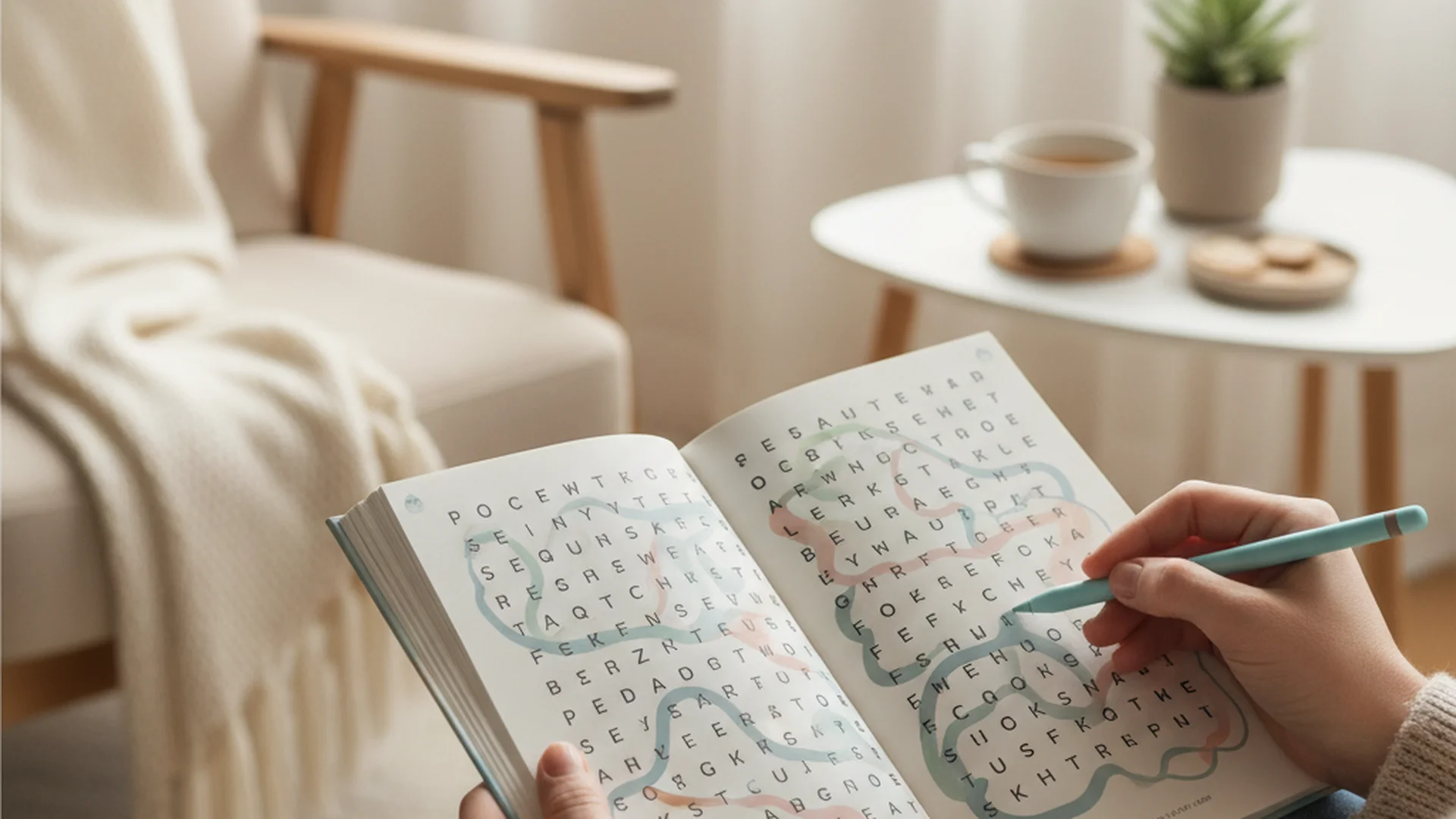
For decades, many dismissed the humble word search as a simple childhood pastime or a way to kill time in a doctor’s waiting room. However, as we move through 2025, the narrative has shifted dramatically. Today, word search for adults has evolved into a sophisticated tool for cognitive maintenance, stress reduction, and tactical mental play. Whether you are a high-performance athlete looking to sharpen your focus or a professional seeking a digital detox, adult word search puzzles offer a unique blend of linguistic challenge and visual pattern recognition that few other hobbies can match.
The Science of the Search: Cognitive Age Reversal
The primary reason many are turning to adult word search puzzles isn't just for entertainment—it’s for brain health. A landmark 2019 study conducted by the University of Exeter and King’s College London provided some of the most compelling evidence to date regarding puzzle-solving. The research found that adults who engage in word puzzles regularly (at least once a day) score significantly higher on tests measuring short-term memory and mental processing speed.
In fact, the data suggested that these regular solvers had brain functions equivalent to people eight years younger than their actual age. This "cognitive age reversal" is a powerful motivator for the modern adult who wants to maintain mental acuity well into their senior years.
Why Retrieval Matters
Unlike a crossword, which requires you to recall a definition, a word search requires you to recognize a visual pattern and retrieve it from a chaotic field of data. This mimics real-world tasks, such as finding a specific name on a dense spreadsheet or spotting a safety hazard in a complex environment. Research from Harvard and Scientific American confirms that this visual tracking is an essential component of neuroplasticity.
Digital vs. Print: The Great 2025 Debate
As a retro gaming historian, I often see the tension between classic formats and modern tech. When it comes to word search for adults, both mediums have distinct advantages.
| Feature | Digital Puzzles | Print Puzzles |
|---|---|---|
| Feedback | Real-time "correct" notifications | Manual checking |
| Brain Impact | 15% higher pattern recognition improvement | Significant reduction in cortisol levels |
| Accessibility | Adjustable font/contrast | Limited by book design |
| Health | Progress tracking and gamification | Zero blue light; reduces eye strain |
A 2022 study in the Journal of Cognitive Development highlighted that interactive digital puzzles lead to faster improvements in spatial awareness. Conversely, the "Slow Sunday" movement of 2025 emphasizes print puzzles as a form of active meditation, helping users disconnect from the "always-on" digital world.
Advertisement
Advanced Strategies: Solving Like a Pro
If you find yourself stuck or simply want to improve your efficiency, you need to move beyond random scanning. Experts use specific linguistic and visual techniques to deconstruct even the most complex 20x20 grids.
The "Rare Letter" Method
Instead of scanning for common vowels like 'E' or 'A', focus your eyes on "high-visibility" letters. Letters like Q, Z, X, J, and K are far less common in the English language. When your brain identifies one of these "anchor points" in the grid, perform a spiral scan around it to see if it belongs to one of your target words.
Ignore the List (Initially)
Counterintuitively, the best way to start a puzzle is to ignore the word list for the first 60 seconds. Let your brain’s natural pattern recognition take over. Often, the longest or most complex words will "pop out" because the human eye is naturally drawn to anomalies in a repetitive field of letters. Once the easy wins are found, then refer to the list for specific targets. For more on this, check out our guide on Word Search Strategies: How to Find Words Faster.
Systematic Scanning
Don't jump around the grid haphazardly. This leads to "visual fatigue." Instead, use a row-by-row or column-by-column approach. This is particularly effective for finding Backwards Words in Word Searches, which are often the hardest for the adult brain to process.
What Makes an "Adult" Word Search Challenging?
A standard word search for kids usually involves horizontal and vertical placements with very few overlaps. Adult versions, however, employ several "difficulty multipliers":
- Diagonal Placements: Adding diagonal words increases solve time by approximately 40%. It requires the brain to process text at a 45-degree angle, which is not a natural reading state. You can learn more about mastering these in our article on Diagonal Word Search Tips.
- Overlapping Letters: In a "Pro" level puzzle, at least 25% of letters should belong to more than one word. This creates visual "noise" that can confuse the solver.
- Grid Size: While children’s puzzles are often 10x10 or 12x12, adult versions typically start at 20x20 and can go much larger.
- Topical Authority: Modern adults prefer themed collections over random lists. Whether it's 1980s Pop Culture, Botanical Terms, or Legal Terminology, these themes engage the memory more than a list of unrelated nouns.
Recent Trends in the Puzzling World (2025–2026)
The world of puzzles is not static. We are currently seeing a revolution in how people engage with word search for adults.
AI-Personalized Puzzles
The biggest shift in 2025 is the rise of AI-generated puzzles tailored to the user’s life. Imagine a law student generating a word search based on their current "Torts" textbook or a traveler solving a puzzle filled with the names of streets in the city they are visiting. This personalization makes the "retrieval" aspect of puzzling even more relevant to daily life.
Gamified Ecology
New apps like Word Search 2025 have introduced "meta-games." Every word you find might contribute virtual "energy" to cleaning a virtual ocean or building a digital forest. This adds an extra layer of dopamine-driven motivation to the cognitive exercise.
Active Meditation and "Slow Sundays"
Many adults are using word searches as a bridge to mindfulness. By focusing on a single, low-stakes task, the brain enters a "flow state" similar to deep meditation. This has led to the popularity of puzzles with soft color palettes and calming nature themes. For those specifically interested in aging well, Word Search Games for Seniors provide an excellent entry point into this meditative practice.
Advertisement
Common Mistakes to Avoid
Even seasoned solvers fall into traps that slow them down or reduce the cognitive benefits of the game.
- The "Nerd" Myth: Many believe word puzzles are only for language experts. This is false. High-performance athletes, including LeBron James, have been known to use word puzzles to sharpen mental focus and visual tracking before games.
- The "Walking Dictionary" Fallacy: You do not need a massive vocabulary. These puzzles are about pattern recognition, not definitions. Don't feel intimidated by complex themes; use them as an opportunity to learn new word shapes.
- Neglecting the Perimeter: Beginners often focus on the center of the grid. However, puzzle designers frequently place "anchor words" along the top and side rows to frame the puzzle. Always check the edges first!
- The "Rushing" Mistake: Rushing creates stress, which is the opposite of why most adults play. Speed comes with better strategy, not by moving your pen (or finger) faster.
Frequently Asked Questions
Are word searches actually educational or just busy work?
Research from Harvard confirms they are sophisticated educational tools. They strengthen "retrieval" skills, improve spelling, and help expand "sight-word" vocabulary by forcing the brain to recognize words as complete shapes rather than just a string of letters.
Can word searches prevent dementia or Alzheimer's?
While no puzzle is a "cure," physicians frequently recommend them to seniors and middle-aged adults. Mental stimulation keeps neural pathways active and can potentially delay the onset of age-related cognitive decline by building "cognitive reserve."
How do I make a word search more challenging for myself?
Try the "No-List Challenge." Attempt to find at least five words before you look at the provided list. Additionally, look for puzzles that include words in all eight directions, including backwards diagonals.
Is digital or print better for my brain?
Both have merits. Digital puzzles often provide better pattern recognition training through gamification, while print puzzles are superior for reducing cortisol and providing a "brain break" from digital screens.
Conclusion: The Evolution of the Search
Whether you are revisiting this hobby for the nostalgia of the 1968 Norman E. Gibat origins or you're diving into the AI-powered apps of 2026, word search for adults is a powerful ally in the quest for mental fitness. It is a rare activity that manages to be both stimulating and relaxing, challenging and accessible.
By employing strategies like the "Rare Letter Method" and embracing themed, complex grids, you aren't just finding words—you're training your brain to stay sharp, focused, and resilient.
Ready to Start?
Challenge your brain with our advanced adult puzzles today.
Put it into practice

Keep reading
Word Search
The Ultimate Guide to Word Search Books for Kids: Cognitive Benefits and 2025 Trends
Discover why word search books kids love are booming in 2025. Explore cognitive benefits, age-appropriate grids, and the latest trends in children’s puzzles.
Mar 15, 2025 12 min

Word Search
The Science of the Grid: Comprehensive Word Search Benefits for 2025
Discover the profound word search benefits for brain health, anxiety reduction, and literacy based on the latest 2025 cognitive research and studies.
May 18, 2025 12 min
Word Search
The Ultimate Guide to Printable Word Search Puzzles for Kids: Education Meets Play
Discover why printable word search kids love are essential for development. Learn about 2025 trends, age-appropriate designs, and cognitive benefits.
Aug 20, 2026 10 min
Advertisement