Word Search Strategies: How to Find Words Faster
Master the art of the word find with professional word search strategies. Learn rare letter hunting, Z-pattern scanning, and the science behind puzzle solving.
By Free To Play Puzzles Editorial Team 12 min read
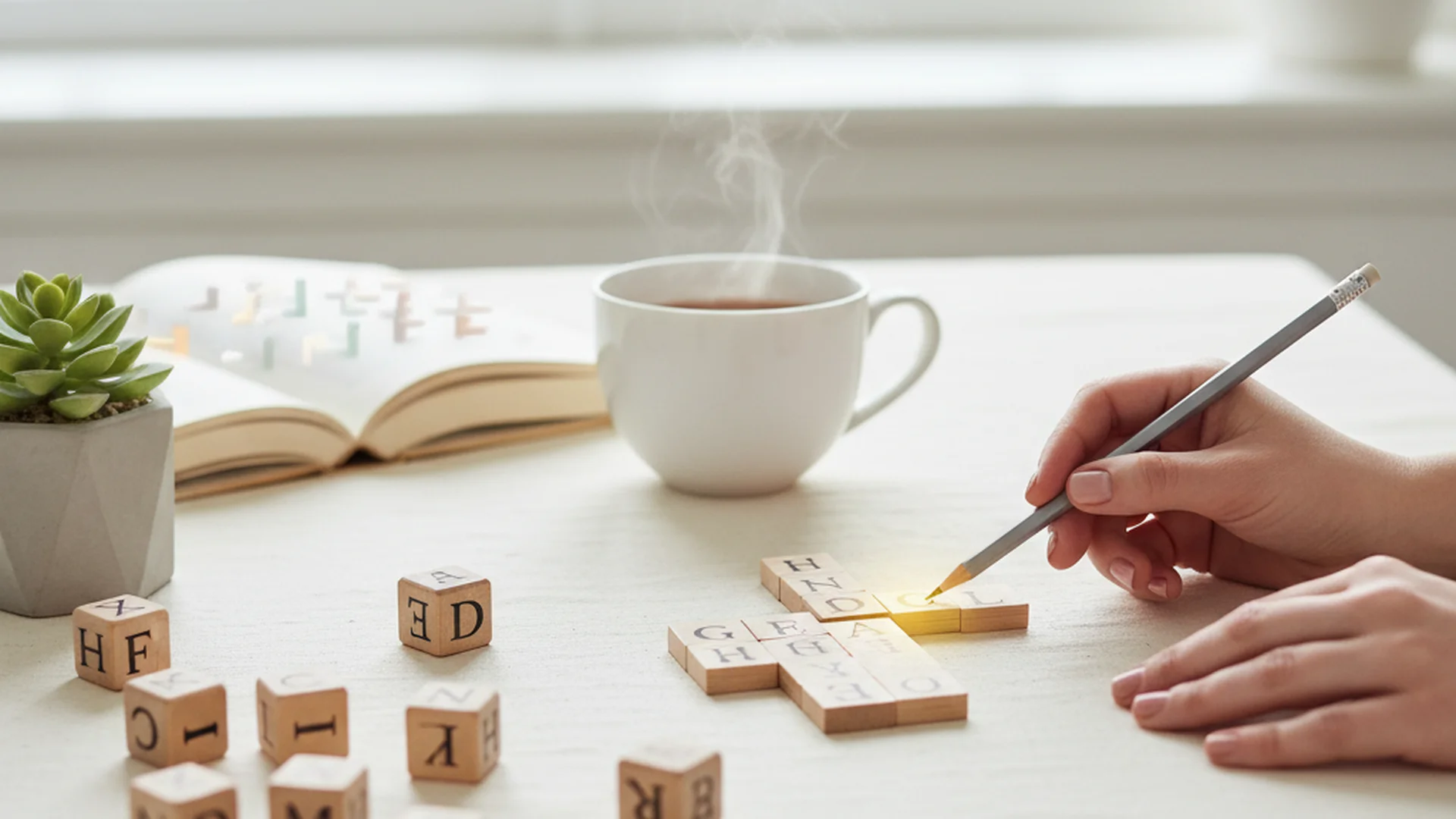
Since their modern inception in the late 1960s, word search puzzles have evolved from simple classroom supplements into a global phenomenon that spans printed newspapers, mobile apps, and competitive online platforms. Whether you are tackling a classic paper grid or navigating the "snaking" paths of modern variations like NYT Strands, utilizing specific word search strategies is the key to improving your completion time and sharpening your cognitive focus.
What most people view as a relaxing pastime is actually a complex exercise in visual processing and linguistic sorting. By shifting your approach from random "hunting" to systematic "scanning," you can transform your gameplay.
The Evolution and Science of the Word Search
Before we dive into the advanced word search tips, it is essential to understand the history and the neurological impact of these puzzles. The modern word search was invented by Norman E. Gibat in 1968. Originally published in the Selenby Digest in Norman, Oklahoma, the puzzle was designed to engage readers of a local circular. Little did Gibat know that his creation would become a staple of cognitive therapy and educational development.
The Cognitive Advantage
In 2025, the scientific community continues to validate what puzzle enthusiasts have known for decades: word searches are "gymnastics for the brain." A landmark study from the University of Exeter and King’s College London (updated in early 2025) revealed that adults who regularly engage in word and number puzzles possess brain function equivalent to someone 10 years younger in grammatical reasoning and 8 years younger in short-term memory.
Beyond memory, the "aha!" moment when you find a hidden word triggers a release of dopamine. This neurotransmitter doesn't just make you feel good; it reinforces the neural pathways associated with pattern recognition, making you faster at solving subsequent puzzles.
Fundamental Word Search Strategies for Success
If you want to stop staring aimlessly at a wall of letters and start finding words with surgical precision, you need a system. Here are the foundational strategies used by competitive solvers.
The "Perimeter First" Sweep
Puzzle creators often face a structural challenge: the edges of the grid are the hardest places to hide words because they have fewer surrounding letters to act as "camouflage." Consequently, many designers place several "easy win" words along the four outer borders to fill the space.
Your first move should always be a clockwise scan of the perimeter. This usually allows you to cross off 10% to 20% of the word list in the first minute, clearing the mental "clutter" and giving you a boost of dopamine to start the session.
Systematic Scanning: The Z-Pattern
One of the most common mistakes beginners make is "scattershot searching"—looking at the grid and hoping a word "pops out." While this works for the first few words, it leads to significant "blind spots" later on.
Instead, employ the Z-pattern scan:
- Start at the top-left corner.
- Scan the first row from left to right.
- Move your eyes to the second row and scan from right to left.
- Continue this "S" or "Z" shape until you reach the bottom.
This method ensures that your eyes pass over every single letter in the grid. If you are looking for a specific word, use this method to look for the first letter of that word.
Advertisement
Advanced Visual Techniques
Once you have mastered the basic scan, you can begin utilizing more advanced word search tips that rely on the unique properties of the English language and visual geometry.
The Unique Letter Method
This is perhaps the most effective strategy for high-speed solving. Instead of looking for common letters like E, S, T, or A, which appear everywhere and create "visual noise," focus your search on rare characters.
Rare letters act as beacons in a sea of common characters. Look for:
- Q, X, Z, J, K
- V, W, Y
If the word you are looking for contains a 'Q', don't look for the word; look for the 'Q'. Because there are likely only one or two 'Q's in the entire grid, you will find your target almost instantly.
The Double Letter Strategy
The human brain is naturally wired to find symmetry and repetition. When scanning a grid, your eyes will naturally gravitate toward double letters (e.g., OO, LL, TT, SS).
| Strategy | Focus | Best For |
|---|---|---|
| Rare Letters | Q, X, Z, J | Finding specific hard words quickly |
| Double Letters | OO, EE, LL | Scanning the grid without a specific word in mind |
| Soft Focus | The whole grid | Letting long words "pop" out visually |
If you see two 'O's sitting next to each other, check your word list for words like "Balloon," "Success," or "Cook." This strategy is highly effective for clearing mid-length words that are otherwise well-hidden.
Utilizing Peripheral Vision (Soft Focus)
Instead of focusing intensely on a single letter, try "softening" your gaze. By slightly blurring your vision or looking at the grid as a whole rather than a collection of individual characters, the shapes of the words often begin to stand out from the background. This is particularly useful for identifying Diagonal Word Search Tips where the angles might break your standard horizontal reading patterns.
Analyzing the Word List
The word list is not just a set of instructions; it is a strategic map. How you interact with the list determines how quickly you will finish the grid.
Solve Long Words First
It is a common misconception that short words are easier. In reality, short words (3-4 letters) are the hardest to find because their letter combinations appear frequently by accident throughout the grid.
Longer words (8+ letters) have fewer possible placements. Because they take up more "real estate," they are easier to spot when using a systematic scan. By finding the long words first, you remove the most significant chunks of the puzzle, making the remaining "white space" easier to navigate.
Identifying Word Directions
Most traditional word searches include words in eight directions:
- Horizontal (Forward and Backward)
- Vertical (Up and Down)
- Diagonal (Four variations)
If you find yourself stuck, it is usually because your brain is subconsciously filtering out one of these directions—most commonly the Backwards Words in Word Searches.
Modern Trends: 2025 and 2026
The world of word puzzles is changing. While the traditional grid remains popular, new "twist" mechanics are becoming the industry standard for digital apps and social media challenges.
Snaking and "Strands" Mechanics
Following the massive success of NYT Strands in 2024 and 2025, many new puzzles have abandoned the "straight line" rule. In these "snaking" puzzles, words can bend and turn in any direction, similar to the classic game Boggle. This requires a different set of word search strategies, focusing more on letter-clustering than linear scanning.
AI-Personalized Puzzles
In 2026, we are seeing a surge in AI-generated puzzles. These platforms allow users to create custom grids based on specific themes, such as "Medical School Prep" or "Family Vacation 2026." These Educational Word Searches are being used by teachers to help students with word recognition and spelling in a way that feels like play rather than work.
Advertisement
Common Mistakes to Avoid
Even seasoned solvers can fall into habits that slow them down. Avoid these common pitfalls to keep your times competitive:
- Ignoring the List: Never start the grid without reading the list first. Your brain needs to "prime" itself with the words it is looking for.
- Disorganized Marking: If you use a dark marker and cross out words messily, you will obscure the letters of other words that might overlap. Use a light-colored highlighter or a clean, thin circle.
- Staying Stuck: If you can't find a word after 60 seconds, move on. Finding other words will often reveal the one you were missing by narrowing down the available letters.
- Over-focusing on the Center: Beginners often get "trapped" in the middle of the grid. Remember to use the perimeter strategy mentioned earlier.
Frequently Asked Questions
Is there a specific age for word searches?
No. Word searches are highly adaptable. Kindergarten-level puzzles use large fonts and simple left-to-right words, while advanced puzzles for adults include backwards, diagonal, and overlapping words with complex themes.
Are word searches "busy work" or educational?
While they were once dismissed as simple "busy work," recent educational studies (2023-2025) confirm that they are highly effective for teaching skimming, scanning, and word recognition. They are especially beneficial in ESL (English as a Second Language) curricula for reinforcing vocabulary.
What is the difference between a traditional word search and NYT Strands?
Traditional puzzles require words to be in a straight line (horizontal, vertical, or diagonal). Strands and similar modern variations allow words to "snake" or bend in any direction, as long as the letters are connected adjacently.
Can word searches help with language learning?
Yes. Because they require the solver to look at the specific spelling and letter-order of a word repeatedly, they are excellent for reinforcing new vocabulary in a second language.
How do I find words that are written backwards?
The best way to find backwards words is to scan for the ending of the word first. Our brains are conditioned to look for the start of a word, so looking for the "wrong" end can bypass your natural reading habits and make the word stand out.
Conclusion
Mastering word search strategies is about more than just finding hidden text; it is about training your brain to see patterns where others see chaos. By utilizing the unique letter method, the Z-pattern scan, and prioritizing long words, you can significantly increase your solving speed and enjoy the cognitive benefits that come with regular play.
Whether you are playing to keep your mind sharp or just to enjoy a quiet moment with a cup of coffee, remember that every puzzle solved is a win for your long-term brain health. The release of dopamine you feel when finding that final, stubborn word is your brain’s way of thanking you for the workout.
Ready to Start?
Put your new strategies to the test with our collection of puzzles.
Put it into practice

Keep reading
Word Search
Mastering Word Search Techniques: How to Find Hidden Words Faster
Boost your puzzle-solving speed with professional word search techniques. Learn systematic scanning, cognitive benefits, and 2025 trends for faster results.
Nov 7, 2024 12 min

Word Search
Word Search: How to Play, Expert Strategies, and 2026 Trends
Master how to play word search with our expert guide. Learn advanced scanning techniques, rare letter strategies, and explore the latest 2025 puzzle trends.
Dec 10, 2025 12 min

Word Search
Mastering Word Search Speed: Professional Techniques for Fast Solving
Boost your word search speed with expert strategies. Learn rare letter hunting, the Boustrophedon scan, and peripheral vision tricks from a professional constructor.
Nov 10, 2025 12 min
Advertisement