Tetris Rotation Systems: SRS vs. Classic Mechanics Explained
Master the mechanics of the Tetris rotation system. Explore SRS, classic wall kicks, and professional strategies to improve your gameplay and brain health.
By Free To Play Puzzles Editorial Team 12 min read
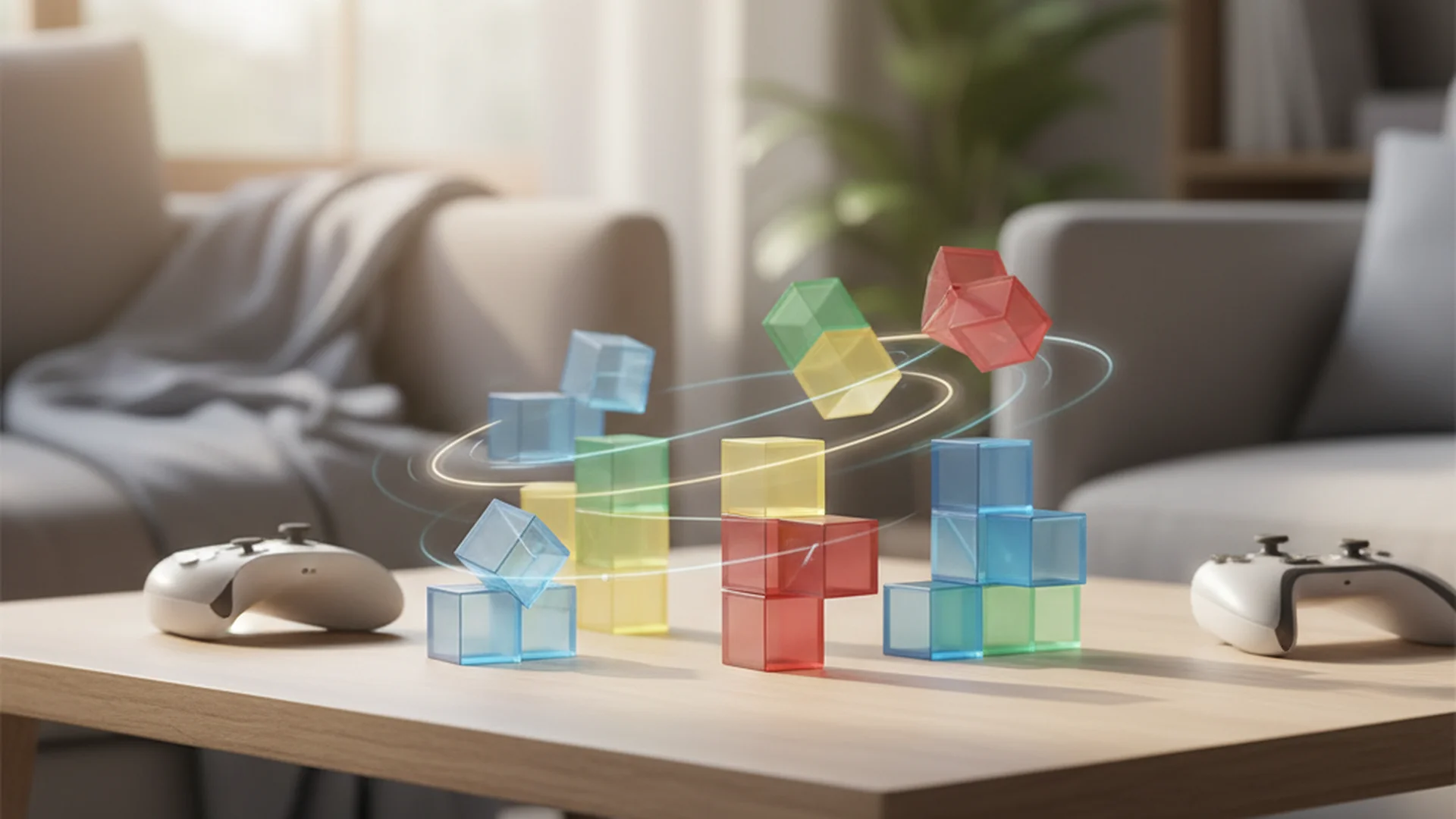
If you have ever played a modern version of Tetris, you have likely experienced a moment where a piece seemed to defy gravity. You press the rotate button while a piece is wedged against a wall, and instead of getting stuck, it "kicks" into a nearby empty space. This isn't a glitch; it is the core of the modern tetris rotation system. These systems are fascinating because they don't just dictate game physics—they define the mental models our brains must build to achieve "flow" state.
Understanding the mechanics of SRS tetris and its predecessors is the difference between a casual player and a master. Whether you are aiming for a high score in the Classic Arcade Games: Ultimate Retro Gaming Guide or competing in modern 2025 tournaments, the rotation system is your most powerful tool.
The Evolution of the Tetris Rotation System
The history of Tetris is as much a history of its rotation logic as its branding. In the early days, rotation was rudimentary. If there wasn't space to turn a piece, the piece simply wouldn't turn. This led to a high "lock-out" rate where players would lose games simply because a piece became stuck at the top of a stack.
From NES to the Super Rotation System (SRS)
In the classic NES version of Tetris, the rotation system was restrictive. This "Classic" or "Nintendo" system required the player to have clear space around the piece's center. If the rotation overlapped with a wall or another block, the input was ignored.
However, in 2001, the "Tetris Guideline" was established with the release of Tetris Worlds. This introduced the Super Rotation System (SRS). Designed by Henk Rogers, SRS was intended to unify the experience across all official titles. It introduced "wall kicks" and "floor kicks," allowing pieces to shift horizontally or vertically to find a valid spot. To learn more about how these changes impacted the game's global reach, see the History of Tetris.
Bounding Boxes and Logic
Every Tetris piece exists within a virtual grid known as a bounding box.
- 3x3 Bounding Boxes: Used for the J, L, S, T, and Z pieces.
- 4x4 Bounding Boxes: Used exclusively for the I-piece (the long bar).
- 2x2 Bounding Boxes: The O-piece (the square) sits in a 2x2 grid, though in standard SRS, its rotation is visually null.
Understanding the 5-Test Kick System
The defining feature of SRS tetris is the 5-test kick system. When you attempt to rotate a piece, the game engine doesn't just check the destination; it runs a sequence of checks to find a way to make the rotation happen.
The Hierarchy of Tests
- Test 1 (Basic Rotation): The game checks if the piece can rotate in its current position without moving.
- Tests 2-4 (Wall Kicks): If Test 1 fails, the game tries to "kick" the piece one or two spaces to the left or right.
- Test 5 (Floor/Ceiling Kicks): The final check often involves shifting the piece vertically.
Because of this lenient system, SRS allows rotations in over 90% of tight spaces. In contrast, the older NES system had a success rate of less than 20% in the same scenarios. This leniency is what makes "T-Spins" possible—a technique where a T-piece is kicked into a T-shaped hole that is otherwise inaccessible from above.
Advertisement
SRS vs. ARS: The Competitive Divide
In the professional world of Arcade Games, players generally fall into two camps: Guideline (SRS) or Arika (ARS).
The Arika Rotation System (ARS)
ARS is the system used in the Tetris: The Grand Master (TGM) series. Unlike the "forgiving" nature of SRS, ARS is designed for high-gravity play, specifically "20G" where pieces fall instantly to the bottom.
- Stricter Kicks: ARS has significantly fewer wall kicks than SRS.
- Downward Preference: While SRS might kick a piece upward to save the player, ARS often forces the piece downward, requiring the player to have perfect foresight.
The 2025 Multi-System Trend
With the release of Tetris Forever in late 2024, the competitive landscape changed. The "Time Warp" mechanic forces players to switch between modern SRS and classic E60/NES logic mid-match. In 2025, the elite players are those who are "bi-lingual"—able to shift their mental rotation logic instantly as the game engine changes.
Expert Recommendations for Rotation Mastery
We recommend approaching rotation as a form of Brain Training. It improves spatial reasoning and reaction time. Here are the best practices for 2025:
1. Dual-Button Rotation (The Finesse Standard)
Many beginners only use one button to rotate (usually Clockwise). This is a major efficiency mistake. Pro players use separate keys for Clockwise (CW) and Counter-Clockwise (CCW).
- Why? Rotating a piece three times clockwise to reach a position that takes one counter-clockwise turn increases your "Key-presses Per Piece" (KPP). Lower KPP equals higher speed.
2. The Initial Rotation System (IRS)
In high-speed play, you don't wait for the piece to appear to rotate it. By holding the rotation button before the piece spawns, the piece enters the board already rotated. This is essential for surviving "Super Kill Screens" at Level 49 in modern NES tournaments.
3. Exploiting 180-Degree Rotations
While not part of the original Tetris Guideline, 180-degree rotations have become a standard in competitive fan games like Jstris and TETR.IO. This allows you to flip a piece upside down with a single tap, further reducing KPP and allowing for "All-Spins" (L-spins and Z-spins).
| Rotation System | Primary Use | Difficulty | Wall Kick Lenience |
|---|---|---|---|
| SRS | Modern/Guideline | Easy/Intermediate | High |
| ARS | TGM / 20G Play | Hard | Low |
| NES/Classic | Retro / NES | Expert | None |
| SRS+ | Competitive Fan Games | Intermediate | Very High |
Common Mistakes to Avoid
Even seasoned players fall into habits that limit their scoring potential.
Mistake: Assuming Wall Kicks are Random
Many players panic-mash the rotation button hoping a piece will "find its way" into a hole. Wall kicks are 100% deterministic. They follow a fixed offset table. If a piece kicks to a specific spot once, it will always do so in that exact configuration. Memorizing these "kicks" is what allows for professional T-Spin Triple setups.
Mistake: Rotating Only After Landing
Beginners often wait for a piece to touch the stack before rotating. This limits your options. By rotating in the air, you keep your "Ghost Piece" active, showing you exactly where the piece will land after its kicks are calculated.
Mistake: Ignoring the "Lock Delay"
In SRS-based games, rotating a piece resets the "lock delay" (the brief moment before a piece becomes permanent). Beginners often forget that they can "wiggle" a piece by rotating it back and forth to keep it from locking, giving them extra seconds to think or slide the piece across the stack.
Advertisement
The Neuroscience of Rotation Systems
Why does the tetris rotation system matter for your brain? From a cognitive perspective, Tetris is a task of "Mental Rotation." This is the ability to rotate mental representations of two-dimensional and three-dimensional objects.
Research suggests that playing games with complex rotation systems like SRS increases the efficiency of the parietal lobe. By forcing the brain to calculate potential wall kicks (the 5-test system), players are engaging in high-level spatial problem solving. This is a core component of cognitive flexibility, allowing the brain to switch between different logical frameworks (like SRS and ARS) seamlessly.
Frequently Asked Questions
What is the difference between SRS and SRS+?
SRS is the official guideline used by The Tetris Company. SRS+ is a community-enhanced version found in games like TETR.IO. SRS+ includes more robust 180-degree rotation tables and allows for "All-Spins," meaning pieces like the L, J, and Z can be spun into spots that the standard SRS would deny.
Why can't I rotate the long 'I' piece against a wall in some games?
This usually happens in older rotation systems or poorly implemented clones. In standard SRS, the I-piece has a 4x4 bounding box and a specific set of wall kicks that allow it to rotate even when pressed against a flat wall. If it won't rotate, you are likely playing a "Classic" logic game.
What are 'T-Spins' and why do they require SRS?
A T-Spin occurs when a T-piece is rotated into a slot at the last moment, usually where the corners are obstructed. SRS makes this easier by "kicking" the T-piece into the hole. Because T-Spins award significantly more points and send more lines in multiplayer, the SRS rotation logic is the foundation of modern competitive scoring.
Can AI predict rotation kicks better than humans?
In 2026, we are seeing the rise of "Dynamic Rotation Systems" where AI generates wall kicks on the fly based on surrounding blocks. While AI can calculate these perfectly, human players rely on "muscle memory" of the fixed SRS tables. For now, fixed deterministic tables remain the standard for fair competitive play.
Conclusion
The tetris rotation system is far more than a simple game mechanic; it is the language of the game itself. From the restrictive logic of the NES era to the fluid, "kick-heavy" world of modern SRS tetris, how you turn your pieces defines your ceiling as a player.
By mastering the 5-test kick system, adopting dual-button rotation, and understanding the deterministic nature of wall kicks, you can transform your gameplay. As we look toward the future of the series in 2025 and 2026, the ability to navigate multiple rotation systems will be the hallmark of the true Tetris master.
Ready to Test Your Skills?
Put your rotation knowledge to the test in our arcade.
Put it into practice

Keep reading
Arcade Games
Tetris Piece Names: All 7 Tetriminos Explained
Discover the official names and history of the 7 Tetris pieces. From I-pieces to T-spins, learn how to master Tetriminos for high-scoring gameplay.
Oct 21, 2025 9 min
Arcade Games
Tetris Line Clears Explained: Mastering Singles, Doubles, Triples, and Tetrises
Master the art of the Tetris line clear. Learn scoring multipliers, T-spins, and pro-level strategies from the 2025 competitive scene to maximize your high score.
Jul 24, 2025 12 min

Arcade Games
Tetris Rules Explained: Mastering the Science of the Stack
Master the essential Tetris rules and advanced strategies. Learn about the 7-bag system, T-spins, and expert stacking techniques to improve your high score.
Mar 29, 2025 12 min
Advertisement