Mastering the T Puzzle: A Guide to the World's Most Deceptive Brain Teaser
Discover the history, psychology, and solution strategies for the classic four piece t puzzle. Learn why this 1900s brain teaser still stumps 95% of players.
By Free To Play Puzzles Editorial Team 10 min read
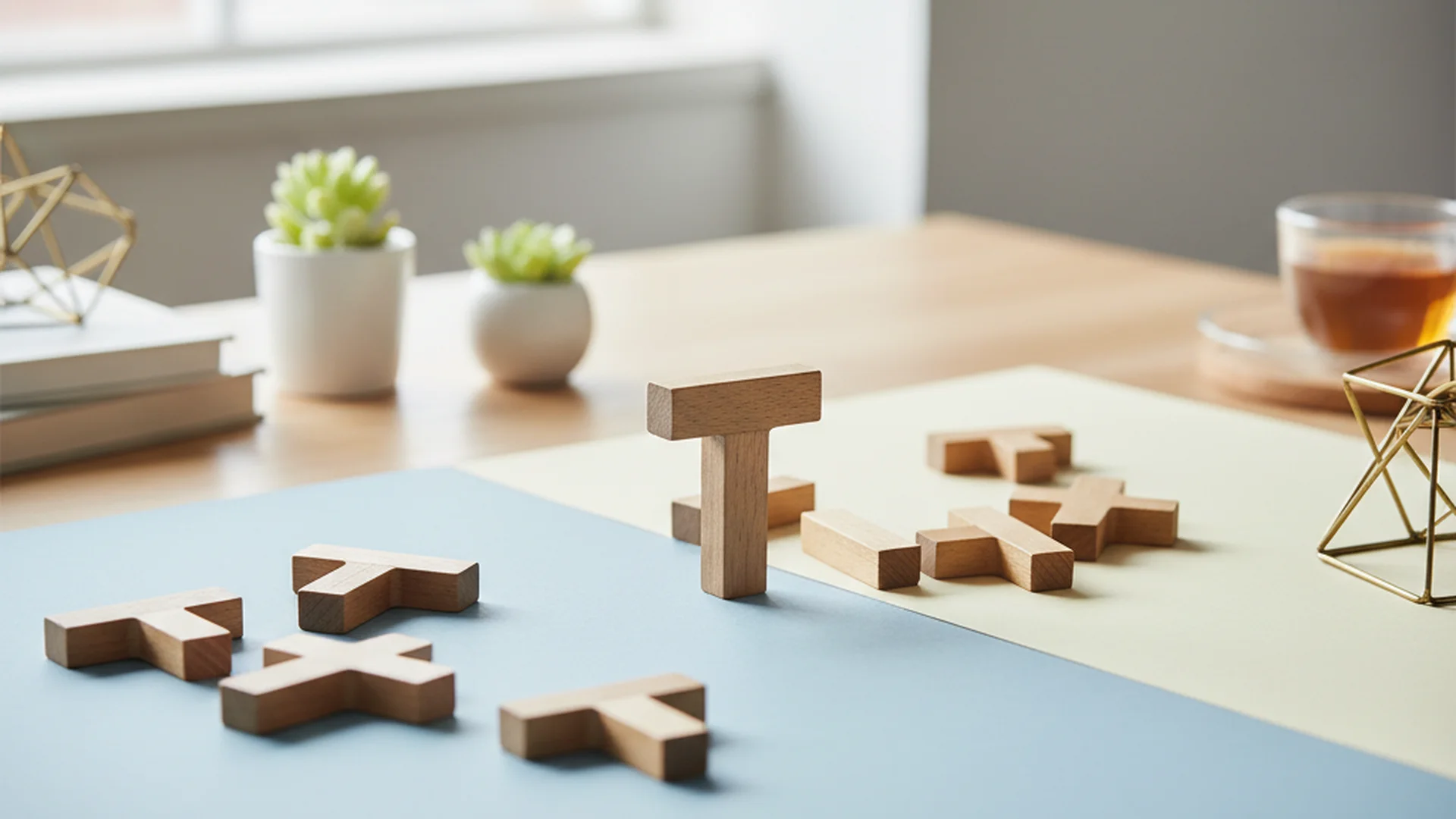
At first glance, the t puzzle looks like a toy you would give to a toddler. It consists of only four wooden or plastic shapes that must be arranged to form a perfect capital letter "T." However, this simplicity is an illusion. As a director of Sudoku tournaments and a logic instructor, I have seen seasoned mathematicians reduced to fits of frustration by these four pieces. It is the ultimate "deceptively simple" challenge, a masterpiece of geometric design that exploits the way the human brain processes shapes and spatial relationships.
Whether you are a casual hobbyist or a dedicated fan of Logic Puzzles, understanding the mechanics of the T puzzle is a rite of passage. It isn't just about fitting shapes together; it is about unlearning the mental shortcuts that usually help us navigate the world.
The History of the Four Piece T Puzzle
The T puzzle didn't start as a modern desktop toy. It emerged around 1900 as a clever marketing tool. During the early 20th century, companies like White Rose Ceylon Tea (1903) and Armour’s Sausages distributed the puzzle as a promotional giveaway. The logic was simple: if a customer spent thirty minutes staring at a puzzle with your brand name on it, they were unlikely to forget you.
Historically, the T puzzle is a streamlined version of the older "Latin Cross" puzzle, which uses five pieces to form a cross. By removing one piece and shifting the geometry, designers created a more difficult challenge. By the mid-1900s, it had become a staple of psychological research, used to study how humans solve problems and where our cognitive processes tend to fail.
Anatomy of the Puzzle: The Four Pieces
To master the four piece t puzzle, you must first understand the unique geometry of its components. While some modern variants exist, the classic version consists of:
- The Isosceles Right Triangle: The smallest piece, often used to fill corners.
- Two Right Trapezoids: These are usually of different sizes and are responsible for the "stems" and "arms" of the T.
- The Irregular Pentagon: Often called the "notch" piece, this is the most critical and confusing part of the set.
| Piece Type | Role in Construction | Difficulty Rating |
|---|---|---|
| Pentagon | The "Crux" - usually placed at a diagonal | Extremely High |
| Trapezoid (Large) | Forms the majority of the vertical stem | Medium |
| Trapezoid (Small) | Bridges the gap between the arm and stem | Medium |
| Triangle | Fills the internal "notch" of the pentagon | Low |
Advertisement
Why Our Brains Struggle: The Psychology of the T
The reason the t puzzle is so difficult isn't mathematical; it's psychological. Researchers have identified two main reasons why adults struggle more than children with this specific challenge.
The "60% Trap" and the Notch Fallacy
In controlled studies, participants were observed spending more than 60% of their total solving time trying to use the pentagon piece incorrectly. Our brains are wired to find "logical" fits. When we see the "V" shaped notch in the pentagon, we instinctively try to use it as an inner corner for the "T" where the horizontal bar meets the vertical stem. This is almost always a mistake. In the actual solution, that notch is often filled by the point of the triangle or remains partially "open" within the internal structure.
Functional Fixedness
"Functional fixedness" is a cognitive bias that limits a person to using an object only in the way it is traditionally used. In the context of the T puzzle, we tend to align the pieces horizontally or vertically because the final T-shape is composed of right angles. However, the internal "seams" of the puzzle are often diagonal. Until you are willing to rotate the pentagon to a 45-degree angle, you are unlikely to find the solution.
Expert Strategies for Success
If you find yourself stuck, use these professional techniques to break through the mental fog. These strategies are similar to those used in other spatial challenges like Tangrams.
1. Identify the "Crux" Piece
Ignore the final "T" shape for a moment. Instead, focus entirely on the irregular pentagon. Because this piece is the most complex, it dictates where every other piece must go. Try placing the pentagon in various rotations in the "center" of where the T-junction would be. Once you find the correct orientation for the pentagon, the other three pieces usually fall into place in seconds.
2. Think Diagonally
As mentioned, the 45-degree rotation is the "secret sauce" of the T puzzle. If you are aligning every edge to be perfectly horizontal or vertical, you are likely repeating the same mistake. Force yourself to place the longest edge of the pentagon at a diagonal and build around it.
3. Use the "Negative Space" Strategy
Instead of trying to "build" the T, look at the "V" notch of the pentagon and ask what doesn't belong there. Often, the solution involves leaving that notch "open" to be filled by the point of another piece rather than trying to fit it against the main corner of the T.
Modern Trends: The T Puzzle in 2025 and 2026
The world of Logic Puzzles has seen a resurgence in the mid-2020s, and the T puzzle is at the forefront of this movement.
- 3D-Printed "Impossible" Variations: In 2025, a new trend emerged involving 3D-printed "packing" T puzzles. These versions require you to fit multiple T-shaped blocks into a small box, adding a layer of depth and volume to the traditional 2D dissection.
- Digital AR Solvers: Early 2026 has seen the rise of Augmented Reality (AR) apps that can scan your physical wooden pieces. These apps don't just give you the answer; they provide "ghost" silhouettes and hints based on your current progress, helping to train your spatial logic.
- Eco-Friendly Movement: High-end, sustainable versions made from bamboo and reclaimed hardwoods have become popular "executive desk toys," moving away from the cheap plastic versions of the 1990s.
Advertisement
Common Mistakes to Avoid
- The Right Angle Trap: Don't assume the right angle of the pentagon must be one of the four corners of the "T."
- Over-Focusing on the Stem: Most people start by building the long vertical stem. This is the easiest part to visualize but the hardest way to solve the puzzle. Start at the junction where the pieces meet.
- Forgetting to Flip: Especially with wooden sets, the solution might require one piece to be flipped to its "back" side.
- Giving Up Too Soon: Because it only has four pieces, people feel "stupid" when they can't solve it in two minutes. This leads to a quick exit. Remind yourself that even geniuses take 20 minutes to crack this.
Frequently Asked Questions
How many pieces are in a T Puzzle?
While there are modern variations with five or more pieces, the classic, standard T puzzle is strictly a four-piece tiling puzzle. Any more or fewer pieces changes the geometric intent of the original 1900s design.
Is the T Puzzle a Tangram?
No, though they are cousins in the "dissection puzzle" family. Digital vs Physical Tangrams often focus on a seven-piece set (the Tan) that can form thousands of shapes. The T puzzle is more specialized, focusing on a single, highly difficult target shape.
Why is the T puzzle used in psychology?
It is used to measure "insight" problem-solving. Unlike puzzles that can be solved through step-by-step logic (like Sudoku), the T puzzle requires a "lightbulb moment" where the solver suddenly sees the pieces in a new way, overcoming their initial cognitive biases.
Are there multiple solutions?
For the standard, perfectly proportioned capital "T," there is only one unique solution. However, the same four pieces can often be rearranged to form dozens of other shapes, including a fat T, a house, and various geometric polygons.
Conclusion
The T puzzle remains a testament to the power of minimalist design. It proves that you don't need hundreds of pieces or complex rules to create a world-class challenge. By understanding the history, avoiding the "notch fallacy," and embracing diagonal thinking, you can join the elite 5% who have mastered this four piece t puzzle.
If you enjoyed this deep dive into spatial logic, you might also find our guide on Akari Light Up Puzzles or our exploration of Deductive Reasoning Puzzles helpful for your next mental workout. Engaging with these challenges offers significant Puzzle Benefits for long-term cognitive health and focus.
Ready to Level Up?
Explore our full collection of logic and spatial games.
Put it into practice


Keep reading
Logic Puzzles
Soma Cube Guide: History, Solutions, and Expert Tips (2025-2026 Edition)
Unlock the secrets of the Soma Cube. Learn its history, master the 240 solutions, and discover expert strategies for this classic 3D logic puzzle.
Sep 3, 2026 12 min

Logic Puzzles
Mastering the IQ Puzzle: The Ultimate Guide to Logic and SmartGames (2025-2026)
Discover the cognitive benefits and expert strategies for solving the IQ puzzle. Learn about 2025 trends, SmartGames, and how to sharpen your mind effectively.
Jun 20, 2026 12 min
Logic Puzzles
Mastering Kuromasu Puzzles: The Ultimate Guide to "Where Is Black Cells"
Explore the fascinating world of Kuromasu puzzles. Learn rules, advanced strategies, and the cognitive benefits of this Nikoli classic.
Sep 30, 2026 10 min
Advertisement