Memory Match Games for Brain Training: Complete Guide
Discover how memory match games improve cognitive function. Learn strategies, benefits for all ages, and tips to enhance your memory through card matching puzzles.
By Free To Play Puzzles Editorial Team 10 min read
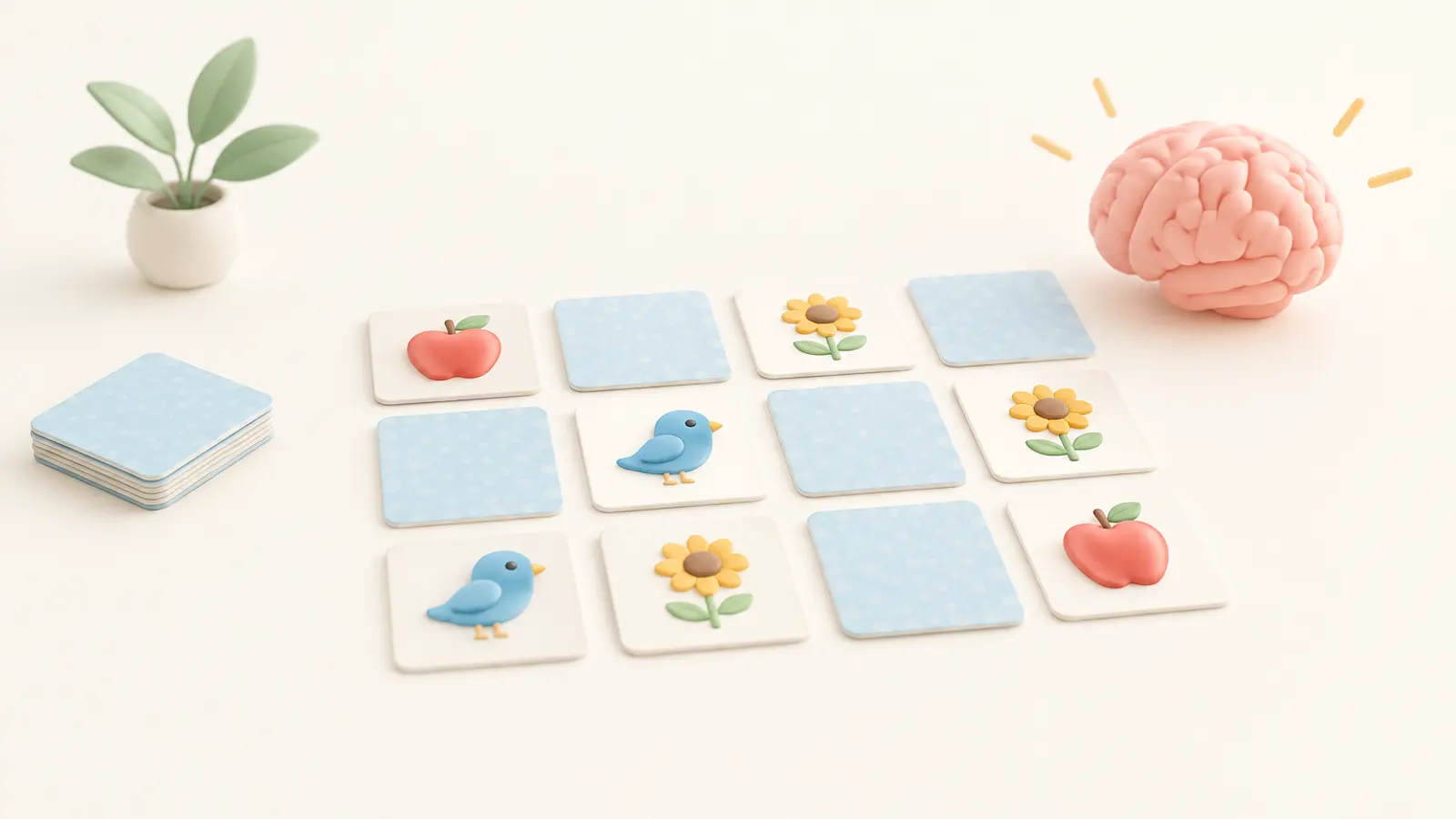
Remember the excitement of flipping over cards as a child, trying to find matching pairs? That simple game wasn't just entertainment—it was actually giving your brain a powerful workout. Memory match games have evolved from classic card games into one of the most effective tools for cognitive training, backed by science and loved by millions worldwide.
Whether you're looking to sharpen your mental edge, help your children develop better concentration, or maintain cognitive health as you age, memory match games offer a fun and accessible path to a stronger mind. Let's dive into everything you need to know about using these games for serious brain training.
What Are Memory Match Games and How Do They Work?
Memory match games, also known as concentration or pairs games, follow a beautifully simple concept: players flip over cards or tiles to reveal images, numbers, or symbols, with the goal of finding matching pairs. When you find a match, those cards stay revealed. When you don't, they flip back over, and you must remember their locations for future turns.
The basic gameplay mechanics involve:
Initial Setup: Cards are laid face-down in a grid pattern, typically ranging from 12 cards (6 pairs) for beginners to 40+ cards for advanced players.
Turn Structure: Players take turns flipping two cards at a time. If the cards match, they're removed from the board or kept face-up. If they don't match, both cards return to their face-down position.
Memory Challenge: The core challenge lies in remembering the location of previously revealed cards. Each flip provides information, and successful players build a mental map of the entire grid.
Victory Condition: The game ends when all pairs are found. In competitive versions, the player with the most matches wins.
Modern digital versions have expanded on this foundation with themes, difficulty levels, timed challenges, and multiplayer options, but the cognitive benefits remain rooted in that fundamental memory exercise.
The Science Behind Memory Improvement
Memory match games aren't just fun—they're a scientifically-validated tool for cognitive enhancement. Understanding the neuroscience behind these games can help you maximize their benefits.
Short-Term Memory vs. Working Memory
When you play memory match games, you're primarily engaging two critical memory systems:
Short-term memory acts as your brain's temporary storage system, holding information for about 20-30 seconds. When you flip a card and see a blue star, that image enters your short-term memory. Without reinforcement, it'll fade quickly.
Working memory goes a step further—it's your brain's active workspace where information is not just stored but manipulated and used. This is what allows you to compare the blue star you just saw with the red circle you saw three turns ago, and decide which card to flip next.
Research published in the Journal of Cognitive Enhancement has shown that regular practice with memory match games can increase working memory capacity by up to 15% over an eight-week period. This improvement isn't limited to game performance—it transfers to real-world tasks like following directions, mental math, and multitasking.
Brain Regions Activated During Play
When you engage with memory match games, multiple brain regions spring into action:
The hippocampus, your brain's memory center, encodes the location and appearance of each card. The prefrontal cortex handles executive functions like planning your strategy and inhibiting impulses to flip randomly. The parietal lobe manages spatial relationships, helping you mentally map the grid layout.
This multi-region activation is what makes memory games such effective brain training. You're not exercising just one cognitive skill—you're giving your entire brain a comprehensive workout.
Neuroplasticity and Long-Term Benefits
Perhaps most exciting is how memory games leverage neuroplasticity—your brain's ability to form new neural connections throughout life. Each time you successfully recall a card's location, you strengthen the neural pathways involved in memory formation and retrieval.
Studies from the University of California found that adults who played memory games for 15 minutes daily over six months showed measurable improvements in attention span, processing speed, and problem-solving abilities—benefits that persisted even after they stopped playing regularly.
Ready to experience these benefits yourself? Play Free Memory Match and start your brain training journey today.
Advertisement
Strategies for Better Performance
While memory match games seem straightforward, employing specific strategies can dramatically improve your performance and accelerate cognitive gains.
The Chunking Technique
Instead of trying to remember each card individually, group them into "chunks" of related information. Your brain can hold about 4-7 chunks in working memory at once.
For example, if you reveal a dog, cat, and bird in the top row, mentally categorize them as "animals in row one." If you later see geometric shapes in row three, you've created another chunk. This organization makes recall significantly easier than remembering 20+ individual items.
Visualization and Association
Create vivid mental images linking cards to their positions. If there's a sun symbol in the top-left corner, visualize the sun rising in that corner. For a moon in the bottom-right, imagine it setting there.
The more bizarre or exaggerated your mental images, the better they stick. If you see matching apples, imagine giant apples stacked in those grid positions. Your brain remembers unusual imagery far better than mundane details.
Spatial Memory Mapping
Develop a systematic approach to scanning the board. Many successful players use a "zone" strategy, mentally dividing the grid into quadrants. Focus on mastering one zone at a time rather than randomly jumping around the entire board.
Some players prefer a "clockwise spiral" approach, starting from the outer edges and working inward. Others use a "row-by-row" method. Experiment to find what resonates with your natural thinking style, then stick with it to build pattern recognition.
The First-Turn Strategy
Your opening moves set the foundation for success. Rather than trying to find immediate matches, use your first several turns to gather information. Flip cards in different areas of the board to create a broad mental map.
Resist the temptation to immediately re-flip a card you just saw. Instead, use those early turns to maximize new information, which pays dividends in later rounds.
Pattern Recognition Development
As you play regularly, you'll start recognizing common patterns. In a 20-card grid, certain positions become "hot spots" for difficult-to-remember cards. Deliberately focusing on these challenging positions during practice builds stronger neural pathways.
Benefits by Age Group
One of memory match games' greatest strengths is their universal appeal and age-appropriate benefits.
Benefits for Children (Ages 4-12)
For young minds, memory match games are foundational cognitive tools:
Attention Span Development: Games train children to focus for extended periods, a skill that translates directly to classroom performance.
Pattern Recognition: Learning to identify matching images builds mathematical and literacy skills, supporting shape recognition and letter differentiation.
Turn-Taking and Patience: In multiplayer games, children learn impulse control and social skills.
Confidence Building: Successfully finding matches provides immediate positive reinforcement, encouraging a growth mindset around learning challenges.
Research from the American Academy of Pediatrics suggests that children who regularly engage with memory games show improved academic performance, particularly in reading comprehension and mathematical problem-solving.
Benefits for Adults (Ages 18-64)
For adults juggling complex lives, memory games offer practical cognitive maintenance:
Stress Reduction: The focused attention required creates a meditative effect, temporarily silencing the mental chatter of daily stress.
Professional Skills: Enhanced working memory translates to better multitasking, information retention during meetings, and improved decision-making under pressure.
Mental Agility: Regular practice keeps cognitive processing speed sharp, countering the natural decline that begins in our late 20s.
Screen-Time Quality: Memory games provide a cognitively beneficial alternative to passive scrolling, making your digital time more productive.
A 2024 study in Cognitive Psychology Today found that working professionals who incorporated 10 minutes of memory games into their lunch break showed 23% better information retention in afternoon meetings compared to colleagues who used that time for social media.
Benefits for Seniors (Ages 65+)
For older adults, memory games serve as powerful preventive medicine:
Cognitive Reserve Building: Regular mental exercise builds cognitive reserve—the brain's resilience against age-related decline and neurodegenerative diseases.
Memory Maintenance: Games specifically target the short-term and working memory systems most vulnerable to aging.
Social Engagement: Multiplayer versions combat isolation while providing cognitive stimulation, addressing two major factors in healthy aging.
Mood Enhancement: The sense of accomplishment and mental engagement helps combat depression and anxiety common in older populations.
The landmark ACTIVE study (Advanced Cognitive Training for Independent and Vital Elderly) demonstrated that memory training, including games like memory match, produced cognitive benefits lasting up to 10 years.
How to Build a Daily Practice Routine
Consistency trumps intensity when it comes to cognitive training. Here's how to create a sustainable memory game practice:
Start Small and Specific
Begin with just 5-10 minutes daily. Choose a specific time—perhaps with your morning coffee or during an afternoon break. Habit research shows that linking new behaviors to existing routines dramatically increases adherence.
Progressive Difficulty Scaling
Week 1-2: Start with 12-16 cards (6-8 pairs) Week 3-4: Progress to 20-24 cards (10-12 pairs) Week 5-6: Challenge yourself with 30+ cards (15+ pairs) Week 7+: Introduce timed challenges or themed variations
This gradual progression prevents frustration while ensuring continuous challenge—the sweet spot for neuroplasticity.
Track Your Progress
Keep a simple log of your daily practice. Note the difficulty level, completion time, and how you felt during the session. This creates accountability and lets you observe improvement, which reinforces motivation.
Many digital memory games include built-in progress tracking, making this effortless. Try our Memory Match game to automatically track your improvements over time.
Vary Your Practice
While consistency is crucial, variety prevents cognitive plateaus. Alternate between:
- Speed challenges (how fast can you complete?)
- Accuracy focus (minimize mistakes, ignore time)
- Different themes (numbers, images, words)
- Varying grid sizes
This variation ensures you're building adaptable cognitive skills rather than just mastering one specific game configuration.
Make It Social
Consider weekly multiplayer sessions with family or friends. The competitive element boosts engagement, and the social connection enhances overall wellbeing—a crucial component of cognitive health.
Rest and Recovery
Your brain consolidates learning during rest, especially sleep. Avoid the trap of marathon sessions. Multiple short sessions distributed throughout the week produce better long-term results than one exhausting weekend binge.
Advertisement
Common Mistakes to Avoid
Even experienced players fall into these cognitive traps:
Random Flipping Without Strategy
Impulsively flipping cards without a systematic approach wastes your brain's working memory capacity. Each random flip is a missed opportunity to gather useful information. Instead, develop a deliberate pattern for exploring the board.
Trying Too Hard Too Fast
Starting with expert-level grids leads to frustration and abandonment. Your brain needs time to develop the neural pathways supporting superior memory performance. Respect the learning curve.
Ignoring the Forgetting Curve
The forgetting curve tells us we lose about 50% of new information within an hour without reinforcement. During games, periodically review the locations of important cards, even when it's not immediately useful. This spaced repetition strengthens encoding.
Playing Only When Perfectly Focused
Waiting for ideal conditions means you'll rarely play. Some of the best cognitive training happens when you're slightly tired or distracted—your brain learns to maintain performance under less-than-ideal circumstances, building cognitive resilience.
Neglecting Physical Health
Memory is embodied. Poor sleep, dehydration, and lack of exercise all impair cognitive function. No amount of memory games can compensate for fundamental health neglect. View memory training as one component of comprehensive brain health.
Giving Up After Plateaus
Everyone hits performance plateaus where improvement seems to stop. This is normal and temporary. Your brain is consolidating gains before the next leap forward. Consistent practice during plateaus is what separates those who achieve long-term improvement from those who don't.
Frequently Asked Questions
How long does it take to see cognitive improvements from memory match games?
Most people notice subjective improvements—feeling sharper, remembering appointments better—within 2-3 weeks of daily practice. Measurable improvements on cognitive assessments typically appear after 6-8 weeks of consistent play. However, the timeline varies based on your starting point, practice intensity, and individual neuroplasticity. The key is consistency: 10 minutes daily produces better results than occasional hour-long sessions.
Can memory match games help prevent dementia and Alzheimer's disease?
While memory games cannot prevent dementia, they contribute to cognitive reserve—your brain's resilience against age-related decline. Research shows that people who regularly engage in cognitively stimulating activities, including memory games, experience symptoms of dementia later and less severely than those who don't. Think of it as building a buffer: cognitive reserve won't prevent underlying disease processes, but it helps your brain maintain function despite them. Memory games are most effective as part of a comprehensive approach including physical exercise, social engagement, healthy diet, and cardiovascular health.
What's the optimal difficulty level for maximum brain training benefit?
The sweet spot is what researchers call "desirable difficulty"—challenging enough to require full attention and occasional mistakes, but not so hard that you feel overwhelmed. If you're completing games with 90%+ accuracy and minimal effort, increase difficulty. If you're making matches primarily by luck and feeling frustrated, reduce difficulty. Aim for about 70-80% success rate for optimal learning. This keeps you in the "growth zone" where neuroplasticity is maximized.
Are digital memory match games as effective as physical card games?
Both formats provide cognitive benefits, with slight differences. Physical card games offer tactile engagement and potentially stronger spatial memory encoding through physical positioning. Digital games provide advantages like automatic difficulty scaling, precise progress tracking, and unlimited variety. Research suggests the cognitive benefits are essentially equivalent—the best choice is whichever format you'll actually use consistently. Many cognitive scientists recommend alternating between both for maximum variety.
How do memory match games compare to other brain training tools?
Memory match games excel specifically at training visual-spatial memory, working memory capacity, and attention control. They're among the most research-validated cognitive training tools. However, comprehensive brain health requires diverse challenges. Combine memory games with other activities: word puzzles for language skills, math games for numerical reasoning, physical exercise for executive function, and social activities for emotional cognition. Think of memory games as one valuable tool in a complete cognitive fitness toolkit.
Start Your Brain Training Journey Today
Memory match games represent one of the most accessible, enjoyable, and scientifically-validated approaches to cognitive enhancement. Whether you're a parent looking to support your child's development, a professional seeking a mental edge, or a senior committed to healthy aging, these simple games pack a powerful cognitive punch.
The beauty of memory training is its simplicity—you don't need expensive equipment, complicated instructions, or hours of free time. Just a few minutes daily can build the neural pathways supporting sharper memory, better focus, and enhanced cognitive resilience.
Remember, the best brain training program is the one you'll actually stick with. Start small, be consistent, and celebrate your progress along the way. Your brain has an remarkable capacity for growth at any age—memory match games are your tool to unlock it.
Ready to challenge your mind and experience the benefits for yourself? Play our Memory Match game now and take the first step toward a sharper, more resilient brain. Your future self will thank you.
Put it into practice
Keep reading
Memory Visual
Memory Games for Seniors: Brain Training for Healthy Aging
Discover the best memory games for seniors to maintain cognitive health. Learn benefits, strategies, and accessible games designed for older adults.
Jan 19, 2025 12 min
Memory Visual
Tangram Puzzles: Complete Beginner's Guide
Learn everything about tangram puzzles - the ancient Chinese dissection puzzle. Discover the 7 pieces, solving strategies, and benefits for spatial reasoning.
Jan 18, 2025 10 min
Brain Health
5-Minute Brain Games: Quick Mental Workouts for Peak Performance
Discover the power of quick brain games. Learn how 5-minute mental workouts can boost memory, attention, and cognitive health based on 2025 research.
Jul 30, 2026 12 min
Advertisement