Pattern Recognition Training: Master Visual Intelligence Through Puzzles
Discover how pattern recognition training enhances cognitive abilities. Learn exercises, real-world applications, and puzzle techniques to boost your brain.
By Free To Play Puzzles Editorial Team 11 min read
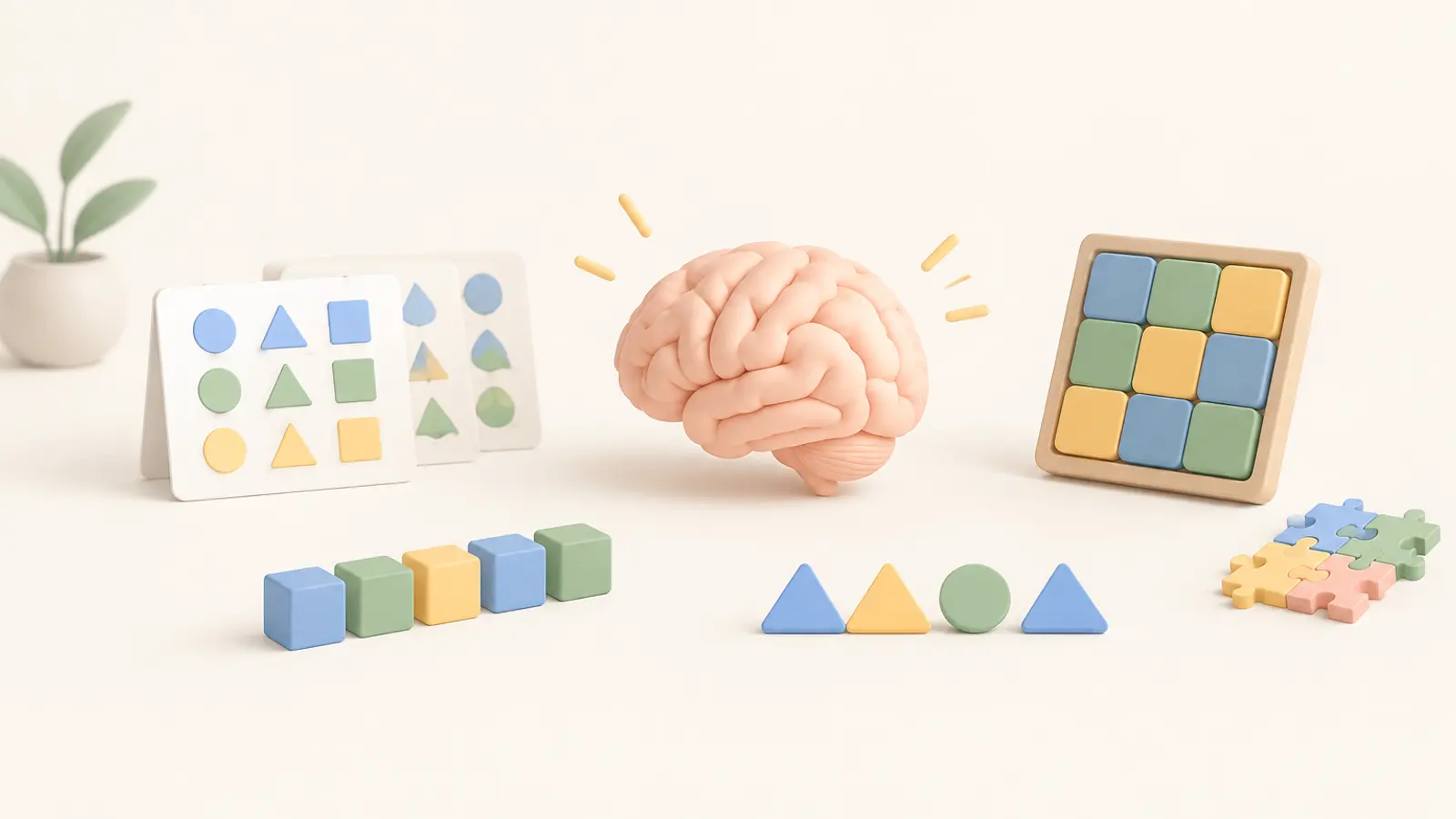
Have you ever looked at clouds and seen familiar shapes? Noticed repeating tiles on a floor before anyone else? Predicted what comes next in a sequence? Congratulations—your pattern recognition system is at work. This fundamental cognitive ability shapes how we understand the world, make decisions, and solve problems. The good news? Like any mental skill, pattern recognition can be trained, strengthened, and refined through deliberate practice.
Pattern recognition isn't just about spotting visual similarities. It's the brain's ability to identify regularities, predict outcomes, and make sense of complex information by recognizing familiar structures. From reading this sentence (recognizing letter patterns as words) to navigating your daily commute (recognizing route patterns), this skill underpins countless aspects of human intelligence.
In this comprehensive guide, we'll explore what pattern recognition truly is, why it matters, and most importantly, how you can systematically develop this crucial cognitive ability through targeted exercises and puzzle practice.
Understanding Pattern Recognition: The Foundation of Intelligence
Pattern recognition is your brain's ability to detect regularities, similarities, and structures in sensory information. It's one of the most fundamental cognitive processes, allowing us to make sense of an overwhelmingly complex world by identifying familiar elements and predicting what comes next.
The Neuroscience of Pattern Detection
When you encounter new information, your brain doesn't process it in isolation. Instead, it immediately begins comparing this input against millions of stored patterns from your lifetime of experiences.
This process primarily involves the visual cortex for visual patterns, the temporal lobe for pattern sequencing and memory, and the prefrontal cortex for higher-order pattern analysis and decision-making based on recognized patterns.
The brain uses both bottom-up processing (building understanding from small details) and top-down processing (using prior knowledge to interpret information). Expert pattern recognizers excel at seamlessly integrating both approaches.
Research from the Massachusetts Institute of Technology shows that pattern recognition activates neural networks across multiple brain regions simultaneously. When you recognize a pattern, you're not using a single "pattern recognition center"—you're orchestrating a complex symphony of neural activity spanning perception, memory, and reasoning systems.
Types of Patterns the Brain Processes
Pattern recognition isn't a single skill but rather a family of related abilities:
Visual Patterns: Recognizing shapes, colors, spatial arrangements, and symmetries. This includes everything from identifying faces to noticing repeating designs in architecture.
Sequential Patterns: Detecting order and progression in information presented over time. Mathematical sequences (2, 4, 6, 8...), musical melodies, and narrative structures all involve sequential pattern recognition.
Logical Patterns: Identifying relationships between concepts, understanding cause-and-effect, and recognizing abstract principles that govern systems.
Spatial Patterns: Understanding how objects relate to each other in physical space, including rotation, reflection, and transformation patterns.
Numerical Patterns: Detecting mathematical relationships, proportions, and statistical regularities in data.
Each type engages slightly different neural circuits, which is why comprehensive pattern recognition training should incorporate diverse exercises targeting multiple pattern categories.
Why Pattern Recognition Matters
Pattern recognition is far more than an interesting cognitive curiosity—it's foundational to human intelligence and success across virtually every domain:
Learning Efficiency: When you recognize patterns, you don't need to relearn similar information from scratch. Each new experience builds on pattern knowledge, exponentially accelerating learning.
Problem-Solving: Most complex problems are variations on patterns you've encountered before. Strong pattern recognizers quickly identify these similarities and adapt proven solutions.
Prediction and Planning: Recognizing patterns allows you to anticipate future events, whether predicting traffic patterns during your commute or forecasting trends in your field.
Creative Innovation: Creativity often involves recognizing unexpected patterns—seeing connections others miss. The most groundbreaking innovations frequently come from applying patterns from one domain to solve problems in another.
Decision Making: Rapid, accurate decisions depend on quickly recognizing familiar situations and their likely outcomes based on past pattern data.
A landmark study published in Nature Neuroscience found that individuals with superior pattern recognition abilities showed significantly better performance in professional domains ranging from medical diagnosis to financial analysis to software development—all fields requiring rapid pattern identification in complex information.
Pattern Recognition Training Exercises
Developing superior pattern recognition requires deliberate, progressive practice. Here are evidence-based exercises to systematically strengthen this cognitive ability.
Visual Pattern Exercises
Symmetry Detection Practice: Look for symmetrical objects in your environment. Start with obvious examples (butterflies, faces) and progress to detecting subtle symmetries in architecture, nature, and design. Create sketches where you complete one half of a symmetrical pattern.
Shape Transformation Sequences: Practice mental rotation by visualizing how shapes transform. If a square rotates 90 degrees, what does it look like? How about a complex 3D object? Tetris and Tangram puzzles provide excellent training for this skill, requiring you to mentally rotate pieces before placing them.
Color and Design Pattern Recognition: Study repeating patterns in textiles, tiles, and artwork. Try to identify the "unit" that repeats and predict what comes next. Many traditional art forms like Islamic geometric patterns or Celtic knots offer complex challenges for advanced practitioners.
Visual Anomaly Detection: Look at complex images and identify what doesn't fit the pattern. This "spot the difference" approach trains your brain to quickly establish baseline patterns and detect deviations—a skill crucial for quality control, proofreading, and security analysis.
Sequential Pattern Exercises
Number Sequence Completion: Start with simple arithmetic sequences (2, 4, 6, 8...) and progress to more complex patterns. Try Fibonacci sequences, geometric progressions, and multi-rule patterns (where multiple operations alternate). Create your own sequences and challenge others to solve them.
Letter and Word Patterns: Recognize alphabetical patterns, such as "A, C, E, G..." (every other letter) or "CAT, DOG, ELF, GNU..." (alphabetically ordered three-letter words with increasing alphabetical positions). Word puzzles excel at building letter pattern recognition.
Rhythm and Temporal Patterns: Clap out rhythmic patterns and try to predict what comes next. This builds temporal pattern recognition, which transfers to music appreciation, language learning, and timing-dependent skills.
Story Structure Recognition: When reading or watching narratives, consciously identify common story patterns—the hero's journey, setup-complication-resolution structures, foreshadowing patterns. This meta-awareness strengthens abstract pattern recognition.
Logical Pattern Exercises
Analogy Training: Practice solving analogies: "Hot is to cold as summer is to ___?" These exercises force you to identify the underlying relationship pattern and apply it to new domains. Start with concrete analogies and progress to abstract ones.
Rule Discovery Games: Look at sets of items sorted into groups and determine the sorting rule. Is it by color? Size? Number of sides? Functional category? Games that require deducing hidden rules provide excellent logical pattern training.
Categorical Pattern Recognition: Given a set of items, identify multiple valid ways to categorize them. A tomato could be grouped with fruits (botanically), vegetables (culinarily), red items (visually), or round objects (spatially). This flexibility strengthens pattern recognition adaptability.
Conditional Logic Patterns: Practice "if-then" pattern recognition. If every time Event A happens, Event B follows, recognize this conditional pattern. Sudoku brilliantly trains conditional logical patterns—if this number goes here, then that number must go there.
Spatial Pattern Exercises
Mental Mapping: When navigating familiar routes, create mental maps noting landmarks and their spatial relationships. Then try drawing these maps from memory, noting pattern errors. This builds spatial pattern memory.
3D Rotation Practice: Visualize rotating three-dimensional objects in your mind. If you're looking at a cube from one angle, what would it look like from another? This skill is fundamental to engineering, architecture, and many scientific fields.
Jigsaw Puzzles: Traditional jigsaw puzzles train your brain to recognize edge patterns, color gradients, and how pieces spatially relate. Digital versions like Tangram provide endless variety for spatial pattern practice.
Navigation Challenges: In new environments, consciously identify spatial patterns—how streets are laid out, where landmarks cluster, directional patterns. This transforms routine navigation into pattern recognition training.
Numerical Pattern Exercises
Mental Math Patterns: Notice patterns in multiplication (all multiples of 9 have digits that sum to 9), division remainders, and mathematical operations. This pattern awareness makes mental calculation dramatically faster.
Data Visualization Analysis: Look at graphs, charts, and data visualizations. Identify trends, outliers, and recurring patterns. Try to predict future data points based on recognized patterns.
Probability Pattern Recognition: When observing random events, track outcomes and identify actual randomness versus perceived patterns. This trains your brain to distinguish genuine patterns from coincidence—a crucial critical thinking skill.
Mathematical Puzzle Games: Games like 2048 combine numerical patterns with strategic thinking. You must recognize number patterns (powers of 2) and spatial patterns (how tiles merge) simultaneously, providing integrated training.
Advertisement
Real-World Applications of Pattern Recognition
Understanding pattern recognition training is valuable, but recognizing how this skill translates to practical benefits makes the practice meaningful and motivating.
Professional Applications
Medical Diagnosis: Doctors rely heavily on pattern recognition, matching patient symptoms and test results against patterns of known conditions. Studies show that experienced physicians recognize disease patterns almost instantaneously—expertise built through years of pattern exposure and training.
Financial Analysis: Investment professionals recognize patterns in market data, financial statements, and economic indicators. While past patterns don't guarantee future outcomes, pattern recognition allows analysts to identify similar situations and assess probabilities.
Software Development: Programmers constantly recognize code patterns—common algorithms, design patterns, bug patterns, and optimization opportunities. Superior pattern recognition directly correlates with coding speed and quality.
Quality Control and Inspection: Manufacturing inspectors, airport security screeners, and quality assurance professionals must rapidly identify deviations from normal patterns. Training significantly improves both speed and accuracy in these critical roles.
Scientific Research: Scientists recognize patterns in experimental data, identifying trends, anomalies, and relationships that point toward new discoveries. Many breakthrough moments came from recognizing unexpected patterns.
Education and Tutoring: Effective educators recognize learning patterns in students—which concepts they grasp easily, where they struggle, and how they learn best. This allows personalized instruction targeting individual patterns.
Academic Applications
Mathematics Mastery: Math is essentially the study of patterns. Students with strong pattern recognition grasp mathematical concepts faster, see relationships between topics, and solve problems more creatively.
Language Learning: Learning new languages requires recognizing grammatical patterns, pronunciation patterns, and vocabulary patterns. Strong pattern recognizers acquire languages significantly faster.
Reading Comprehension: Reading isn't decoding individual letters—it's recognizing word patterns, sentence structure patterns, and narrative patterns. Speed reading techniques leverage enhanced pattern recognition.
Test-Taking Skills: Standardized tests follow patterns in question types, answer distributions, and logical structures. Recognizing these patterns improves performance beyond content knowledge alone.
Research and Analysis: Academic research involves recognizing patterns in literature, identifying gaps, and connecting ideas across disciplines. This meta-pattern recognition defines scholarly excellence.
Daily Life Applications
Social Intelligence: Human interaction follows patterns. Recognizing emotional patterns, conversation structures, and social dynamics improves relationships and communication effectiveness.
Time Management: Effective schedulers recognize patterns in their energy levels, productivity rhythms, and time consumption. This pattern awareness enables better planning.
Health and Fitness: Recognizing patterns in how your body responds to foods, exercise, and sleep allows personalized optimization of health routines.
Problem-Solving: Daily challenges—from figuring out why your car won't start to resolving conflicts—benefit from pattern recognition. "I've seen something similar before" dramatically accelerates solutions.
Consumer Decisions: Recognizing pricing patterns, quality indicators, and marketing tactics protects you from manipulation and helps identify genuine value.
Safety Awareness: Recognizing environmental patterns—situations that felt similar before something bad happened—activates appropriate caution, keeping you safer.
Creative Applications
Artistic Skill: Visual artists recognize color patterns, compositional patterns, and style patterns. Musicians recognize melodic, harmonic, and rhythmic patterns. Writers recognize narrative patterns and language patterns. All creative excellence builds on pattern mastery.
Innovation and Invention: Revolutionary ideas often come from recognizing patterns in one domain and applying them elsewhere. Velcro was invented by recognizing how burrs stick to fabric. Nature-inspired design (biomimicry) is systematic cross-domain pattern recognition.
Strategic Gaming: Whether chess, poker, or video games, top players recognize strategic patterns, opponent patterns, and situational patterns faster than competitors. Strategy games provide excellent training ground for competitive pattern recognition.
How Puzzles Train Pattern Recognition
Puzzles are specifically designed pattern recognition training tools. Here's how different puzzle types target distinct aspects of this crucial skill.
Visual Puzzles Build Perceptual Patterns
Tangram Puzzles: Tangram puzzles train your brain to recognize how simple geometric shapes combine to form complex patterns. Each solution requires identifying spatial relationships and shape transformations—core pattern recognition skills transferable to design, architecture, and spatial reasoning tasks.
Nonogram Puzzles: Nonogram puzzles (also called picture logic puzzles) combine numerical patterns with visual outcomes. You must recognize how number sequences translate into filled grid patterns, training the crucial skill of moving between abstract and concrete pattern representations.
Tetris: Tetris demands real-time pattern recognition under pressure. You must recognize falling piece patterns, space patterns on the board, and opportunity patterns for line clears—all while the game accelerates. This builds processing speed alongside pattern accuracy.
Logic Puzzles Build Reasoning Patterns
Sudoku: Sudoku is perhaps the ultimate logical pattern recognition trainer. Every puzzle requires recognizing numerical patterns, spatial patterns, and constraint patterns. The "if-then" reasoning chains you develop transfer directly to programming, mathematics, and systematic problem-solving.
Crossword Puzzles: Crossword puzzles train language pattern recognition—word patterns, definition patterns, and thematic patterns. Regular crossword solvers develop superior vocabulary and verbal reasoning through extensive pattern exposure.
Logic Grid Puzzles: These puzzles require recognizing relationship patterns across multiple categories. The systematic elimination and deduction processes build transferable analytical thinking patterns.
Memory Puzzles Build Recognition Patterns
Memory Match Games: Memory Match trains your brain to create and recall spatial patterns. The more you play, the better you become at encoding location patterns efficiently and retrieving them accurately—skills valuable for navigation, organization, and information management.
Word Search Puzzles: Word Search builds letter pattern recognition in multiple orientations (horizontal, vertical, diagonal, reversed). This flexibility in pattern detection transfers to reading speed and visual scanning efficiency.
Strategy Puzzles Build Complex Patterns
2048: The 2048 game combines numerical patterns (powers of 2), spatial patterns (tile arrangement), and strategic patterns (optimal move sequences). This integration of multiple pattern types simultaneously mimics real-world complexity.
Snake Game: Snake trains predictive pattern recognition—you must recognize future patterns based on current trajectory, anticipating where your snake will be several moves ahead. This future-state pattern visualization is crucial for planning and strategy.
Action Puzzles Build Dynamic Patterns
Flappy Bird: Flappy Bird trains rhythm pattern recognition and timing patterns. Success requires recognizing the timing pattern of taps needed to navigate obstacles—a skill transferable to music, athletics, and any timing-dependent activity.
Breakout: Breakout demands recognition of ball trajectory patterns, brick patterns, and paddle positioning patterns. The physics-based pattern prediction builds intuitive understanding of spatial dynamics.
Space Invaders: Space Invaders trains enemy movement patterns, projectile patterns, and threat priority patterns. Managing multiple simultaneous patterns under pressure builds cognitive flexibility.
Building Your Pattern Recognition Training Program
Knowing exercises and applications is valuable, but systematic practice produces results. Here's how to create an effective training regimen.
Start With Assessment
Before beginning training, assess your current pattern recognition abilities. Try a variety of puzzles and note which come easily and which challenge you. This baseline helps you track improvement and identify areas needing focus.
Take mental note of your daily life pattern recognition—how quickly you navigate new spaces, whether you spot typos easily, how fast you learn new procedures. These informal assessments complement formal puzzle performance.
Design Progressive Challenges
Pattern recognition improves fastest when challenges slightly exceed current abilities—the "desirable difficulty" zone where you're stretched but not overwhelmed.
Week 1-2: Begin with fundamental pattern exercises. Simple visual patterns, basic number sequences, and introductory logic puzzles. Focus on accuracy over speed.
Week 3-4: Introduce variety. Alternate between visual, sequential, logical, and spatial pattern exercises. Start tracking completion times to add mild speed pressure.
Week 5-6: Increase complexity. Multi-step patterns, larger puzzle grids, and combined pattern types (like 2048 which integrates numerical and spatial patterns).
Week 7-8: Add time constraints and competitive elements. Challenge yourself to beat previous times or compete against others. This pressure builds pattern recognition under stress—crucial for real-world applications.
Week 9+: Specialize in pattern types relevant to your goals while maintaining variety. If you're learning programming, emphasize logical patterns. For artistic pursuits, focus on visual and spatial patterns.
Create Consistent Practice Routines
Neuroscience research consistently shows that distributed practice (multiple short sessions) produces better long-term results than massed practice (infrequent long sessions).
Aim for 15-20 minutes of deliberate pattern recognition practice daily rather than occasional marathon sessions. This could be:
- 5 minutes of visual pattern puzzles with morning coffee
- 5 minutes of logical puzzles during lunch break
- 5 minutes of memory pattern games before bed
- Weekend longer sessions for complex integrated challenges
Consistency matters more than duration. Your brain strengthens neural pathways through regular activation, not occasional intense training.
Leverage Cross-Training
Just as athletes cross-train to build comprehensive fitness, pattern recognizers benefit from diverse exercises targeting different pattern types.
Monday: Visual patterns (Tangram, Tetris) Tuesday: Logical patterns (Sudoku, logic puzzles) Wednesday: Memory patterns (Memory Match, Word Search) Thursday: Numerical patterns (2048, sequence completion) Friday: Integrated challenges combining multiple pattern types Weekend: Extended practice on personally challenging areas
This variety prevents cognitive plateaus and builds versatile pattern recognition applicable across diverse situations.
Track and Analyze Progress
Keep a simple training log noting:
- Date and duration of practice
- Puzzle types attempted
- Performance metrics (completion time, accuracy, difficulty level)
- Subjective difficulty (how challenging did it feel?)
- Real-world pattern recognition observations
Review this log weekly. You'll notice improvement patterns—certain puzzle types advancing faster, breakthrough moments, persistent challenges. This meta-awareness guides program adjustments.
Many puzzle platforms automatically track performance over time. Our puzzle collection provides built-in progress monitoring, making self-assessment effortless.
Apply Learning to Real Contexts
Training transfers best when you consciously connect practice to applications. After puzzle sessions, spend a few minutes reflecting:
- "What pattern recognition strategies did I just use?"
- "Where in my work/life could I apply this approach?"
- "What real-world patterns have I noticed today?"
This reflection bridges the gap between abstract training and practical application, maximizing transfer of learning.
Deliberately seek pattern recognition opportunities in daily life. When reading, consciously notice writing patterns. When in conversations, identify communication patterns. When observing nature, spot repeating patterns. This transforms your entire life into pattern recognition training ground.
Join Community Challenges
Social elements boost motivation and adherence. Consider:
- Competing on puzzle leaderboards
- Joining online pattern recognition communities
- Sharing interesting patterns you've discovered
- Teaching others about pattern recognition
Teaching is particularly powerful—explaining patterns to others dramatically strengthens your own understanding and recognition abilities.
Advertisement
Common Pattern Recognition Training Mistakes
Even well-intentioned training can be ineffective if you fall into these common traps:
Mistake 1: Pattern Overfitting
Seeing patterns where none exist (pareidolia) is the flip side of pattern recognition. This happens when your brain becomes too eager to find patterns, detecting false signals in random noise.
Combat this by:
- Deliberately practicing with random data, learning to recognize true randomness
- Requiring multiple confirming instances before accepting a pattern
- Studying statistical concepts like regression to the mean
- Questioning your pattern interpretations, especially those confirming biases
Mistake 2: Rigid Pattern Thinking
Becoming locked into familiar patterns prevents recognizing novel ones. This cognitive rigidity limits creative problem-solving.
Maintain flexibility by:
- Deliberately seeking alternative patterns in the same data
- Practicing with ambiguous stimuli that support multiple interpretations
- Studying how different cultures and fields recognize different patterns in identical information
- Regularly attempting completely unfamiliar puzzle types
Mistake 3: Surface Pattern Focus
Recognizing superficial similarities while missing deeper structural patterns limits transfer of learning. A student might memorize specific math problems without recognizing underlying patterns applicable to new problems.
Build depth by:
- Asking "why" this pattern exists, not just "what" the pattern is
- Looking for patterns in patterns (meta-patterns)
- Connecting patterns across different contexts
- Focusing on principles and relationships, not just surface features
Mistake 4: Neglecting Pattern Integration
Training each pattern type in isolation without developing the ability to recognize multiple simultaneous patterns reduces real-world effectiveness.
Integrate pattern types by:
- Attempting complex puzzles requiring multiple pattern recognition skills
- Real-world projects combining visual, logical, and sequential patterns
- Time-pressured challenges forcing rapid pattern-switching
- Reflective practice identifying how different pattern types interact
Mistake 5: Passive Consumption vs. Active Practice
Reading about pattern recognition or passively observing patterns provides minimal benefit. Active engagement—attempting to identify patterns before seeing solutions—drives improvement.
Ensure active practice by:
- Attempting puzzles before looking at solutions
- Generating your own pattern challenges
- Teaching pattern recognition to others
- Applying patterns to solve real problems
Frequently Asked Questions
How long does it take to improve pattern recognition abilities?
Most people notice subjective improvements within 2-3 weeks of daily practice—patterns start "popping out" more readily, and puzzles that initially challenged you become easier. Measurable improvement on cognitive assessments typically appears after 6-8 weeks of consistent training. However, pattern recognition continues developing over years of practice. Expert-level pattern recognition in specialized domains (like chess or medical diagnosis) requires thousands of hours of deliberate practice. The good news: meaningful improvement comes quickly, while mastery provides a lifetime journey.
Is pattern recognition an innate ability or can anyone improve?
Both nature and nurture play roles. Research shows genetic factors influence baseline pattern recognition abilities, but training produces substantial improvements regardless of starting point. Brain plasticity allows anyone to strengthen pattern recognition neural pathways through practice. Think of it like musical ability—some people have natural advantages, but everyone can improve significantly through deliberate training. Studies of professional pattern recognizers (radiologists, chess masters, quality inspectors) show that expertise comes primarily from extensive practice, not innate talent.
Can pattern recognition training improve IQ scores?
Some evidence suggests pattern recognition training produces modest gains on certain IQ subtests, particularly those involving visual-spatial reasoning and fluid intelligence. However, IQ is multifaceted, and pattern recognition is just one component. More importantly, pattern recognition training improves real-world cognitive performance in ways that matter more than IQ scores—faster learning, better problem-solving, and enhanced decision-making. Focus on practical cognitive gains rather than test scores.
What's the relationship between pattern recognition and creativity?
Contrary to the misconception that pattern recognition makes thinking rigid, it's actually fundamental to creativity. Creative breakthroughs often involve recognizing unexpected patterns—connections between seemingly unrelated domains. The most innovative thinkers excel at both recognizing conventional patterns (expertise) and identifying novel patterns others miss (creativity). Training pattern recognition provides the mental tools for creative pattern synthesis. However, balance pattern recognition with divergent thinking exercises to maximize creative potential.
Are there risks or downsides to pattern recognition training?
When practiced thoughtfully, pattern recognition training is safe and beneficial. However, potential pitfalls include: seeing false patterns (overfitting to noise), becoming rigid in pattern thinking (missing novel patterns), and developing confirmation bias (seeking patterns supporting existing beliefs). Additionally, excessive puzzle play without real-world application may produce skills that don't transfer effectively. Mitigate these risks through varied practice, critical evaluation of recognized patterns, and deliberate application to real-world contexts. Balance pattern recognition training with other cognitive exercises for comprehensive mental development.
How does age affect pattern recognition training?
Pattern recognition remains trainable throughout the lifespan. Children naturally excel at rapid pattern learning, making youth an ideal time for building foundational pattern skills. Adults benefit from combining pattern training with extensive existing knowledge, allowing recognition of sophisticated conceptual patterns. Older adults may experience slightly slower processing speeds but often excel at complex pattern recognition drawing on decades of experience. Research shows that cognitive training, including pattern recognition exercises, helps older adults maintain mental acuity and cognitive reserve. Regardless of age, consistent practice produces meaningful improvements.
Start Your Pattern Recognition Journey Today
Pattern recognition is perhaps the most fundamental cognitive skill underlying human intelligence. From making sense of visual information to predicting future events, from learning new skills to solving complex problems, pattern recognition shapes how effectively we navigate our world.
The remarkable news is that this crucial ability responds beautifully to training. Through systematic practice with diverse exercises—visual puzzles, logic games, memory challenges, and strategic play—you can measurably strengthen your pattern recognition capabilities.
Unlike many cognitive abilities that require expensive training programs or specialized equipment, pattern recognition training is freely accessible. A few minutes daily with engaging puzzles can build neural pathways supporting sharper perception, faster learning, and more effective problem-solving.
The best pattern recognition training program combines variety, consistency, and real-world application. Challenge yourself with different puzzle types to build versatile skills. Practice regularly—even briefly—to strengthen neural connections. And consciously apply your developing pattern recognition abilities to work, learning, and daily life.
Your brain's pattern recognition system is remarkably plastic, capable of significant growth regardless of your starting point or current age. Every puzzle you solve, every pattern you identify, and every connection you make strengthens this fundamental cognitive capability.
Ready to transform how your brain recognizes patterns? Start training today with our comprehensive collection of pattern recognition puzzles:
- Sudoku for logical pattern mastery
- Tetris for spatial pattern recognition under pressure
- 2048 for integrated numerical and spatial patterns
- Memory Match for visual pattern memory
- Tangram for geometric transformation patterns
- Word Search for multi-directional letter patterns
Explore our complete puzzle collection and discover which pattern types resonate with your learning style. Your journey toward superior pattern recognition—and the countless benefits it brings—begins with a single puzzle.
The patterns are everywhere, waiting to be discovered. Train your brain to see them.
Put it into practice


Keep reading
Memory Visual
Tangram Puzzles: Complete Beginner's Guide
Learn everything about tangram puzzles - the ancient Chinese dissection puzzle. Discover the 7 pieces, solving strategies, and benefits for spatial reasoning.
Jan 18, 2025 10 min

Brain Health
Mastering the Matrix: The Future of Pattern Recognition Games and Visual Training
Explore the science of pattern recognition games and visual training. Learn expert strategies, 2025 market trends, and how to enhance your cognitive reserve.
Mar 5, 2026 12 min
Word Search
Word Search Pattern Recognition: The Science Behind the Solve
Unlock the secrets of word search patterns. Explore cognitive science, eye-tracking research, and expert strategies to master word search puzzles.
Dec 29, 2025 12 min
Advertisement