Magic Squares Guide: How to Create and Solve These Ancient Puzzles
Unlock the secrets of magic squares. Learn the history, mathematical formulas, and expert algorithms like the Siamese and LUX methods to solve any grid size.
By Free To Play Puzzles Editorial Team 12 min read
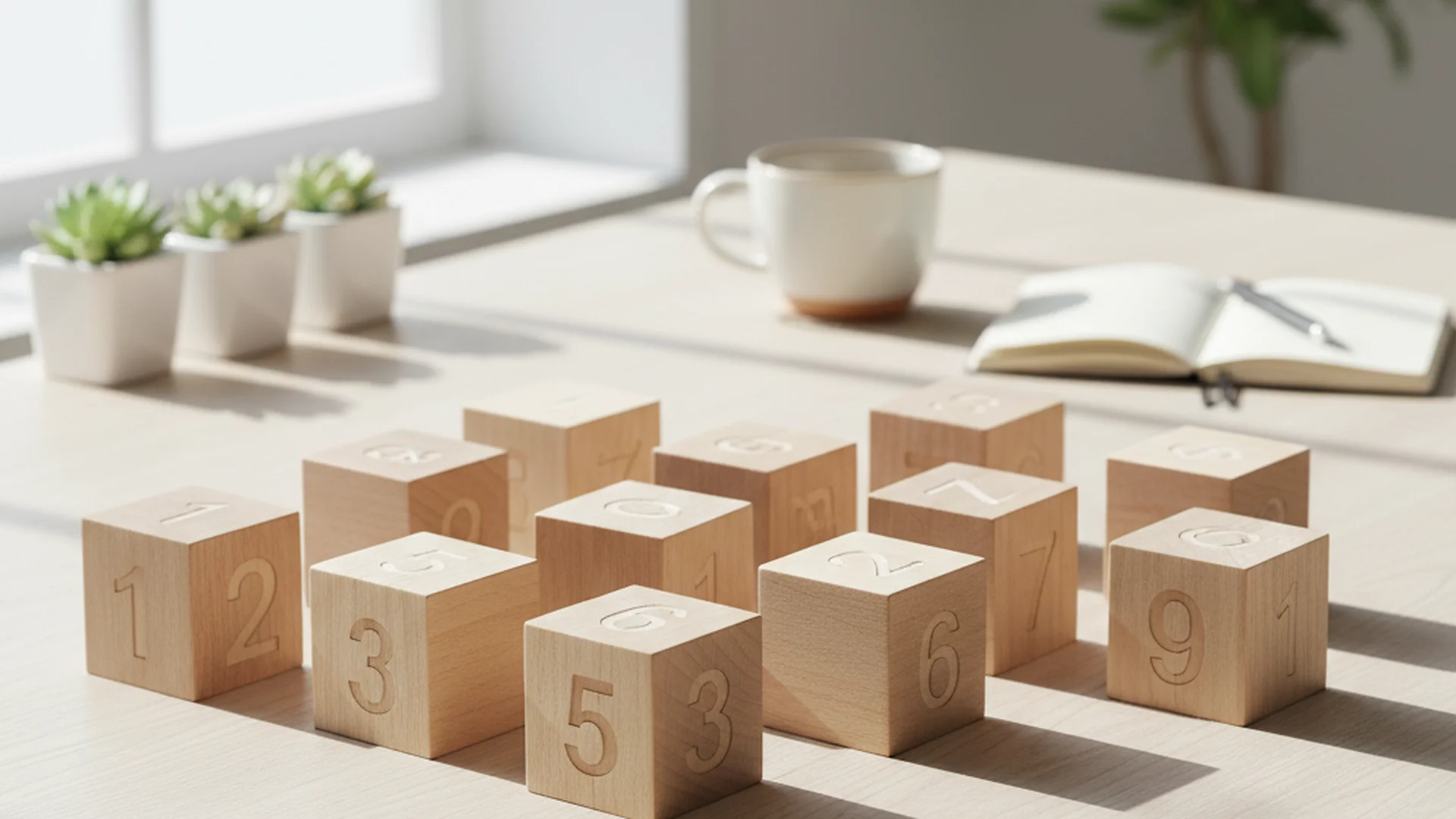
For over four millennia, magic squares have captivated the minds of emperors, mathematicians, and artists alike. At first glance, a magic square puzzle looks like a simple grid of numbers, but beneath the surface lies a perfect equilibrium of logic and symmetry. Whether you are a fan of Sudoku or you enjoy the strategic planning required for 2048, mastering the magic square is the ultimate test of your numerical intuition.
In this guide, we will explore the fascinating world of these mathematical marvels—from the legendary Lo Shu square of ancient China to the cutting-edge "Year Square" challenges of 2025. You will learn the exact formulas used by professionals and the specific algorithms required to build your own magic square from scratch.
What Is a Magic Square?
A magic square is an $n \times n$ grid (where $n$ is the "order" or number of cells across) filled with distinct numbers. The "magic" happens when the sum of every row, every column, and both main diagonals equals the exact same value. This value is known as the Magic Constant ($M$).
For a square to be considered "normal," it must use consecutive integers starting from 1 up to $n^2$. For example, a $3 \times 3$ normal magic square uses the numbers 1 through 9.
The Magic Formula
You don't have to guess what the total should be. Mathematicians use a universal formula to determine the Magic Constant for any normal square:
$M = \frac{n(n^2 + 1)}{2}$
| Order ($n$) | Grid Size | Magic Constant ($M$) |
|---|---|---|
| 3 | 3x3 | 15 |
| 4 | 4x4 | 34 |
| 5 | 5x5 | 65 |
| 6 | 6x6 | 111 |
The Ancient History of Magic Squares
The history of the magic square puzzle is as much about mythology as it is about mathematics.
The Lo Shu Square
Legend has it that around 2200 BC, during a great flood in China, Emperor Yu the Great saw a mystical turtle emerge from the Luo River. On the turtle's shell was a $3 \times 3$ grid of dots representing the numbers 1 through 9. This became known as the Lo Shu Square. It was considered a symbol of cosmic balance and served as a foundation for Feng Shui and Chinese astrology.
The Dürer Square
Fast forward to 1514 AD, and the German Renaissance artist Albrecht Dürer included a $4 \times 4$ magic square in his famous engraving Melencolia I. This square is particularly famous because Dürer managed to place the year of the artwork's creation—1514—in the two center cells of the bottom row.
Advertisement
How to Solve Odd-Order Magic Squares
If you are dealing with a $3 \times 3$, $5 \times 5$, or any square where $n$ is an odd number, the most effective technique is the Siamese Method (also known as De la Loubère's Method).
Step-by-Step: The Siamese Method
- The Starting Point: Place the number '1' in the center cell of the top row.
- The Up-Right Rule: Move up one row and right one column to place the next number.
- Wrapping Around:
- If your move takes you off the top of the grid, wrap around to the bottom cell of the next column.
- If your move takes you off the right side of the grid, wrap around to the leftmost cell of the previous row.
- The Obstacle Rule: If you encounter a cell that is already occupied, move down one cell from the last number you placed, then continue with the Up-Right Rule.
Solving Even-Order Magic Squares
Even-order squares are divided into two categories: Doubly-Even (multiples of 4, like 4x4 or 8x8) and Singly-Even (even but not multiples of 4, like 6x6).
The Doubly-Even Strategy (4x4)
For a $4 \times 4$ square, a common technique is the "Cross-Out" method:
- Fill the grid from 1 to 16, row by row, from top-left to bottom-right.
- Imagine two large "X" shapes crossing the grid. One X connects (1, 6, 11, 16) and the other connects (4, 7, 10, 13).
- Keep the numbers that fall on these diagonal lines where they are.
- For all other numbers, swap them with their "diametrically opposite" number in the grid (e.g., the number in the top-left non-X cell swaps with the bottom-right non-X cell).
The LUX Method (Singly-Even)
The $6 \times 6$ square is historically the most difficult to construct. The LUX Method, popularized by John Conway, involves dividing the $6 \times 6$ grid into $2 \times 2$ blocks. These blocks are labeled with the letters L, U, or X, which dictate the order in which the four numbers within that block are filled. This method is an advanced extension of the Siamese Method and is a favorite among logic puzzle enthusiasts.
Real-World Examples of Magic Squares
To truly understand how these work, let’s look at three distinct examples.
Example 1: The Standard $3 \times 3$ (Lo Shu)
| 8 | 1 | 6 |
|---|---|---|
| 3 | 5 | 7 |
| 4 | 9 | 2 |
| Magic Constant: 15. Note how the middle number is 5 (the median). In a normal $3 \times 3$ square, the middle number is always $M/3$. |
Example 2: The Dürer $4 \times 4$ (1514)
| 16 | 3 | 2 | 13 |
|---|---|---|---|
| 5 | 10 | 11 | 8 |
| 9 | 6 | 7 | 12 |
| 4 | 15 | 14 | 1 |
| Magic Constant: 34. Notice the bottom row shows "15" and "14" together, representing the year 1514. |
Example 3: The 2025 "Year Square"
As 2025 is a perfect square ($45^2$), mathematicians have developed special "Year Squares" where the magic constant equals 2025. One such $3 \times 3$ square uses an arithmetic progression rather than the numbers 1-9:
- Numbers: 667, 668, 669, 674, 675, 676, 681, 682, 683.
- Central Number: 675.
- Magic Constant: $675 \times 3 = 2025$.
Advertisement
Current Trends: Magic Squares in 2025-2026
Magic squares are seeing a massive resurgence in the brain training community. Much like the Sudoku boom of the early 2000s, these puzzles are being recognized for their cognitive health benefits.
- The 2025 Challenge: With 2025 being $45 \times 45$, there is a global challenge to create a "perfect" $45 \times 45$ magic square where every sub-grid also possesses magic properties.
- Equate 8: This is a new puzzle genre emerging in 2025 that combines magic square logic with arithmetic operators ($+$, $-$, $\times$). Instead of just summing numbers, players must manipulate equations within the grid to reach a target constant.
- Computational Breakthroughs: In late 2024, researchers used parallel computing to explore the $6 \times 6$ order, narrowing down the exact count of "semi-magic" squares (where only rows and columns sum correctly).
Common Mistakes to Avoid
Even seasoned math puzzle solvers can get tripped up by these common pitfalls:
- The Semi-Magic Trap: A square where the rows and columns sum to the constant, but the diagonals do not, is a semi-magic square. It is not a true magic square until the diagonals are balanced.
- Duplicate Numbers: A "normal" magic square must use distinct numbers. If you use "5" twice to make the math work, you haven't solved a magic square; you've simply filled a grid.
- The Middle Number Myth: While the middle number of a $3 \times 3$ square is always the median of the set, this doesn't apply to $4 \times 4$ squares (which have no single center cell) or non-consecutive number sets.
- Ignoring Symmetry: Many people forget that if you find one solution, you can find seven more just by rotating the square or reflecting it (flipping it like a mirror).
Expert Tips for Construction
If you want to move beyond solving and start creating your own magic square puzzle sets, follow these expert recommendations:
- Use Spreadsheet Validation: If you're building a large square (like a $10 \times 10$), use Excel or Google Sheets. Set up a
=SUM()formula for every row, column, and diagonal. This allows you to see the totals update in real-time as you swap numbers. - Start with Arithmetic Progressions: You don't have to use 1, 2, 3... You can use any sequence with a common difference (e.g., 5, 10, 15, 20...). The logic remains identical.
- Identify the Median: For odd-order squares, always place the median value of your number set in the center cell. This is the "anchor" of the square’s balance.
Frequently Asked Questions
What makes a magic square "normal"?
A magic square is called "normal" if it uses the set of integers ${1, 2, 3, \dots, n^2}$. If it uses other numbers (like all primes or all even numbers), it is still a magic square but not a "normal" one.
Can a $3 \times 3$ magic square be made of perfect squares?
This is a famous unsolved problem in mathematics. While a $4 \times 4$ magic square of squares (where every number in the grid is a perfect square like 1, 4, 9, 16...) exists, no one has ever found a $3 \times 3$ version, and many mathematicians believe it is impossible.
How is a magic square different from Sudoku?
In Sudoku, the goal is to ensure no numbers repeat in any row, column, or subgrid. There is no summation involved. In a magic square, the specific sum of the numbers is the primary goal, and numbers cannot repeat across the entire grid.
Why were they historically called "magic"?
Ancient cultures believed that the perfect balance of these numbers reflected the harmony of the universe. They were used in talismans to ward off disease or as mathematical proofs of a divine order.
What is the most difficult magic square to solve?
Historically, the $6 \times 6$ (singly-even) square is the most difficult for humans to construct from scratch because the simple diagonal-swap methods used for $4 \times 4$ don't work, and the Siamese method for odd squares also fails.
Conclusion
Magic squares are more than just a number game; they are a bridge between ancient mysticism and modern computational theory. From the turtle shells of ancient China to the high-tech "2025 Magic Sum" challenges, these grids continue to prove that there is beauty and "magic" in mathematical symmetry.
By mastering the Siamese Method for odd squares and the diagonal swap for even squares, you can join the ranks of those who have solved these puzzles for centuries. Whether you're looking to sharpen your mind or simply impress your friends with a $5 \times 5$ grid built from memory, the magic square is a rewarding pursuit for any logic lover.
Ready to Start?
Test your logic skills with our full library of puzzles.
Put it into practice

Keep reading

Number Games
Mastering Number Crossword Puzzles: The Ultimate Strategy Guide
Discover the world of number crossword puzzles, also known as cross-figures. Learn rules, solving strategies, and the cognitive benefits of math-based grids.
May 7, 2026 9 min

Number Games
The Ultimate Guide to Hidato Puzzles (2025-2026)
Master Hidato puzzles with our comprehensive guide. Learn expert strategies, understand the history of number snakes, and discover 2026 trends in logic gaming.
Sep 20, 2026 12 min
Number Games
The Ultimate Guide to Factor Puzzles: Bridging Logic and Arithmetic
Master factor puzzles with our comprehensive guide. Explore strategies, educational benefits, and 2025 trends in multiplication puzzles for all ages.
Aug 14, 2026 10 min
Advertisement