Brain Teasers Team Building: Solving the Office Productivity Puzzle
Discover how brain teasers team building and office puzzles can boost productivity by 30%, improve communication, and foster a collaborative workplace culture.
By Free To Play Puzzles Editorial Team 12 min read
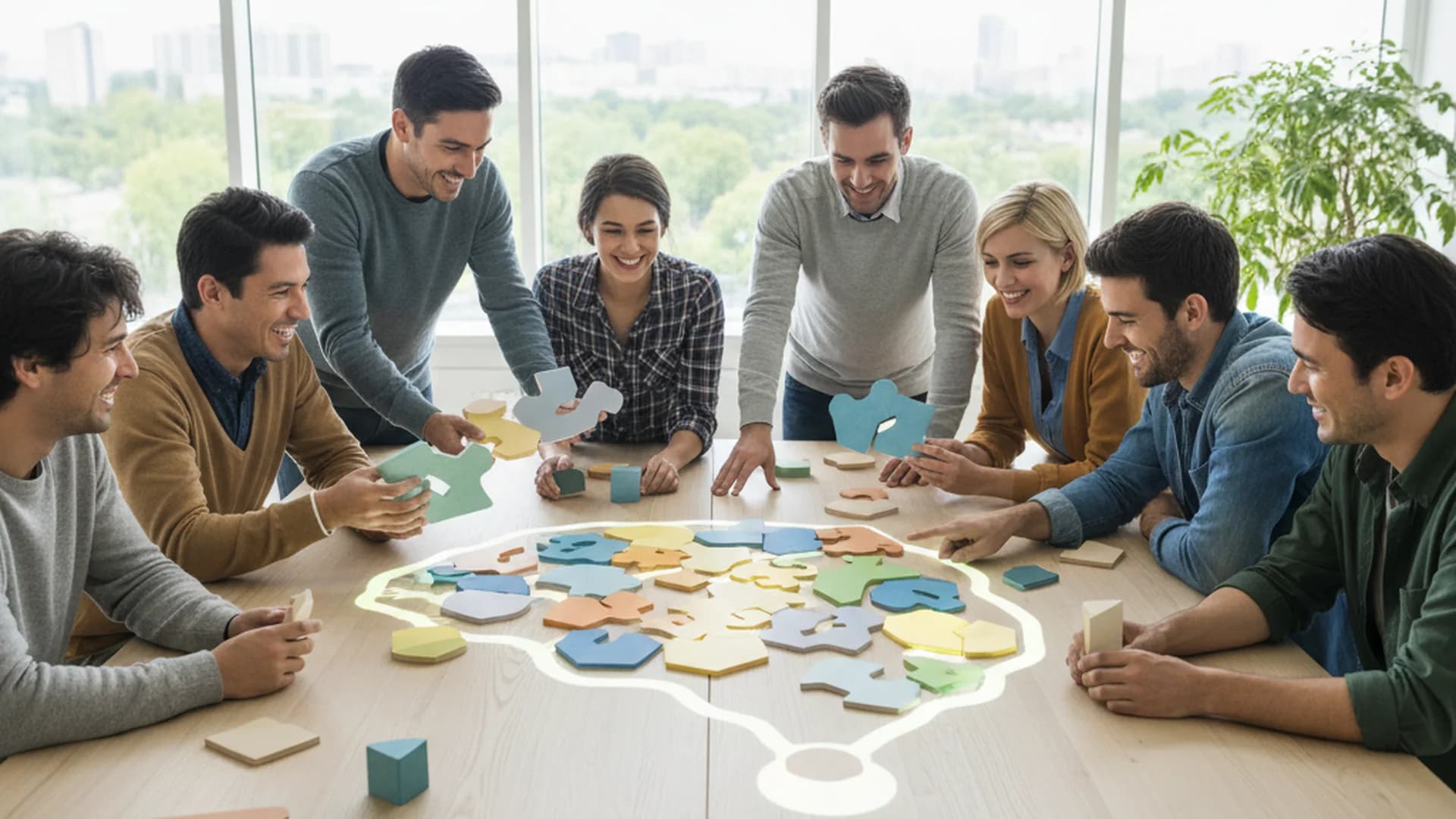
In the modern corporate world, the term "team building" often conjures images of awkward trust falls or expensive, day-long retreats that leave employees feeling more exhausted than engaged. However, as we look toward the workplace landscape of 2025 and 2026, a more intellectual and efficient trend has taken center stage: brain teasers team building. By integrating strategic office puzzles into the daily or weekly workflow, organizations are finding that they can sharpen cognitive skills and bridge communication gaps without ever leaving the conference room.
As a crossword constructor, I spend my life thinking about how different minds approach a single problem. What one person sees as an impossible riddle, another sees as a simple pattern. This diversity of thought is the "secret sauce" of high-performing teams. When you bring brain teasers into the office, you aren't just playing games; you are building a mental gym where your team learns to flex their collective analytical muscles.
The Science Behind Why Office Puzzles Work
It is easy to dismiss puzzles as a distraction, but the data suggests otherwise. According to research from IDC, organizations that foster highly collaborative environments see 30% higher productivity and a matching 30% higher revenue per employee. The reason is simple: collaborative problem-solving—the kind required to solve Hard Brain Teasers—is a direct rehearsal for project management.
The MIT "Social Factor"
One of the most compelling arguments for using office puzzles comes from MIT’s Human Dynamics Lab. Their research found that informal social interactions and communication patterns are the strongest predictors of team success. In fact, these patterns account for over 50% of the positive changes in performance—outperforming factors like individual intelligence or talent. Brain teasers provide a structured way to spark these essential interactions.
Cognitive Diversity in Action
When a team sits down to solve a logic puzzle, they are essentially practicing how to handle partial information. In a real-world scenario, a marketing department might have the "clues," but the engineering department holds the "solution." Puzzles simulate this "information gap," forcing team members to communicate their unique perspectives to reach a common goal.
Strategic Benefits of Team Puzzles
Beyond just "fun," using brain teasers in a professional setting offers several strategic advantages that directly impact the bottom line.
1. Increased Employee Retention
Companies that prioritize regular team-bonding activities report a 36% higher employee retention rate. In an era where 37% of employees cite "working with a great team" as their primary reason for staying with a company, creating moments of shared success through Easy Brain Teasers is a low-cost, high-impact investment.
2. Sharper Decision-Making
Teams that practice collaborative puzzles are 64% more focused on their tasks. This is because these activities act as "mental warm-ups," clearing away the cognitive fog of a long morning of emails and preparing the brain for deep work.
3. Psychological Safety
Solving a difficult riddle requires the willingness to be wrong. When a manager facilitates a puzzle session where "failing" to find the answer is part of the process, it builds psychological safety. Employees become more comfortable admitting when they don't have the answer in high-stakes work scenarios, which prevents costly mistakes down the line.
Advertisement
Implementing Brain Teasers: Three Real-World Examples
To get the most out of brain teasers team building, you need to match the activity to your specific team goals. Here are three ways to implement office puzzles based on common workplace needs.
Example 1: The "New Project" Kickoff
The Goal: Break down silos and encourage cross-departmental talk. The Puzzle: An "Information Gap" challenge. Give the Sales team one half of a complex riddle and the Engineering team the other half. They cannot show each other their papers; they can only talk. The Result: The teams learn that they cannot succeed in isolation. They must develop a shared language to combine their "clues" and find the answer.
Example 2: The Monday Morning Warm-up
The Goal: Increase focus and reduce "weekend brain." The Puzzle: A quick 5-minute Logic Puzzles session displayed on the main screen during a morning huddle. The Result: It wakes up the analytical centers of the brain. Instead of staring blankly at a slide deck, employees are actively participating and engaging with one another within the first ten minutes of the week.
Example 3: The Remote Team Sync
The Goal: Reduce "Zoom Fatigue" and build rapport across time zones. The Puzzle: An asynchronous "Office Whodunnit" played over Slack. A clue is posted every 4 hours, and the team must collaborate in a thread to solve the mystery by the end of the day. The Result: It maintains a "social thread" throughout the day that doesn't require a synchronized video call, making it perfect for global teams.
| Puzzle Type | Best For | Recommended Time |
|---|---|---|
| Logic Riddles | Critical Thinking | 10-15 min |
| Word Scrambles | Quick Energy Boost | 5 min |
| Collaborative Crosswords | Communication | 20 min |
| Spatial Puzzles | Creative Teams | 15 min |
Best Practices for Facilitating Office Puzzles
If you want your team-building efforts to be effective, you can't just throw a riddle at your staff and walk away. Successful integration requires a thoughtful approach.
Match the Puzzle to the Goal
Don't use a math-heavy puzzle if you are trying to encourage creative brainstorming. Use Brain Teasers Collection resources to select challenges that align with your objectives. For communication, use puzzles that require sharing clues. For focus, use visual-spatial challenges.
The "Debrief" is Mandatory
The real learning happens after the puzzle is solved (or not solved). As a facilitator, always ask:
- "Who took the lead in organizing our thoughts?"
- "At what point did we feel stuck, and how did we move past it?"
- "Did everyone feel they had a chance to contribute their ideas?"
Rotate Formats
To keep engagement high, switch between logic, visual, and word-based challenges. This ensures that different "types" of intelligence are celebrated. Someone who struggles with a math riddle might be the first to solve a visual pattern, reinforcing the idea that every team member brings a unique strength to the table.
Trends for 2025–2026: The Future of Team Puzzles
The way we work is changing, and team building is evolving with it. Here are the top trends for the next two years.
AI-Powered Customization
Teams are now using AI to generate "hyper-local" riddles. Imagine a logic puzzle that uses your company’s internal project names or a riddle where the answer is an "inside joke" from the last office holiday party. This increased personal investment makes the activities feel less like "work" and more like part of the culture.
VR and 3D Escape Rooms
Virtual Reality is moving into the mainstream office. VR puzzles allow remote teams to inhabit the same 3D space, which significantly reduces the "distance" felt in 2D video calls. Solving a puzzle together in a virtual room creates shared memories that a standard meeting simply cannot match.
Wellness-Integrated Puzzles
There is a growing shift toward "mindful" puzzles. These are low-stress, tactile activities, like collaborative coloring grids or group LEGO builds. They are designed to reduce cortisol levels while still encouraging bonding, making them perfect for high-stress environments like legal firms or medical offices.
Advertisement
Common Mistakes to Avoid
Even with the best intentions, brain teasers team building can backfire if not handled correctly.
- Lack of Consistency: A one-off annual retreat is significantly less effective than a 5-minute puzzle every Monday morning. Treat team building like a "soft skill workout"—it requires regular reps.
- Ignoring Group Dynamics: If one dominant person solves every puzzle, the team isn't building; they're spectating. Use puzzles that require multiple viewpoints or "clue-sharing" to ensure total participation.
- Too Much Pressure: If an employee feels their "intelligence" is being judged by how fast they solve a riddle, they will disengage. Keep the atmosphere light and focused on the process rather than the final answer.
- Neglecting Remote Workers: In a hybrid environment, ensure that the puzzles are accessible to everyone. If the in-office team is doing a physical puzzle, the remote team should have a digital version they can work on simultaneously.
Frequently Asked Questions
Do brain teasers actually help with real work tasks?
Yes. They act as "mental gyms," training the brain to recognize patterns, handle partial information, and adapt to colleagues' thinking styles. These are all transferable skills for project management, coding, and strategic planning.
How long should a team-building puzzle take?
For the best results, aim for 5–15 minutes. This is long enough to "warm up" the brain but short enough to avoid "meeting fatigue." For deeper sessions, you can occasionally extend this to 30 minutes during a dedicated lunch-and-learn.
Will introverts feel uncomfortable with these activities?
Actually, puzzles often favor quieter, analytical thinkers. Unlike high-energy "icebreakers," brain teasers give introverts a platform to lead through logic and problem-solving rather than charisma or social dominance.
What if my team is completely remote?
Digital puzzles are now standard. You can use collaborative crosswords, virtual escape rooms, or even asynchronous challenges in messaging apps. Research shows they are just as effective at building rapport as in-person activities if facilitated correctly.
Are these puzzles relevant for non-analytical roles like Sales?
Absolutely. Creative and social roles benefit just as much from Brain Teasers for Interviews and general logic challenges. They force "out-of-the-box" thinking and help different departments understand each other’s unique logic and approach to hurdles.
Conclusion
Incorporating brain teasers team building into your office culture is more than just a way to pass the time; it is a strategic tool for enhancing productivity, communication, and employee satisfaction. By turning the "work of collaborating" into the "play of solving," you create a more resilient and unified team.
As the workplace continues to evolve toward more hybrid and AI-integrated models, the human element of shared problem-solving remains the most valuable asset any company has. Start small—perhaps with a simple riddle next Monday—and watch as your team's collective focus and morale begin to transform.
Level Up Your Team?
Discover our full library of puzzles to challenge your office.
Put it into practice

Keep reading
Brain Teasers
Hard Brain Teasers: Expert-Level Challenges for 2025-2026
Explore the science and strategy behind hard brain teasers. Discover 2026 trends, expert tips, and challenges that only 13% of people solve.
Jun 26, 2026 12 min
Brain Teasers
Quick Brain Teasers: The 30-Second Science of Mental Agility
Boost your cognitive health with quick brain teasers. Discover the 3-2-1 productivity method, 2025 trends in AI puzzles, and how fast puzzles delay dementia.
May 31, 2026 10 min
Brain Teasers
The Ultimate Brain Teasers Collection: 100 Puzzles to Challenge Your Mind
Explore our massive brain teasers collection. Featuring 100 puzzles, logic grids, and riddles designed to boost cognitive health and improve lateral thinking.
Mar 12, 2026 15 min
Advertisement