The Ultimate Text Twist Strategy Guide: Master the Board for 2025
Unlock the secrets of high-scoring word games with our comprehensive Text Twist strategy guide. Learn the 4-3-5-6 method and advanced tips from a pro.
By Free To Play Puzzles Editorial Team 12 min read
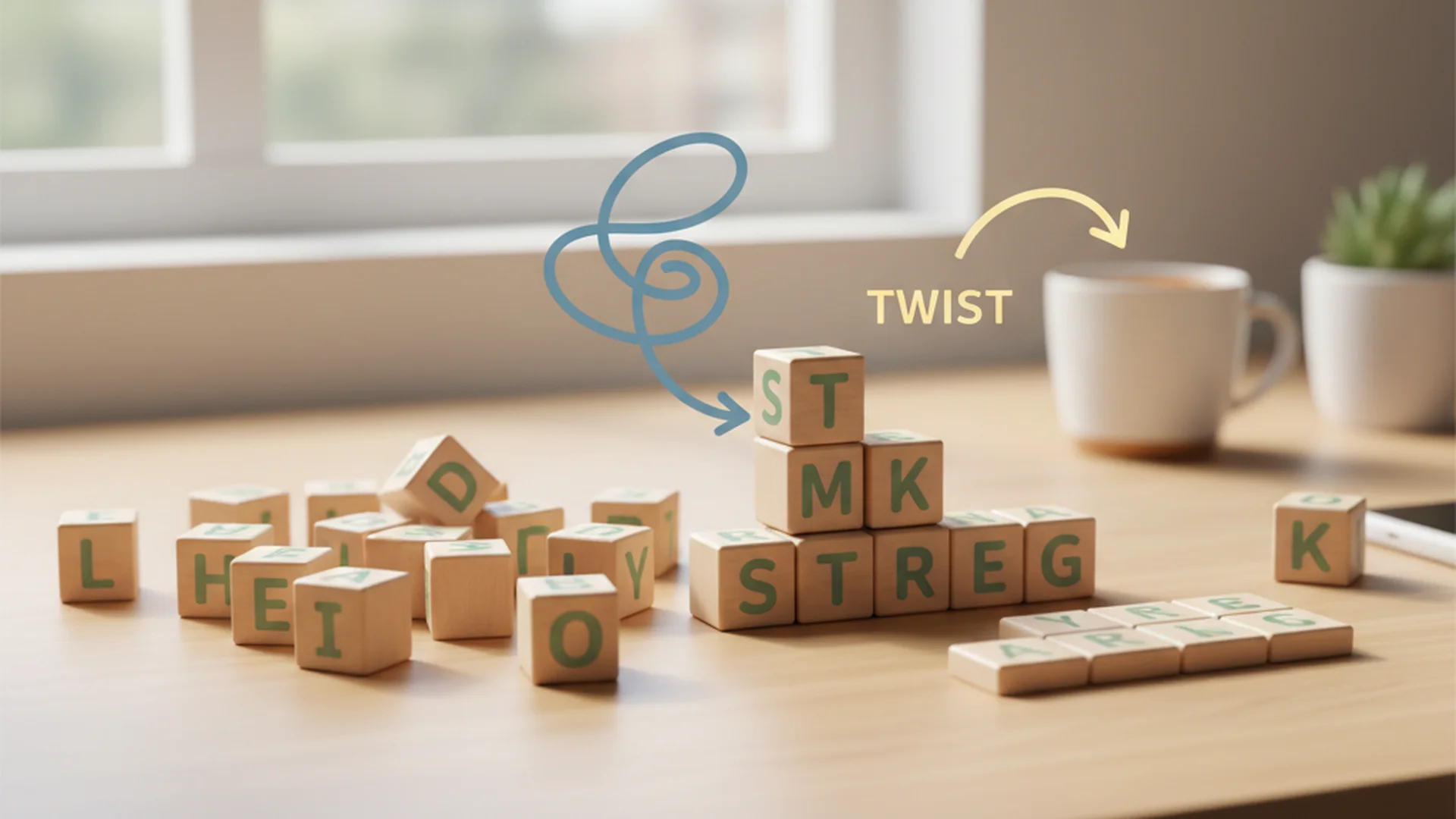
For over two decades, Text Twist has remained a titan of the casual gaming world, challenging players to find as many words as possible from a jumbled set of six or seven letters. Whether you are playing the classic GameHouse original, Text Twist 2, or the modern indie iterations surfacing in 2026, the core challenge remains: a ticking clock and a limited vocabulary. To truly excel, you need more than just a good vocabulary; you need a refined text twist strategy that prioritizes both speed and systematic clearance.
As a crossword constructor, I spend my days analyzing letter patterns. I’ve found that the same mental frameworks used to build high-level puzzles can be applied to dominate this game. In this guide, we will dive deep into the mechanics, scoring, and advanced text twist tips that separate casual players from the leaderboard elites.
The Core Mechanics: Scoring and Progression
Before we jump into the high-level tactics, it is crucial to understand how the game rewards you. In Text Twist, points are scaled based on word length. While finding 3-letter words keeps the momentum going, the real rewards lie in the longer strings.
| Word Length | Base Points |
|---|---|
| 3 Letters | 90 Points |
| 4 Letters | 160 Points |
| 5 Letters | 250 Points |
| 6 Letters | 360 Points |
| 7 Letters* | 490 Points |
*Note: 7-letter words are typically found in Super Text Twist or Text Twist 2.
The most important rule for any text twist strategy is the "Bingo" rule. To move to the next round, you must find at least one word that uses every single letter provided. If you find fifty 3-letter words but miss the 6-letter word, the game ends.
The 4-3-5-6 Method: A Professional Workflow
Linear thinking is the enemy of high scores. Most players look at the letters and wait for words to "pop out." Professionals use a systematic workflow called the 4-3-5-6 Method. This approach ensures you hit the ground running and maximize your time bonus.
Phase 1: The 4-Letter Warm-Up
Start with 4-letter words. They are statistically easier for the human brain to recognize than 5-letter words but offer nearly double the points of 3-letter words. Rapidly entering three or four 4-letter words "warms up" your pattern recognition and usually reveals the vowel-consonant structure of the set.
Phase 2: The 3-Letter Rapid Fire
Once you have a handful of 4-letter words, look for the 3-letter derivatives. For example, if you found "DEAR," you immediately have "ARE" and "RED." This is the fastest way to rack up points early in the round.
Phase 3: The 5-Letter Bridge
5-letter words often contain the "root" of the 6-letter word. If you see "TRAIN," it’s a very short mental jump to "STRAIN" or "TRAINS." These act as the bridge to the final phase.
Phase 4: The 6-Letter "Bingo"
By now, the board should be nearly half-full. Because Text Twist uses a "cleaned" dictionary, the remaining letters will often only fit into one or two possible 6-letter combinations. If you’ve followed the previous steps, the "Bingo" word usually reveals itself through the remaining patterns.
Advertisement
Advanced Text Twist Tips: Suffixes and Prefixes
The highest scores in Text Twist don't come from a massive vocabulary; they come from "stacking." Stacking is the process of finding one word and then immediately checking for all its grammatical variations.
If you find a base word like "PLAY," you should immediately check for:
- Plurals: PLAYS
- Past Tense: (If 'E' and 'D' are present) PLAYED
- Action/Gerund: (If 'I', 'N', and 'G' are present) PLAYING
- Agent Nouns: PLAYER
In many versions of the game, plurals are incredibly generous. If there is an 'S' in your letter tray, you should be able to double your word count almost instantly by pluralizing every valid noun you find.
Decoding the Alphabetical Hint
One of the most overlooked elements of text twist strategy is the layout of the empty word boxes. In almost every version of Text Twist, the boxes are organized alphabetically within their length groups. This is a massive hint that the game gives you for free.
Example Scenario: Imagine you have found two 4-letter words: "BOLD" and "BUNT." Between these two words on the screen, there is one empty 4-letter box.
Because the list is alphabetical, the missing word must start with 'B' and its second letter must be between 'O' and 'U'. This narrow window allows you to guess words like "BOND" or "BULL" much faster than if you were guessing blindly.
| Box Position | Known Word | Status | Possible Guess |
|---|---|---|---|
| Box 1 | BAKE | Found | - |
| Box 2 | [Empty] | Hidden | BALE / BANE |
| Box 3 | BEAD | Found | - |
If you are a fan of other word games, you might recognize similar logic in our 10 Crossword Solving Strategies the Pros Use.
2025–2026 Trends: The AI and Social Era
As we move into 2026, Text Twist is seeing a resurgence through "Daily Challenges." Similar to the Wordle phenomenon, players now compete on the same letter sets daily and share their "Full Clear" streaks on social media.
Furthermore, new AI-integrated versions of the game are beginning to emerge. These versions use "contextual dictionaries" that track the words you miss and re-introduce those letter patterns in future rounds to help improve your vocabulary. This makes the game an excellent tool for cognitive development. If you enjoy this type of mental exercise, you might also want to explore Games Like Wordle to keep your skills sharp.
Advertisement
Common Mistakes to Avoid
Even seasoned players fall into traps that kill their momentum. Here are the most common pitfalls:
- The "Bingo or Bust" Fallacy: Some players find the 6-letter word and immediately jump to the next round to save time. This is a mistake. The 1,000-point clear bonus is worth significantly more than the time bonus you gain by skipping. Only skip if you have less than 5 seconds left and haven't found the Bingo word yet.
- Over-Twisting: The "Twist" (shuffle) button is helpful, but clicking it every two seconds prevents your brain from forming a "mental map" of the letters. Experts recommend twisting only once every 15–20 seconds when you hit a genuine wall.
- Keyboard vs. Mouse: If you are playing on a PC, clicking letters with a mouse is roughly 50% slower than typing. Use the Spacebar to twist and the Enter key to submit. This is the single most effective way to improve your score instantly.
- The Scrabble Trap: Don't avoid simple words. Unlike Scrabble, where "QI" or "ZA" are king, Text Twist thrives on common English. If a word seems "too easy," type it anyway. There is no penalty for an incorrect guess!
If you find yourself stuck on a specific set of letters, practicing with a Free Word Scramble Online can help you recognize common anagrams more quickly.
Frequently Asked Questions
How do I move to the next round in Text Twist?
To advance to the next round, you must find at least one "Bingo" word—this is the word that uses all of the provided letters (usually 6 or 7 letters depending on the game mode). Smaller words provide points but do not unlock the next level.
What is the difference between Text Twist 1 and 2?
Text Twist 2 includes higher-resolution graphics and several new game modes: Lightning, where you must find the Bingo word before time runs out; Crossword, which uses the letters to fill a grid; and Word of the Day. It also features a significantly larger dictionary.
Is Text Twist educational?
Yes. Studies in cognitive psychology suggest that fast-paced word games improve "lexical access" (the speed at which you can retrieve words from memory) and pattern recognition. It is frequently recommended as a "brain training" exercise for maintaining mental acuity.
Is there a Text Twist 3?
While GameHouse hasn't released an official "Text Twist 3" as of early 2026, several high-quality indie versions, such as the one by Tuga Studios on Steam, have adopted the title. These versions often include thousands of levels and support for multiple languages.
How are the words chosen in the game?
Text Twist uses a "cleaned" dictionary. This means most proper nouns (like "London"), archaic terms, and obscure slang are removed to ensure the game remains accessible. However, it is very generous with plurals and common American and British English variations.
Conclusion: Putting Your Text Twist Strategy into Practice
Mastering Text Twist is a journey of pattern recognition and discipline. By implementing the 4-3-5-6 method, utilizing alphabetical hints, and avoiding the "Bingo or Bust" trap, you will see your scores soar into the top percentiles.
Remember, the goal isn't just to find words—it's to understand the relationships between letters. The more you play, the more "RAINED" will instantly look like "DRAIN," "DINER," and "DEAR." For those looking to branch out into other word challenges, check out our guide on Connections Game Strategy for a different kind of linguistic puzzle.
Ready to Start?
Apply your new strategies and see how high you can score today.
Put it into practice


Keep reading

Word Games
Master the Grid: The Ultimate NYT Connections Game Strategy for 2025
Level up your NYT Connections game with expert strategies from a neuroscientist. Learn to spot red herrings, master the purple tier, and boost your solve rate.
Oct 12, 2026 12 min

Word Games
Free Word Scramble Online: The Ultimate 2025 Guide to Master the Jumble
Discover the best sites for free word scramble online. Explore 2025 trends, expert solving strategies, and the cognitive benefits of daily word puzzles.
Jan 23, 2026 12 min
Word Games
Mastering NYT Strands: The Ultimate Strategy Guide (2025 Edition)
Learn the most effective strands game strategy and expert nyt strands tips to master the 6x8 grid. Improve your solve rate with logic-based techniques.
Mar 17, 2025 12 min
Advertisement