Tetris Techniques: T-Spins Explained
Master T-Spins in Tetris with this complete guide. Learn setups, recognition, scoring systems, and advanced techniques to dominate competitive play.
By Free To Play Puzzles Editorial Team 14 min read
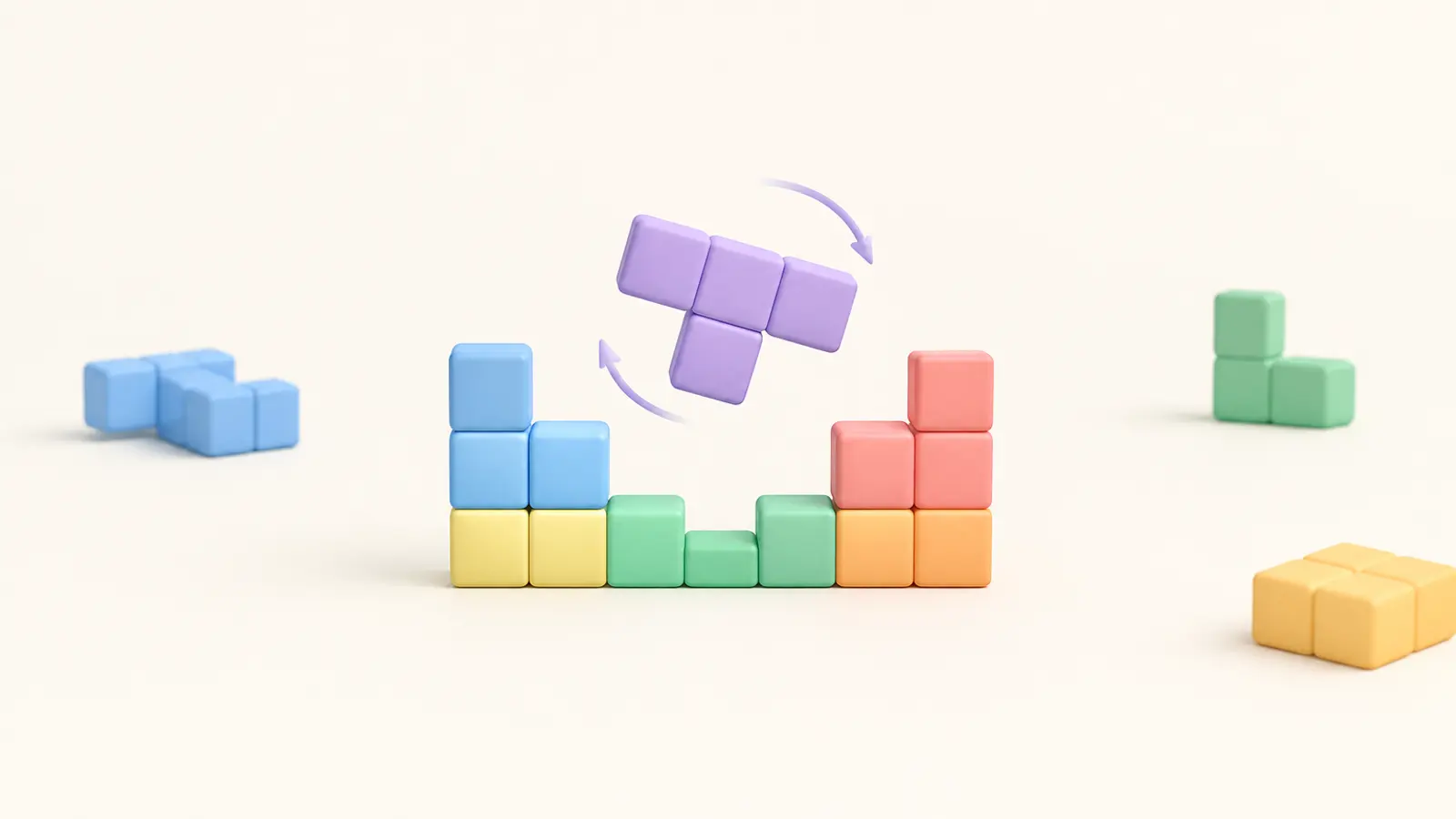
Tetris Techniques: T-Spins Explained
If you've watched competitive Tetris players or studied high-level gameplay, you've likely seen impressive maneuvers involving the T-piece that seem to defy the basic rules of stacking. These aren't glitches or tricks—they're T-Spins, one of the most powerful and rewarding techniques in modern Tetris.
T-Spins transform the humble T-piece from a simple building block into a scoring powerhouse. They're the signature move of advanced players, combining spatial reasoning, setup knowledge, and precise execution. While they might seem complex at first, understanding T-Spins will fundamentally change how you approach Tetris and unlock scoring potential you never knew existed.
This comprehensive guide breaks down everything you need to know about T-Spins: what they are, why they matter, how to recognize opportunities, common setups, and the path from beginner attempts to competitive mastery.
What Exactly Is a T-Spin?
At its core, a T-Spin is a special move where you rotate a T-piece into a tight space rather than simply dropping it into place. The rotation happens as the final movement, "spinning" the T-piece into a cavity where it couldn't fit before rotation.
The Basic Mechanics
In most modern Tetris games (using the Super Rotation System or SRS), pieces can rotate even when partially blocked, with the game using "wall kicks" to nudge pieces into valid positions. The T-piece has special wall kick properties that allow it to rotate into seemingly impossible spaces.
A T-Spin requires three essential elements:
- A T-shaped cavity in your stack with specific geometric properties
- Rotation as the last movement before the piece locks in place
- Proper corner detection where at least three of the four corner spaces around the T-piece are filled
The third element is crucial: the game checks the four diagonal corners around the T-piece's center. If three or four corners are occupied by blocks or walls, the rotation counts as a T-Spin.
T-Spin vs. Regular Placement
Let's clarify the difference:
Regular T-piece placement: You rotate the T-piece to the desired orientation while it's falling or moving horizontally, then drop it into a gap. No bonus points.
T-Spin placement: You position the T-piece next to or above a cavity, then rotate it at the last moment to slide it into the gap. The rotation itself places the piece into the cavity. Bonus points awarded.
The rotation must be the final action. If you rotate the T-piece into position and then move it horizontally afterward, it usually doesn't count as a T-Spin in most scoring systems.
Why the T-Piece Is Special
While other pieces can perform rotations in tight spaces, only the T-piece has scoring recognition for this maneuver in standard Tetris games. The T-piece's shape creates unique geometric possibilities—it can fit into overhangs, slide under ledges, and fill irregular gaps that other pieces can't reach.
The Scoring Advantage: Why T-Spins Matter
Understanding the scoring mechanics reveals why competitive players prioritize T-Spins so heavily.
Standard Line Clear Scoring
In most modern Tetris games, basic line clears award points like this (values vary by game but proportions are consistent):
- Single (1 line): 100 points × level
- Double (2 lines): 300 points × level
- Triple (3 lines): 500 points × level
- Tetris (4 lines): 800 points × level
T-Spin Scoring Bonuses
T-Spins dramatically increase these values:
- T-Spin Mini (special case, no lines): 100 points × level
- T-Spin Mini Single (1 line): 200 points × level
- T-Spin Single (1 line): 800 points × level
- T-Spin Double (2 lines): 1,200 points × level
- T-Spin Triple (3 lines): 1,600 points × level
Notice that a T-Spin Single (800 points) scores as much as a regular Tetris, but only requires clearing one line instead of four. A T-Spin Double at 1,200 points significantly exceeds even a Tetris.
Combo and Back-to-Back Bonuses
T-Spins become even more powerful when combined with other multipliers:
Back-to-Back (B2B): When you perform "difficult" clears consecutively (Tetrises or T-Spins), each subsequent difficult clear gets a 50% bonus. This means a B2B T-Spin Double can award 1,800 points × level.
Combos: Clearing lines on consecutive piece placements (no piece placed without clearing a line) creates combo bonuses. T-Spins can initiate and maintain combos while scoring high base points.
Competitive Implications
In competitive Tetris modes (especially multiplayer battle modes), T-Spins often send more "garbage" lines to opponents than regular line clears. A T-Spin Double typically sends four lines of garbage—equivalent to a Tetris—but can be executed much more quickly and with greater flexibility.
This is why watching competitive Tetris reveals players constantly building T-Spin setups rather than waiting for I-pieces. Speed and aggression favor T-Spin-focused gameplay.
Advertisement
Recognizing T-Spin Opportunities
Before you can execute T-Spins, you need to recognize when and where they're possible. Developing this "T-Spin vision" is the first major hurdle.
The Three-Corner Rule
The simplest recognition method is checking corners. Look at your stack and identify places where:
- There's a T-shaped cavity (three blocks in a row with one block above or below the middle)
- Three of the four diagonal corners around the T-piece center point would be occupied
- You can maneuver the T-piece into position to rotate into the cavity
Common Cavity Shapes
T-Spin cavities come in several standard shapes:
Overhang setup: The most common beginner setup features an overhang (blocks sticking out) with a T-shaped cavity underneath. The T-piece slides under the overhang, then rotates upward to fill the space.
Fin setup: A vertical "fin" of blocks sticks up from your stack with space on both sides. The T-piece rotates into the space beside the fin.
Notch setup: A notch or indentation in your stack creates a cavity. The T-piece rotates from a horizontal orientation into the vertical space.
The Point System vs. Mini T-Spins
Not all T-Spins are created equal. Games distinguish between "proper" T-Spins and "mini" T-Spins based on which corners are filled:
Proper T-Spin: The two corners on the T-piece's "pointy" side (the three-pronged end) must both be filled, plus at least one other corner.
Mini T-Spin: Valid rotation geometry exists, but the pointy side corners aren't properly set up. These award fewer points.
When building setups, always aim for proper T-Spins by ensuring the cavity corners align with the T-piece's pointy end.
Visual Pattern Training
Experienced players don't consciously count corners—they recognize patterns instantly. Train yourself by:
- Pausing to identify: When playing, occasionally pause and scan your entire stack for potential T-Spin cavities
- Studying replays: Watch competitive players and pause when they execute T-Spins to study the cavity shape
- Setup drills: Practice building specific setups repeatedly until the pattern becomes automatic
Over time, you'll develop intuitive recognition—potential T-Spins will "pop out" from the stack automatically.
Basic T-Spin Setups for Beginners
Let's explore the fundamental setups you should master first. These are the building blocks of T-Spin play.
The Imperial Cross (T-Spin Double)
This is arguably the most famous T-Spin setup—a foundational pattern every player should know.
How to build it:
- Create a flat surface with a single column well on one side (like you're building for a Tetris)
- Place blocks on either side of the well at the second row up, leaving the well column open
- Build the third and fourth rows completely across, covering the well
- This creates an overhang over the well with a T-shaped cavity
Execution:
- Position the T-piece horizontally above the well
- Drop it down until it's one row above the cavity opening
- Rotate the T-piece to spin it upward into the cavity
- The rotation clears two lines (the two middle rows) while filling the T-shaped space
The Imperial Cross is reliable, easy to recognize, and scores excellent points. Master this setup first.
The TKI T-Spin Setup
A variation that's slightly more advanced but very common in competitive play.
How to build it:
- Build your stack mostly flat with a small 2-block high bump somewhere
- Next to this bump, create a one-column well
- Place a block on top of one side of the well opening, creating an L-shaped cavity
Execution:
- Slide the T-piece next to the cavity horizontally
- Rotate it to spin into the L-shaped space
- Clears one line (T-Spin Single)
This setup is more flexible than the Imperial Cross and can be created with more piece combinations.
The Fin Setup (T-Spin Single)
This creates quick T-Spin Singles during downstacking.
How to build it:
- Create a small vertical "fin" (2-3 blocks tall) with space on one side
- Build blocks on the opposite side at mid-height, creating a cavity next to the fin
Execution:
- Position the T-piece horizontally next to the cavity
- Rotate it to point into the gap next to the fin
- Clears one line while filling the space
Fin setups are excellent for recovering from messy stacks because they're forgiving and don't require perfect geometry.
The Mechanical T-Spin Double
A setup specifically designed for consistency and speed.
How to build it:
- Build three columns on the right side, leaving a gap on the left
- Place a single block on the left at the third row
- Build the fourth row completely across both sides
- Continue building rows above, creating a cavity
Execution:
- The T-piece slides into the cavity horizontally
- Rotate once to fill the T-shape and clear two lines
This setup is called "mechanical" because it works the same way every time with minimal variation.
Advanced T-Spin Techniques
Once you've mastered basic setups, these advanced techniques will elevate your play to competitive levels.
T-Spin Triples
Yes, you can clear three lines with a T-Spin, though it's much harder to set up and execute.
Requirements:
- A very specific cavity shape with at least three complete rows ready to clear
- Precise corner positioning
- Often requires "donation" pieces (pieces placed specifically to create the geometry)
T-Spin Triples score 1,600 points—double a regular Tetris. However, they're so situational that most competitive players don't specifically build for them. They're opportunistic moves rather than planned setups.
Fractal T-Spins
This advanced concept involves creating a T-Spin setup that, after execution, leaves behind geometry for another T-Spin. You chain T-Spins together, with each one setting up the next.
The concept:
- Build your first T-Spin setup with extra geometry
- Execute the T-Spin, clearing lines
- The remaining blocks form a cavity for another T-Spin
- Execute the second T-Spin
- Repeat if the chain continues
Fractal patterns are extremely difficult to build reliably but create devastating combos in multiplayer battles.
T-Spin Openers
Competitive players memorize specific piece sequences for the first 10-20 pieces of a game that guarantee T-Spin setups. Popular openers include:
DT Cannon: Creates a perfect T-Spin Double followed by additional T-Spin opportunities. Named after its creator.
MKO (Magic Key Opening): A flexible opener that adapts to piece randomness while maintaining T-Spin potential.
PCO (Perfect Clear Opening): Aims for a perfect clear (completely empty board) after 10-12 pieces, often incorporating T-Spins along the way.
Learning openers requires memorization and practice but gives you a powerful, consistent start to every game.
Donation Pieces
Sometimes the pieces you receive don't naturally create T-Spin geometry. Advanced players use "donation" pieces—pieces placed specifically to create or complete T-Spin setups, even if the placement seems suboptimal for stacking.
For example, you might place an S-piece in an awkward position because it creates the exact overhang needed for your T-Spin setup. The immediate stacking quality decreases, but the T-Spin payoff exceeds the cost.
Learning when to donate pieces vs. stacking cleanly is a key skill that separates good players from great ones.
Reading Bag Sequences
Modern Tetris uses a "bag" system where all seven pieces appear once before the bag refills and shuffles. This means you're guaranteed to see each piece within every seven pieces.
Advanced T-Spin play involves tracking the bag to know when the T-piece is coming:
- Count pieces as they appear
- When you've seen six pieces without a T-piece, you know it's next
- Begin building your T-Spin setup before the T-piece arrives
- Execute immediately when the T-piece spawns
This planning-ahead approach makes T-Spin setups much faster and more consistent.
Advertisement
T-Spin Practice Drills
Deliberate practice accelerates your T-Spin learning curve. Try these focused drills.
Drill 1: Setup Recognition
Goal: Train your eyes to spot T-Spin opportunities
Method:
- Play normally until your stack reaches mid-height
- Pause the game
- Identify every potential T-Spin cavity in your stack
- Mentally plan how you'd execute each one
- Resume and continue
Repeat this frequently. Over time, pause less often as recognition becomes automatic.
Drill 2: Imperial Cross Repetition
Goal: Make the most common T-Spin setup automatic
Method:
- Start a game and build only Imperial Cross setups
- Execute the T-Spin Double
- Immediately rebuild the same setup
- Repeat 20 times per session
This drill builds muscle memory for both setup construction and execution.
Drill 3: T-Spin Only Challenge
Goal: Force yourself to build and recognize setups under pressure
Method:
- Play a game where you can only clear lines via T-Spins (any type)
- Regular line clears are "failures" (don't count them but don't restart)
- See how long you can survive while maintaining T-Spin discipline
This drill is difficult but rapidly improves setup recognition and construction.
Drill 4: Opener Memorization
Goal: Learn one opener perfectly
Method:
- Choose one opener (DT Cannon is recommended for beginners)
- Study the exact piece sequence and placement
- Practice it 10 times in a row without mistakes
- Add variations (what if piece X comes instead of piece Y?)
- Practice until you can execute it without thinking
Having one solid opener in your arsenal transforms your early game.
Drill 5: T-Spin Conversion
Goal: Learn to recover by converting messy stacks into T-Spin setups
Method:
- Deliberately create a messy, uneven stack
- Challenge yourself to build a T-Spin setup from the chaos
- Execute the T-Spin
- Repeat with different messy configurations
This drill teaches the practical skill of finding T-Spin opportunities in imperfect situations.
Drill 6: Speed Execution
Goal: Reduce execution time for T-Spins
Method:
- Set up a standard T-Spin (like Imperial Cross)
- When the T-piece spawns, execute as fast as possible
- Use a stopwatch or count frames
- Practice until you can execute in under 2 seconds consistently
Fast execution is crucial for competitive play where speed determines victory.
Common T-Spin Mistakes and How to Fix Them
Even experienced players make these errors. Awareness is the first step to correction.
Mistake 1: Mini T-Spins Instead of Proper T-Spins
Problem: You're building setups that create mini T-Spins (lower points) instead of proper T-Spins.
Cause: Incorrect corner geometry—the T-piece's pointy side corners aren't filled.
Fix:
- Always verify corner positioning before executing
- Ensure the overhang or cavity aligns with where the T-piece's "pointy" end will be
- Study the difference between mini and proper setups until you can spot it instantly
Mistake 2: Forced Setups in Wrong Situations
Problem: You create T-Spin setups when simple stacking would be better.
Cause: Overemphasis on T-Spins at the expense of clean stacking and survival.
Fix:
- T-Spins are powerful but not mandatory for every piece
- If the stack is getting high or messy, prioritize cleaning up first
- Build T-Spins when you have time and space, not desperately
Mistake 3: Execution Errors
Problem: You have the setup but fail the execution—rotating wrong, timing off, or misplacing the T-piece.
Cause: Insufficient practice with execution mechanics.
Fix:
- Slow down execution initially to build accuracy
- Practice the same setup repeatedly until execution is automatic
- Learn finesse (optimal button presses) for each rotation type
- Use hold strategically—hold the T-piece if the setup isn't quite ready
Mistake 4: Ignoring the Queue
Problem: You build T-Spin setups without knowing when the T-piece is coming.
Cause: Not tracking the piece bag or using the preview queue.
Fix:
- Glance at the next piece preview constantly
- Count pieces to know when T is approaching
- Don't complete a T-Spin setup until you see the T-piece in the queue
- Learn to build partial setups that you finish when T approaches
Mistake 5: Creating Overly Complex Setups
Problem: You attempt advanced fractal or triple T-Spins before mastering basics.
Cause: Overambition without foundational skills.
Fix:
- Master simple T-Spin Singles and Doubles first
- Complexity comes from chaining simple setups, not building elaborate structures
- Advanced setups emerge naturally from experience, not forced construction
- Focus on consistency over flashy moves
Mistake 6: Neglecting Dependency Management
Problem: Your T-Spin setup requires specific pieces in specific orders, and when they don't come, your stack becomes unusable.
Cause: Building rigid setups without fallback options.
Fix:
- Learn flexible setups that work with multiple piece sequences
- Always have a "Plan B" if pieces don't cooperate
- Use hold to sequence pieces optimally
- Accept that sometimes you need to abandon a setup and stack normally
T-Spins in Different Tetris Variants
T-Spin mechanics vary slightly across different Tetris games and modes. Understanding these differences matters if you play multiple versions.
Guideline Tetris (Modern Standard)
Most modern Tetris games (Tetris Effect, Tetris 99, Jstris, etc.) use the official guideline rules:
- Super Rotation System (SRS) with standardized wall kicks
- 3-corner or 4-corner detection for T-Spin validation
- Distinction between proper T-Spins and mini T-Spins
- Standardized scoring bonuses
If you learn T-Spins on guideline Tetris, skills transfer to most modern versions.
Classic Tetris (NES, GB)
Original Tetris games don't have T-Spins at all:
- Different rotation systems without wall kicks
- No bonus scoring for rotational placements
- T-Spins as we know them don't exist in these versions
If you're playing classic Tetris competitively, focus on Tetris setups and downstacking instead.
Tetris Friends (Historical)
The now-defunct Tetris Friends had slightly different T-Spin detection:
- More lenient validation that sometimes awarded T-Spins for mini-quality setups
- Some community controversy over consistency
- Many players learned T-Spins here, so older guides may reference Tetris Friends mechanics
Mobile Tetris Variants
Mobile games vary widely:
- Some use guideline rules exactly
- Others simplify or modify T-Spin mechanics
- Some don't include T-Spins at all
- Check your specific game's rules and scoring
Battle Royale Modes (Tetris 99, Tetr.io)
These competitive multiplayer modes emphasize T-Spins heavily:
- T-Spins send large amounts of garbage to opponents
- Speed of execution matters as much as setup quality
- Meta strategies revolve around T-Spin spam vs. Tetris building
- Back-to-back bonuses create momentum swings
From Learning to Mastery: Your T-Spin Journey
Understanding T-Spins intellectually is just the beginning. Mastery requires a progression of skills and practice.
Stage 1: Recognition (Weeks 1-2)
Focus: Train your eyes to spot T-Spin opportunities
Practice:
- Play normally but pause to identify potential cavities
- Study examples and replays
- Learn one basic setup (Imperial Cross recommended)
Success indicator: You can spot T-Spin opportunities in your stack consistently
Stage 2: Construction (Weeks 3-4)
Focus: Build setups intentionally
Practice:
- Deliberately create T-Spin setups during games
- Practice one setup type repeatedly
- Use slower speeds to focus on accuracy
Success indicator: You can build an Imperial Cross or similar setup reliably
Stage 3: Execution (Weeks 5-6)
Focus: Successfully execute the rotation and line clear
Practice:
- Focus on the final movement sequence
- Practice rotation timing
- Reduce execution errors
Success indicator: 80%+ success rate on setup execution
Stage 4: Integration (Weeks 7-10)
Focus: Incorporate T-Spins into normal gameplay
Practice:
- Mix T-Spins with regular stacking naturally
- Learn when to build setups vs. stack cleanly
- Practice multiple setup types
Success indicator: Regular T-Spins during normal play without sacrificing survival
Stage 5: Optimization (Weeks 11+)
Focus: Speed, efficiency, and advanced techniques
Practice:
- Memorize openers
- Practice fractal setups
- Optimize execution speed
- Study competitive play
Success indicator: Consistent T-Spin execution at competitive speeds
Long-term Mastery
True T-Spin mastery never ends. Competitive players continually refine:
- Setup efficiency (building with fewer pieces)
- Execution speed (frame-perfect inputs)
- Pattern variety (more setup types)
- Adaptability (converting any situation into T-Spin opportunities)
- Strategic decision-making (when to push with T-Spins vs. defend with clean stacking)
Resources for Continued Learning
To accelerate your T-Spin journey, leverage these resources:
Video Content
- YouTube tutorial series: Search for "T-Spin tutorial" for visual demonstrations
- Professional player streams: Watch competitors explain their thought process
- Replay analysis: Study slow-motion breakdowns of complex setups
Practice Platforms
- Jstris: Free browser Tetris with excellent training modes
- Tetr.io: Modern competitive Tetris with replay analysis
- Tetris Effect: Beautiful single-player experience with guideline rules
- Puyo Puyo Tetris: Fun alternative with standard T-Spin mechanics
Community Resources
- Hard Drop Wiki: Comprehensive Tetris strategy database
- Reddit r/Tetris: Active community with advice and discussions
- Discord servers: Real-time help and practice partners
- Four.lol: Tetris resources and guides
Analysis Tools
- Replay analyzers: Tools that show your mistakes and optimization opportunities
- Setup databases: Collections of named setups with diagrams
- Finesse trainers: Programs that teach optimal movement patterns
Conclusion: The T-Spin Advantage
T-Spins represent the evolution of Tetris from a simple stacking game to a deep, technical competitive sport. They reward spatial reasoning, pattern recognition, precise execution, and strategic planning—all the skills that make Tetris endlessly engaging.
While T-Spins might seem daunting at first, remember that every expert started exactly where you are now. The journey from your first awkward setup to consistent competitive execution is challenging but incredibly rewarding. Each successful T-Spin feels like solving a puzzle within the larger game of Tetris.
Start with one basic setup. Practice it until it becomes automatic. Then add another. Over weeks and months, T-Spins will transform from conscious effort into intuitive play. You'll start seeing opportunities everywhere, your scoring will increase dramatically, and your competitive potential will skyrocket.
The beautiful thing about T-Spins is that they're always accessible but never fully mastered. There's always a faster execution, a more efficient setup, a more creative solution to explore. This endless depth is what keeps competitive Tetris players engaged for years or even decades.
Whether you're aiming for casual improvement or competitive dominance, T-Spins are worth the investment. They'll change how you see the game, how you approach stacking, and ultimately, how much you enjoy one of the greatest puzzle games ever created.
Start practicing T-Spins now with our free Tetris game and experience firsthand why this technique has revolutionized modern Tetris play. No downloads, no registration—just you, the blocks, and the satisfying moment when that T-piece rotates perfectly into place.
Frequently Asked Questions About T-Spins
Do all Tetris games have T-Spins?
No. T-Spins only exist in Tetris games using the Super Rotation System (SRS) or similar modern rotation systems. Classic Tetris games like NES Tetris don't have T-Spins. Most Tetris games released after 2001 include T-Spin mechanics, but always check your specific game's rules.
Can other pieces perform spins like the T-piece?
Other pieces can rotate in tight spaces using wall kicks, but only the T-piece receives bonus scoring for these rotations in standard Tetris. Some variants include S-Spins, Z-Spins, or other specialty moves, but these aren't part of guideline Tetris.
What's the difference between a T-Spin and a T-Spin Mini?
The difference is corner detection geometry. A proper T-Spin has both corners on the T-piece's "pointy" end (the side with three prongs) filled with blocks, plus at least one other corner. A mini T-Spin meets the basic rotation requirements but doesn't have the proper corner alignment. Proper T-Spins score significantly more points.
Are T-Spins better than Tetrises for scoring?
It depends on the situation. A T-Spin Double (1,200 points) scores more than a Tetris (800 points), but requires only two lines. However, Tetrises are often faster to set up. In competitive play, T-Spins are generally favored because they're more flexible and can be executed more quickly, allowing for aggressive garbage sending in battle modes.
How long does it take to learn T-Spins?
Most players can execute basic T-Spin setups within 2-4 weeks of focused practice. Integrating them into normal gameplay takes 2-3 months. Reaching competitive proficiency with advanced setups and openers typically takes 6-12 months of regular practice. True mastery is a continuous journey that even professional players work on constantly.
Should I learn T-Spins before mastering basic Tetris?
No. You should have solid fundamentals first: clean stacking, managing the well, avoiding gaps, and basic speed. T-Spins are an advanced technique that builds on top of these basics. If you can't consistently survive to high levels with basic play, focus on fundamentals before adding T-Spins to your toolkit.
Why didn't my T-Spin register in the game?
Common causes include: the last movement wasn't a rotation (you rotated then moved horizontally), insufficient corners were filled, or your specific Tetris variant doesn't recognize that particular setup as a valid T-Spin. Try slowing down execution and ensuring the rotation happens as the very last action before the piece locks.
Ready to master the most powerful technique in modern Tetris? Practice your T-Spins with our free online Tetris game—no account needed, just pure skill-building action!
Put it into practice
Keep reading
Arcade
History of Tetris: From Russia to Worldwide Phenomenon
Discover how Tetris went from a Soviet computer experiment to the world's most iconic puzzle game. Explore legal battles, Game Boy success, and more.
Jan 19, 2025 14 min
Arcade Games
Tetris Line Clears Explained: Mastering Singles, Doubles, Triples, and Tetrises
Master the art of the Tetris line clear. Learn scoring multipliers, T-spins, and pro-level strategies from the 2025 competitive scene to maximize your high score.
Jul 24, 2025 12 min
Arcade Games
Tetris Techniques: T-Spins Explained
Master the tetris t-spin with our comprehensive guide. Learn the 3-corner rule, SRS mechanics, and advanced strategies to dominate modern competitive Tetris in 2025.
Jun 17, 2025 12 min
Advertisement