History of Space Invaders: How One Game Changed Everything
Discover how Tomohiro Nishikado's 1978 Space Invaders revolutionized gaming, sparked the arcade boom, and became a cultural phenomenon that defined a generation.
By Free To Play Puzzles Editorial Team 14 min read
History of Space Invaders: How One Game Changed Everything
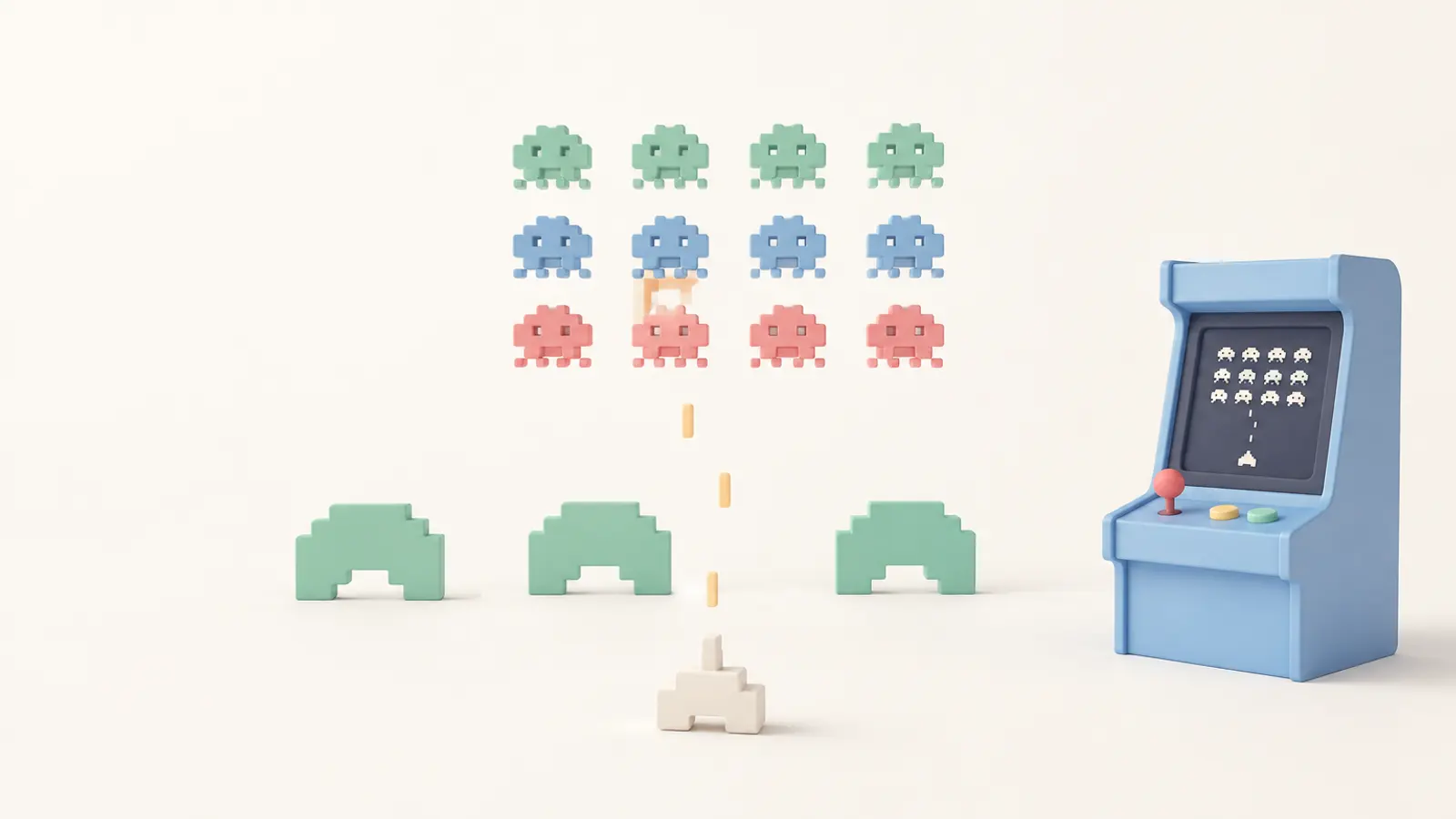
When Tomohiro Nishikado sat down to design a shooting game in 1977, he couldn't have imagined that his creation would spark a global phenomenon, inspire countless imitators, and fundamentally change the trajectory of an entire industry. Space Invaders didn't just create the shoot-'em-up genre—it transformed video games from a novelty into a cultural force that would rival movies and music in entertainment dominance.
This is the story of how pixelated aliens marching across a black screen became one of the most recognizable images in gaming history, how a single game allegedly caused a coin shortage in Japan, and how Space Invaders laid the foundation for the multi-billion dollar gaming industry we know today.
The Visionary Behind the Invasion: Tomohiro Nishikado
Before Space Invaders revolutionized arcades worldwide, Tomohiro Nishikado was a relatively unknown engineer working at Taito Corporation, a Japanese company primarily known for manufacturing jukeboxes and vending machines before entering the nascent video game market in the early 1970s.
Early Career and Influences
Born in 1944, Nishikado joined Taito in 1968 as an engineer. His early work involved designing electro-mechanical arcade games—the primitive predecessors to video games that used physical components, lights, and simple mechanics rather than computer graphics. By the mid-1970s, as video game technology began emerging, Nishikado transitioned to digital game development.
His initial video game projects for Taito included Western Gun (released as Gun Fight in North America), one of the first arcade games to depict human combat. But Nishikado wasn't satisfied with simply creating shooting games featuring people. He wanted something different, something that hadn't been done before.
The Development Challenge
In 1977, Nishikado began work on what would become Space Invaders. The concept was straightforward: players would defend Earth from descending alien invaders. But the execution was anything but simple given the technological limitations of the era.
Nishikado worked alone on the game's design and programming, a remarkable feat considering the game's complexity and innovation. He wrote the code in assembly language—a low-level programming language that required direct manipulation of the computer's processor instructions. There were no game engines, no development frameworks, and no online communities to consult. Everything had to be built from scratch.
The hardware of the time couldn't handle his vision. The Intel 8080 processor Nishikado wanted to use was too slow to render the game's graphics smoothly. Rather than compromise his vision, he designed custom hardware to supplement the processor, creating additional circuitry to handle the graphical demands. This hands-on approach to both software and hardware development was typical of early game designers but rare to see executed at such a sophisticated level.
Designing the Aliens
One of the game's most iconic elements—the alien invader designs—came from pragmatic constraints rather than elaborate artistic vision. Nishikado initially wanted to feature human soldiers as enemies but felt uncomfortable with the idea of shooting people. He considered using tanks or aircraft but found them uninspiring.
His breakthrough came from contemporary popular culture. The mid-1970s saw an explosion of science fiction, with Star Wars debuting in 1977 and Close Encounters of the Third Kind capturing imaginations worldwide. Nishikado drew inspiration from this sci-fi zeitgeist, particularly the octopus-like aliens from H.G. Wells' "The War of the Worlds."
The final alien designs—three distinct types of pixelated creatures arranged in rows—were partially determined by the graphics limitations of the hardware. Each alien had to be created using a small grid of pixels, resulting in the simple but distinctive shapes that became gaming icons. The three types (squid, crab, and octopus in fan terminology) offered varying point values, adding a strategic element to what targets players would prioritize.
The 1978 Launch: A Slow Burn to Phenomenon
Space Invaders officially launched in Japanese arcades in June 1978. Unlike modern games with massive marketing campaigns and midnight launch events, Space Invaders entered the world with relatively little fanfare. Taito was a modest company, and arcade games were still a niche entertainment form. But something special was about to happen.
Initial Reception
The first Space Invaders cabinets appeared in Japanese arcades and game centers in the summer of 1978. Initial player reactions ranged from curiosity to obsession. The game's simple controls—move left, move right, fire—made it immediately accessible to anyone, regardless of gaming experience. Yet beneath this simplicity lay surprising depth and challenge.
Unlike many arcade games of the era that offered essentially the same experience every time, Space Invaders was dynamic. The invaders marched downward in formation, but as players shot them, the remaining aliens moved faster—a feature that wasn't initially intentional. This happened because the processor had fewer sprites to animate as aliens were destroyed, allowing the remaining ones to update more quickly. Nishikado recognized this bug as a feature that added tension and kept the game challenging.
The game's difficulty curve was perfectly calibrated. New players could survive the first wave and feel accomplished, while skilled players could progress through multiple increasingly difficult waves, each bringing the aliens closer to Earth and making them faster. This balance between accessibility and challenge became a template for arcade game design for decades to come.
The Coin Shortage Legend
Perhaps no story about Space Invaders is more famous—or more debated—than the alleged coin shortage it caused in Japan. According to popular legend, Space Invaders became so wildly popular that it created a shortage of 100-yen coins, forcing the Japanese government to increase coin production.
The truth of this story is complicated. While Space Invaders did become enormously popular in Japan—with over 100,000 cabinets eventually deployed across the country—the coin shortage story appears to be exaggerated or apocryphal. Economic records from Japan's mint don't show unusual coin production spikes that correlate with Space Invaders' release.
However, the persistence of this legend speaks to a deeper truth: Space Invaders had an unprecedented cultural impact. Whether or not it literally caused a coin shortage, the game generated enormous revenue, packed arcades with players, and created situations where locations needed more coins to handle the volume of players. The legend, even if embellished, captured the reality of a game that dominated Japanese popular culture in 1978 and 1979.
The Arcade Explosion
By late 1978, Space Invaders fever had consumed Japan. Dedicated Space Invaders parlors opened across the country, filled exclusively with rows of the game's distinctive upright cabinets or cocktail table versions. The game appealed across demographics—not just young boys but also teenagers, adults, and even elderly players tried their hand at repelling the alien invasion.
This broad appeal was revolutionary. Previous arcade games had been seen primarily as children's entertainment. Space Invaders demonstrated that video games could be a mainstream cultural phenomenon. Coffee shops, restaurants, and shopping centers that had never considered arcade games suddenly wanted cabinets to attract customers.
The game's success transformed Taito from a modest arcade game manufacturer into an industry powerhouse. The company struggled to produce cabinets fast enough to meet demand, and even with maximum production, players often waited in line for their turn to play.
Advertisement
International Expansion and the American Arcade Boom
Space Invaders' Japanese success attracted international attention. In 1978 and early 1979, Midway Manufacturing—an American arcade game company—secured the rights to distribute Space Invaders in North America. This licensing deal would bring the alien invasion to American shores and trigger an arcade renaissance.
Conquering America
Space Invaders arrived in American arcades in late 1978 and 1979, manufactured and distributed by Midway. The game's reception in the United States mirrored and perhaps exceeded its Japanese success. American players embraced the game's competitive nature, with players striving to achieve high scores and bragging rights.
The game helped establish arcades as social spaces for teenagers and young adults. Previously, American arcades had been somewhat dingy, marginal spaces associated with pinball machines and occasionally seedy reputations. Space Invaders—along with other games that followed—transformed arcades into vibrant entertainment destinations.
Shopping malls, movie theaters, convenience stores, and pizza parlors all wanted Space Invaders cabinets. The distinctive sound of the game—the rhythmic "thump-thump-thump-thump" that accelerated as aliens descended—became synonymous with arcade culture. Walking past an arcade, you'd hear that hypnotic beat mixed with laser fire sounds and the occasional groan of a defeated player.
The Golden Age Begins
Space Invaders' American success helped trigger what historians now call the Golden Age of Arcade Games, roughly spanning 1978 to 1983. Before Space Invaders, the arcade game industry generated modest revenues. After Space Invaders, it became a billion-dollar industry practically overnight.
The game's financial success attracted investment and competition. Companies like Atari, Williams, Namco, and countless smaller developers rushed to create arcade games, hoping to capture even a fraction of Space Invaders' success. This competition drove rapid innovation in graphics, sound, gameplay mechanics, and cabinet design.
Games like Asteroids (1979), Pac-Man (1980), Defender (1981), Donkey Kong (1981), and countless others followed in Space Invaders' wake, each contributing to arcade culture's expansion. But Space Invaders remained the touchstone—the game that proved video games could be enormously profitable and culturally significant.
Home Console Impact
Space Invaders' influence extended beyond arcades. Atari secured the rights to create a home console version for the Atari 2600, releasing it in 1980. This port was a watershed moment in gaming history for several reasons.
First, the Space Invaders cartridge became the first "killer app" for a home gaming console—a game so desirable that it drove hardware sales. Many people purchased Atari 2600 consoles specifically to play Space Invaders at home. The cartridge sold millions of copies, demonstrating that arcade hits could translate to home gaming success.
Second, the Space Invaders port established the template for licensing arcade games to home consoles, creating a business model that would dominate gaming for decades. Publishers could generate revenue from both arcade cabinets and home console versions, maximizing return on their intellectual property.
The Atari 2600 version, while graphically inferior to the arcade original due to hardware limitations, captured the essential gameplay and became one of the best-selling cartridges in the console's history. For many children in the early 1980s, the Atari 2600 Space Invaders was their introduction to gaming.
Cultural Impact and Legacy
Space Invaders transcended gaming to become a cultural icon recognized worldwide, even by people who had never played the game. Its influence rippled through popular culture, art, music, and fashion in ways that few entertainment products have achieved.
Pop Culture Phenomenon
By 1980, Space Invaders imagery was everywhere. The pixelated aliens appeared on t-shirts, lunchboxes, toys, and posters. The game inspired songs—most notably "Space Invaders" by the Pretenders and references in hits by artists ranging from disco to new wave. The aliens became shorthand for video games in general, appearing in movies, television shows, and advertisements.
This cultural penetration was remarkable for a video game. Prior to Space Invaders, video games had minimal presence in mainstream culture. After Space Invaders, they became a recognized cultural force. When movies or TV shows wanted to depict "modern youth culture" or "the future of entertainment," they showed characters playing Space Invaders or games clearly inspired by it.
The game also inspired moral panic and social commentary. Psychologists, educators, and social critics debated whether Space Invaders and similar games were harmless fun or potentially harmful to young players. These debates—often sensationalized in media coverage—presaged later controversies about video game violence and addiction, though they seem quaint in retrospect given Space Invaders' simple, abstract gameplay.
Competitive Gaming Origins
Space Invaders helped establish competitive gaming culture. Players compared high scores, developed strategies, and competed for recognition as top players. Some locations kept written high score boards, while the game's built-in high score display added official validation to player achievement.
Tournaments emerged, where players would compete to see who could achieve the highest score in a set time period or who could survive the longest. These competitions, though informal by modern esports standards, established frameworks and social dynamics that would evolve into today's competitive gaming scene.
The competitive aspect extended the game's lifespan. Even after players could reliably complete several waves, they kept playing to optimize scores, discover strategies, and compete with friends. This replay value was unprecedented for an arcade game and became an essential design consideration for subsequent releases.
Artistic and Academic Recognition
In recent decades, Space Invaders has gained recognition as an important artistic and historical artifact. Museums including the Museum of Modern Art (MoMA) in New York and the Smithsonian American Art Museum have featured Space Invaders in exhibitions exploring video game design and digital art.
Scholars have analyzed the game's design, its role in gaming history, and its cultural significance. Academic papers have examined everything from its technical innovation to its place in Cold War-era popular culture (the alien invasion theme resonating with contemporary anxieties).
Street artists, particularly French artist Invader, have created entire bodies of work inspired by Space Invaders aesthetics. Invader's mosaic tile installations featuring Space Invaders aliens and similar pixelated characters have appeared in cities worldwide, transforming the game's imagery into recognized urban art.
Technical Innovation and Design Principles
Beyond its commercial success and cultural impact, Space Invaders introduced technical innovations and design principles that influenced game development for decades.
Hardware Innovation
Nishikado's custom hardware design for Space Invaders set precedents for arcade game development. Rather than accepting the limitations of available processors, he augmented them with custom circuitry to achieve his vision. This approach—combining general-purpose computing with specialized hardware—became standard practice in arcade game development.
The game's graphics system, while primitive by modern standards, was sophisticated for 1978. The monochrome display used colored overlays—plastic sheets placed over different screen sections—to create the illusion of color. The aliens appeared white against black, but the overlay added colored tints to different screen regions. This simple technique created visual distinction between game areas without requiring expensive color display technology.
The sound design, created using simple analog circuits, was remarkably effective at building tension. The repetitive marching sound accelerated as fewer aliens remained, creating auditory feedback that reinforced the increasing difficulty. This marriage of audio and gameplay mechanics became a hallmark of effective game design.
Gameplay Design Principles
Space Invaders established or popularized numerous gameplay concepts that became genre staples:
Progressive Difficulty: The accelerating alien descent created natural difficulty progression within a single wave, while successive waves started faster and became harder more quickly. This created a smooth difficulty curve that kept players engaged.
High Score Pursuit: While not the first game with a high score, Space Invaders made it central to the experience. The high score provided a goal beyond simple survival, giving skilled players something to strive for and creating bragging rights.
Risk-Reward Dynamics: Higher-value aliens appeared at the top of the formation, requiring players to choose between safe shots at closer enemies or risky shots at distant high-value targets. This strategic layer added depth to what could have been simple shooting.
Limited Resources: Players had finite lives and limited cover (destructible shields), forcing careful play and creating tension. The gradual erosion of shields as the game progressed increased difficulty and forced adaptation.
Mystery Bonus: The occasional UFO that flew across the top of the screen offered bonus points, creating moments of excitement and opportunity. This random reward element added variety to the otherwise predictable alien patterns.
These design principles became templates copied and refined by countless subsequent games. Modern game designers still study Space Invaders to understand fundamental principles of challenge, reward, and player engagement.
Advertisement
The Clone Wars and Industry Impact
Space Invaders' massive success inevitably spawned countless imitators, clones, and derivatives. While some saw this as plagiarism or laziness, these copies actually played an important role in establishing video games as a viable entertainment industry.
Immediate Clones
Within months of Space Invaders' release, dozens of near-identical copies appeared in arcades. Some changed the aliens to different shapes, others modified the color schemes or added minor features, but the core gameplay remained nearly identical. Games like Galaxian (1979) and Galaga (1981), while more than simple clones, clearly built upon Space Invaders' template.
This flood of similar games served several functions. First, it met overwhelming demand that Taito couldn't satisfy alone, getting similar experiences to players who couldn't access original Space Invaders cabinets. Second, it trained developers in game design and programming, creating a generation of designers who would later create original works. Third, it established that there was a sustainable market for video games, attracting more investment and talent to the industry.
Legal and Industry Consequences
The clone proliferation raised important questions about intellectual property in video games. Could gameplay mechanics be copyrighted or patented? What constituted infringement versus inspiration? These questions, first raised prominently with Space Invaders, remain relevant in gaming today.
Taito and Midway pursued legal action against some clone manufacturers, with mixed results. Courts struggled to apply existing copyright and patent law to this new medium. These early legal battles helped establish precedents and frameworks for protecting game developers' intellectual property while allowing the innovation and iteration that drives industry progress.
The competitive environment created by the clones also drove innovation. Developers realized that simple copying wasn't sustainable—they needed to innovate and improve to stand out. This pressure accelerated the pace of game design evolution during the Golden Age of Arcades.
Space Invaders in the Modern Era
Over four decades after its initial release, Space Invaders remains relevant and recognized. While modern gaming has evolved far beyond the simple mechanics of Nishikado's original creation, the game continues to find new audiences and applications.
Continued Releases and Variations
Taito has released dozens of Space Invaders sequels, remakes, and variations over the decades. Some maintain the original's simplistic gameplay with updated graphics, while others add new mechanics, power-ups, or 3D graphics. Versions have appeared on virtually every gaming platform from arcade cabinets to mobile phones.
Notable iterations include Space Invaders Extreme (2008), which added psychedelic visuals and rhythm game elements while maintaining core gameplay, and Space Invaders Infinity Gene (2009), which featured evolutionary mechanics where the game's graphics and complexity evolved based on player performance.
These modern versions demonstrate the original's flexible design foundation. The core concept—shoot descending aliens before they reach Earth—proves adaptable enough to incorporate modern game design trends while remaining recognizable and enjoyable.
Retro Gaming and Preservation
Space Invaders has become a cornerstone of retro gaming culture. Original arcade cabinets are collector's items, with restored machines commanding significant prices. Enthusiasts maintain communities dedicated to preserving, documenting, and celebrating the game's history.
Emulation projects have made Space Invaders accessible to new generations who can experience the original game on modern computers and devices. These preservation efforts ensure that gaming's history remains playable and accessible rather than becoming a mere historical curiosity.
The game frequently appears in "greatest games of all time" lists, recognized not just for nostalgia but for its genuine design excellence and historical significance. Modern game designers often cite Space Invaders as an inspiration, demonstrating its enduring influence on game design philosophy.
Mobile and Casual Gaming
The smartphone era brought Space Invaders to an entirely new platform and audience. Mobile versions have introduced the game to players worldwide, often as free or low-cost downloads. The simple controls translate well to touchscreens, while the pick-up-and-play nature suits mobile gaming's on-the-go context.
Interestingly, mobile gaming's business models—particularly free-to-play games with microtransactions—echo Space Invaders' original arcade model. Players can play briefly for free (the arcade cabinet on free play) or can pay for extended play or advantages. The arcade game's quarter-eating design philosophy finds new expression in mobile gaming's monetization strategies.
Tomohiro Nishikado: The Man Behind the Legend
While Space Invaders achieved global fame, its creator remained relatively unknown outside gaming industry circles. Tomohiro Nishikado continued working in game development for decades after his most famous creation, though none of his subsequent projects achieved comparable success.
Post-Space Invaders Career
After Space Invaders, Nishikado continued designing games for Taito through the 1980s and 1990s. He worked on various arcade titles, always experimenting with new ideas and technologies. However, the challenge of following up on one of gaming's most successful titles proved daunting.
Nishikado approached his subsequent work with humility and craftsmanship rather than trying to replicate Space Invaders' lightning-strike success. He viewed game design as an engineering challenge and creative pursuit rather than a path to fame or fortune.
In interviews conducted years later, Nishikado expressed surprise at Space Invaders' massive success and lasting impact. He had simply been trying to create an enjoyable game that would do well in arcades, not revolutionize an industry or create a cultural phenomenon.
Recognition and Legacy
In recent years, the gaming industry has increasingly recognized Nishikado's contributions. He's received various lifetime achievement awards and honors from gaming organizations. Interviews and documentary features have brought his story to wider audiences, ensuring that the man behind the aliens receives credit for his revolutionary work.
Nishikado's approach to game design—focusing on core mechanics, player experience, and technical excellence—continues to influence designers today. His willingness to create custom hardware to realize his vision demonstrates a dedication to craft that inspires modern developers working on advanced technology.
The game he created in isolation, writing assembly code and designing circuit boards alone, became a global phenomenon that employed thousands, entertained millions, and helped establish video games as the world's dominant entertainment medium. Few individual creative works can claim such profound and lasting impact.
Lessons from Space Invaders' Success
The story of Space Invaders offers valuable insights into game design, industry dynamics, and cultural phenomena that remain relevant today.
Accessibility Meets Depth
Space Invaders succeeded because anyone could understand it immediately, yet mastering it took skill and practice. This accessibility-depth balance is perhaps the most important lesson from its success. Games that are too simple lose player interest quickly, while games that are too complex alienate potential players. Finding the sweet spot between these extremes remains a central challenge in game design.
Technical Constraints Breed Creativity
Many of Space Invaders' most memorable features emerged from working within severe technical limitations. The accelerating aliens, the simple but distinctive designs, the colored overlays—all reflected creative solutions to hardware constraints rather than unlimited artistic freedom. Modern game designers, with vastly more powerful technology, sometimes forget that constraints can inspire innovation rather than inhibit it.
Cultural Timing Matters
Space Invaders launched at a perfect cultural moment. Science fiction was mainstream, arcades were establishing themselves as social spaces, disposable income was rising, and society was becoming more comfortable with technology in entertainment. The game didn't succeed in isolation but as part of broader cultural trends. Understanding and responding to cultural context remains crucial for entertainment products.
Design Fundamentals Endure
Despite decades of technological advancement, the core gameplay of Space Invaders remains engaging. Its fundamental design principles—clear goals, progressive challenge, risk-reward decisions, responsive controls—are timeless. Technology changes rapidly, but human psychology and what makes games satisfying evolves much more slowly.
Play Space Invaders Today
The alien invasion continues, and you can join the fight. Whether you're a veteran player who defended Earth in 1978 or discovering this legendary game for the first time, Space Invaders remains a perfect example of simple, pure game design executed masterfully.
The game that Tomohiro Nishikado created over 45 years ago—working alone, writing assembly code, designing custom circuits—still delivers the same thrilling experience. The aliens still march downward with that hypnotic rhythm, the shields still erode under fire, and achieving a new high score still provides genuine satisfaction.
Play Space Invaders Free Now and experience the game that changed everything. No quarters required, no waiting in line at the arcade—just you versus the invading forces, exactly as countless players have experienced for nearly half a century.
Conclusion: The Game That Built an Industry
Space Invaders occupies a unique place in gaming history. It wasn't the first video game, nor even the first successful arcade game. But it was the game that demonstrated video games could be a massive, culturally significant entertainment medium rather than a passing novelty.
The game created by one determined engineer working alone became a global phenomenon, generated enormous wealth, inspired countless imitators and innovations, and established templates that game designers still follow today. The pixelated aliens that marched across screens in 1978 became icons recognized worldwide, symbols of gaming itself.
From the alleged coin shortage in Japan to the arcade boom in America, from the first console killer app to modern mobile versions, Space Invaders' influence extends across continents, decades, and technological generations. It transformed Taito from a modest manufacturer to an industry giant, made Tomohiro Nishikado a legendary game designer, and showed the world that video games had arrived as a dominant form of entertainment.
The next time you see those distinctive alien sprites—in art, advertising, or games themselves—remember that they represent more than simple nostalgia. They represent the moment when video games became part of global culture, when arcades became social institutions, when high scores became achievements worth pursuing, and when a vision of pixelated aliens invading Earth captured the imagination of millions.
The invasion that began in 1978 never really ended. It just evolved, spreading from arcade cabinets to home consoles to computers to mobile devices, but always maintaining that essential appeal: the challenge of defending Earth against descending aliens, one laser blast at a time. That's a legacy few entertainment products can match, and it all started with one game designer's vision and determination to create something different.
Ready to defend Earth from the invading forces? Experience gaming history firsthand with our free Space Invaders game. No downloads, no signup—just classic arcade action that defined a generation!
Put it into practice

Keep reading

Arcade Games
The Evolution of Space Invaders History: How One Game Changed Everything
Explore the complete Space Invaders history. From Tomohiro Nishikado’s technical breakthroughs to its billion-dollar legacy, discover how this arcade icon birthed modern gaming.
Jun 25, 2026 12 min
Arcade
History of Tetris: From Russia to Worldwide Phenomenon
Discover how Tetris went from a Soviet computer experiment to the world's most iconic puzzle game. Explore legal battles, Game Boy success, and more.
Jan 19, 2025 14 min

Arcade
Asteroids Game Strategies: Master the Classic Space Shooter
Master Atari's legendary Asteroids with proven strategies. Learn movement patterns, shooting techniques, and survival tactics to dominate the asteroid field.
Jan 19, 2025 12 min
Advertisement