Tangram Puzzles: Complete Beginner's Guide
Learn everything about tangram puzzles - the ancient Chinese dissection puzzle. Discover the 7 pieces, solving strategies, and benefits for spatial reasoning.
By Free To Play Puzzles Editorial Team 10 min read
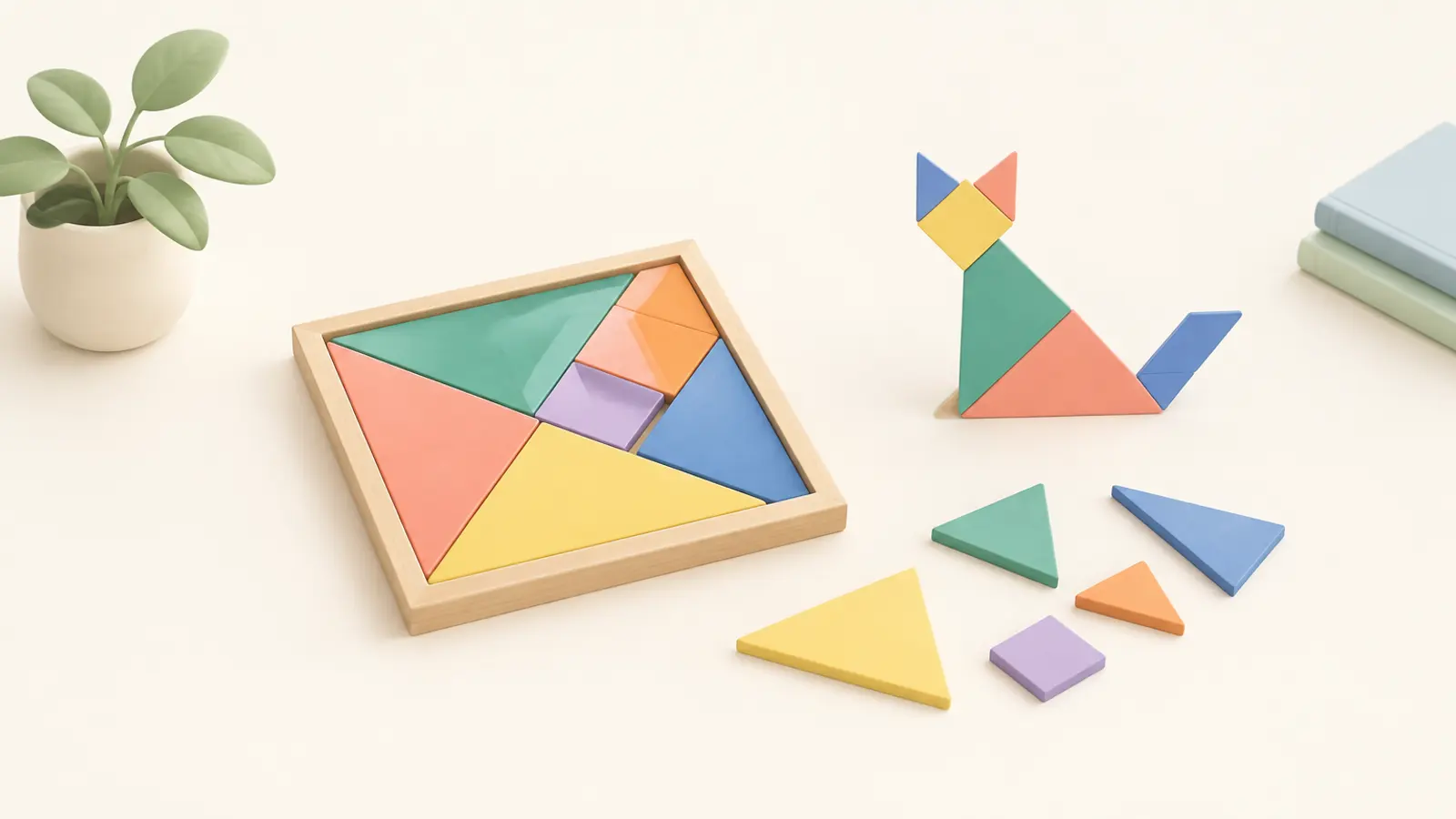
Tangram Puzzles: Complete Beginner's Guide
Have you ever tried to arrange seven simple geometric shapes into a recognizable figure? If so, you've experienced the elegant challenge of tangram puzzles - one of the oldest and most enduring puzzles in human history. This ancient Chinese brain teaser has captivated minds for centuries, and today, it continues to be a powerful tool for developing spatial reasoning, problem-solving skills, and geometric understanding.
Whether you're a complete beginner looking to understand the basics or someone seeking to improve your tangram-solving skills, this comprehensive guide will walk you through everything you need to know about these fascinating geometric puzzles.
What is a Tangram?
A tangram is a dissection puzzle consisting of seven flat geometric pieces, called "tans," which are put together to form specific shapes. The objective is to recreate a particular silhouette or pattern using all seven pieces without any overlapping. The pieces must lie flat and touch each other, creating a complete figure that matches the target outline.
What makes tangrams particularly intriguing is their deceptive simplicity. Despite having only seven pieces, the number of possible configurations is virtually endless, allowing for thousands of different designs ranging from animals and people to objects, letters, and abstract shapes.
The Ancient History of Tangram Puzzles
The origins of the tangram puzzle are shrouded in mystery and legend, much like many ancient Chinese inventions. While the exact date of its creation remains unknown, most historians agree that tangrams emerged in China during the Song Dynasty (960-1279 AD), though they didn't gain widespread popularity until the 18th century during the Qing Dynasty.
One popular legend attributes the tangram's creation to a Chinese servant who accidentally dropped a precious ceramic tile belonging to his master. The tile shattered into seven pieces, and as the servant frantically tried to reassemble it into its original square shape, he discovered that the pieces could form numerous other interesting shapes and figures.
The puzzle's name itself has an uncertain etymology. "Tangram" may derive from the Chinese word "tang," referring to the Tang Dynasty, combined with the Greek suffix "-gram" meaning something written or drawn. However, this remains speculative, as the Chinese traditionally called it "qī qiǎo bǎn" (七巧板), meaning "seven boards of skill" or "seven pieces of cleverness."
Tangrams in the 1800s: Western Popularity
Tangrams reached Europe and America in the early 19th century, sparking an immediate craze that swept through both continents. The puzzle arrived in the Western world around 1815, likely brought by trading ships from China. By the 1820s, tangram mania had gripped European society, with puzzle books selling in unprecedented numbers.
Notable historical figures became fascinated with tangrams, including Napoleon Bonaparte, who allegedly spent time during his exile on Saint Helena solving tangram puzzles. Edgar Allan Poe and Lewis Carroll were also known enthusiasts. The puzzle's popularity transcended social classes, appealing equally to aristocrats in their parlors and children in schoolrooms.
The 19th-century tangram craze eventually subsided, but the puzzle never disappeared entirely. Throughout the 20th century, tangrams experienced periodic revivals and found a permanent place in educational settings, particularly for teaching geometry and spatial concepts.
The 7 Tangram Pieces Explained
Understanding the composition of a tangram set is essential for solving puzzles effectively. A standard tangram consists of exactly seven pieces (tans) cut from a square:
Five Triangles
The tangram includes five triangular pieces, all of which are right-angled isosceles triangles (meaning they have a 90-degree angle and two equal sides):
- Two large triangles: These are the biggest pieces in the set, each covering approximately 1/4 of the original square
- One medium triangle: This piece is half the size of the large triangles
- Two small triangles: The smallest triangular pieces, each being half the size of the medium triangle
All five triangles are similar in shape - they're the same type of triangle, just in different sizes. This similarity creates interesting mathematical relationships that skilled solvers learn to exploit.
One Square
The tangram set includes a single square piece. Interestingly, this square is equal in area to the two small triangles combined, or half the size of the medium triangle. The square often serves as a key reference point when solving complex tangram puzzles.
One Parallelogram
The seventh and final piece is a parallelogram - a four-sided figure with two pairs of parallel sides. This piece is unique because it's the only non-symmetrical piece in the set. The parallelogram has the same area as the square and the two small triangles, making it another important piece for spatial calculations.
The parallelogram is often the trickiest piece for beginners because it can't be flipped in certain tangram variants. However, in most modern tangram puzzles, all pieces can be flipped (reflected) as well as rotated, giving solvers maximum flexibility.
Advertisement
Basic Tangram Rules
While tangrams appear simple on the surface, following the proper rules is crucial for authentic puzzle-solving:
Rule 1: Use All Seven Pieces
Every tangram solution must incorporate all seven pieces without exception. You cannot leave any piece unused, nor can you use fewer pieces to create a simpler version of the target shape. This rule ensures that every puzzle requires the same fundamental challenge.
Rule 2: Pieces Must Lie Flat
All seven pieces must remain flat on the same plane. You cannot stack pieces on top of each other, bend them, or position them at angles. This two-dimensional constraint is what defines tangrams as a planar geometry puzzle.
Rule 3: Pieces Must Touch
The pieces should touch each other along their edges or corners to form a cohesive shape. While small gaps might occasionally appear in amateur solutions, properly solved tangrams create solid, continuous silhouettes.
Rule 4: No Overlapping
Pieces cannot overlap or cover any part of another piece. Each piece occupies its own distinct space within the final configuration. This rule, combined with the requirement to use all pieces, makes tangram puzzles genuinely challenging.
Rule 5: Pieces Can Be Rotated and Flipped
In standard tangram puzzles, you're allowed to rotate any piece to any angle and flip pieces over (creating mirror images). This freedom of transformation is what allows the seven simple shapes to create thousands of different figures.
Solving Strategies for Beginners
Starting with tangrams can feel overwhelming, but employing the right strategies will dramatically improve your success rate. Here are proven techniques for beginners:
Start with the Large Pieces
Begin by positioning the two large triangles first. These pieces occupy the most space and often define the overall structure of the target shape. By placing them correctly early on, you establish a framework for the remaining pieces.
Look for large, obvious areas in the target silhouette that might accommodate these big triangles - such as wings on a bird, the body of an animal, or the sail of a boat.
Identify Distinctive Features
Examine the target silhouette for distinctive features like sharp points, long edges, or right angles. These features often indicate where specific pieces should go. For instance:
- Sharp, protruding points frequently require triangle corners
- Long, straight edges often consist of aligned triangle hypotenuses
- Perfect right angles might indicate the square piece or triangle right angles
Use the Square and Parallelogram Strategically
The square and parallelogram are your special pieces because of their unique shapes. The square is the only piece with four 90-degree angles, making it perfect for creating rectangular features or filling specific gaps. The parallelogram's slanted sides can create dynamic angles that triangles cannot easily achieve.
Work from Outside to Inside
Many beginners find success by building the outer perimeter of the target shape first, then filling in the center. This approach provides a clear boundary and reduces the problem to filling a defined space with the remaining pieces.
Try Different Orientations
Don't forget that each piece can be rotated and flipped. If a piece doesn't seem to fit in one orientation, try rotating it 90 degrees, 180 degrees, or flipping it over. The parallelogram, in particular, looks significantly different when flipped.
Practice Spatial Visualization
Before moving pieces physically (or clicking them digitally), try to visualize where they might fit. Imagine rotating and flipping pieces mentally. This skill develops with practice and dramatically speeds up your solving time.
Learn Common Patterns
As you solve more tangrams, you'll notice recurring patterns - certain combinations of pieces that frequently appear together. For example, the two small triangles often combine to form a square or a parallelogram. Recognizing these sub-patterns helps you solve puzzles more efficiently.
Benefits for Spatial Reasoning and Geometry Skills
Tangram puzzles aren't just entertaining - they're remarkably effective educational tools with scientifically documented benefits:
Develops Spatial Intelligence
Spatial intelligence involves understanding and mentally manipulating objects in space. Tangrams enhance this ability by requiring constant visualization of how pieces fit together, how shapes rotate, and how different configurations relate to target silhouettes. Research shows that regular tangram practice significantly improves spatial reasoning abilities.
Teaches Geometric Concepts
Tangrams provide hands-on experience with fundamental geometric principles:
- Shape properties: Understanding triangles, squares, and parallelograms
- Congruence and similarity: Recognizing how shapes can be the same despite different orientations
- Area and conservation: Learning that the same pieces can form different shapes with identical total area
- Symmetry: Identifying symmetrical and asymmetrical configurations
- Angles: Working with right angles, acute angles, and obtuse angles
Enhances Problem-Solving Skills
Each tangram puzzle presents a unique problem requiring analytical thinking, trial and error, hypothesis testing, and persistence. These are transferable skills applicable to mathematics, science, engineering, and everyday challenges.
Improves Visual-Motor Coordination
Manipulating tangram pieces (whether physical or digital) strengthens the connection between visual perception and motor control. This coordination is essential for activities ranging from handwriting to sports.
Builds Patience and Perseverance
Tangrams can be frustratingly difficult at times, but this struggle teaches valuable lessons about persistence. Learning to work through challenges without giving up builds resilience that extends beyond puzzle-solving.
Advertisement
Tangram for Children's Education
Educators worldwide have recognized tangrams as exceptional learning tools for children across various age groups:
Early Childhood (Ages 3-5)
For young children, tangrams introduce basic shape recognition and fine motor skill development. Even if they can't solve complex puzzles yet, simply playing with the pieces, naming shapes, and creating free-form designs builds foundational skills.
Elementary School (Ages 6-11)
This age group benefits immensely from tangrams as a hands-on geometry tool. Students learn about:
- Shape names and properties
- Fractions and part-whole relationships (seeing how small triangles combine to equal larger pieces)
- Area concepts (understanding that different arrangements maintain the same total area)
- Measurement and comparison
Many mathematics curricula incorporate tangrams as manipulatives for teaching these concepts because they make abstract ideas concrete and visual.
Middle School and Beyond (Ages 12+)
Older students can explore more sophisticated mathematical concepts through tangrams:
- Calculating precise areas using the Pythagorean theorem
- Understanding geometric transformations (translation, rotation, reflection)
- Exploring proof and logical reasoning
- Investigating mathematical paradoxes
Benefits for Special Education
Tangrams are particularly valuable for students with learning differences. The visual-spatial nature of the puzzles provides alternative pathways for understanding concepts that might be challenging through traditional verbal or numerical approaches. The puzzles also accommodate different learning paces without pressure or time constraints.
Famous Tangram Paradoxes
One of the most fascinating aspects of tangrams involves paradoxical puzzles that seem to defy logic:
The Missing Square Paradox
Perhaps the most famous tangram paradox involves two similar human figures, both created with all seven tangram pieces, but one appears to have a foot while the other doesn't. How can the same pieces create two figures that differ in this way?
The secret lies in subtle differences in the positioning of pieces. While both figures use identical pieces with identical total area, small gaps or overlaps (often imperceptible to the casual observer) account for the apparent discrepancy. These paradoxes demonstrate the importance of precise piece placement and the deceptive nature of visual perception.
Area Paradoxes
Some tangram configurations create apparent contradictions where two shapes seem to have different areas despite being composed of the same seven pieces. These paradoxes exploit visual tricks and slight measurement errors to create convincing illusions.
These paradoxes aren't just amusing curiosities - they teach important lessons about mathematical rigor, the importance of precise measurement, and the limitations of visual perception.
The Monk and the Monastery Paradox
This classic tangram paradox shows two similar figures of monks, but one has a complete body while the other appears to be missing part of their robe or body. Like other tangram paradoxes, the solution involves recognizing that our eyes can be deceived by clever arrangements that create the illusion of different total areas.
Frequently Asked Questions
How many different shapes can you make with tangram pieces?
The number of possible tangram configurations is extraordinarily large. While all seven pieces together always have the same total area, they can form over 6,500 documented distinct silhouettes, including animals, people, objects, letters, numbers, and abstract designs. Mathematically, when considering all possible arrangements (including non-meaningful patterns), the number extends into millions.
Are tangrams good for brain training?
Yes, tangrams are excellent for brain training. Scientific studies have shown that regular tangram practice improves spatial reasoning, problem-solving abilities, visual-motor coordination, and geometric understanding. They exercise both analytical thinking (breaking down complex shapes into components) and creative thinking (visualizing different arrangements). Unlike many "brain training" activities, tangrams have solid research backing their cognitive benefits.
What age is appropriate for tangram puzzles?
Tangrams are remarkably versatile across age groups. Children as young as 3-4 can begin exploring basic tangram pieces for shape recognition and free play. By age 5-6, most children can solve simple tangram puzzles with guidance. The puzzles continue to challenge and benefit individuals throughout adulthood, with complexity levels suitable for all ages. The key is matching puzzle difficulty to the solver's skill level.
Can you make a rectangle with tangram pieces?
Yes, you can create multiple different rectangles using all seven tangram pieces. In fact, rectangle puzzles are popular tangram challenges because they require precise spatial planning. The pieces can form rectangles with various proportions, though creating one typically requires advanced problem-solving skills since the relationship between the pieces' angles must be carefully managed.
What's the difference between tangrams and other dissection puzzles?
Tangrams are a specific type of dissection puzzle characterized by their seven particular pieces cut from a square. Other dissection puzzles might have different numbers of pieces, different shapes, or different source configurations. What makes tangrams unique is their specific composition (5 triangles, 1 square, 1 parallelogram), their long history, and their remarkable versatility in creating recognizable silhouettes. While other excellent dissection puzzles exist, tangrams remain the most famous and widely used.
Start Solving Tangrams Today
Tangram puzzles represent a perfect fusion of ancient wisdom and modern cognitive science. These seven simple geometric pieces have survived centuries because they offer something rare: a genuinely challenging mental workout that's accessible, affordable, and enjoyable for people of all ages and backgrounds.
Whether you're looking to improve your spatial reasoning skills, teach geometry concepts to children, exercise your brain, or simply enjoy a meditative puzzle-solving experience, tangrams deliver on all fronts. The beauty of these puzzles lies not just in finding solutions, but in the journey of exploration, the "aha!" moments of discovery, and the satisfaction of watching seemingly impossible configurations suddenly click into place.
Ready to experience the timeless challenge of tangram puzzles? Visit our free online tangram puzzle game and start solving today. No downloads, no registration - just pure puzzle-solving fun. Try starting with beginner-level shapes and gradually work your way up to more complex configurations. With practice, you'll develop an intuitive understanding of how the pieces work together, and those seemingly impossible silhouettes will become achievable challenges.
Remember, every tangram master started as a beginner. The ancient Chinese philosophers who first played with these seven pieces of cleverness discovered something profound: that complex understanding emerges from simple elements, patience transforms confusion into clarity, and the journey of learning can be as rewarding as the destination.
So grab those seven tans and start your tangram journey today. Your brain will thank you for it, and you might just find yourself joining the ranks of Napoleon, Edgar Allan Poe, and countless others who found fascination in these elegant geometric puzzles.
Play Tangram Puzzles Now and discover why this ancient puzzle has captivated minds for over a thousand years!
Put it into practice


Keep reading
Memory Visual
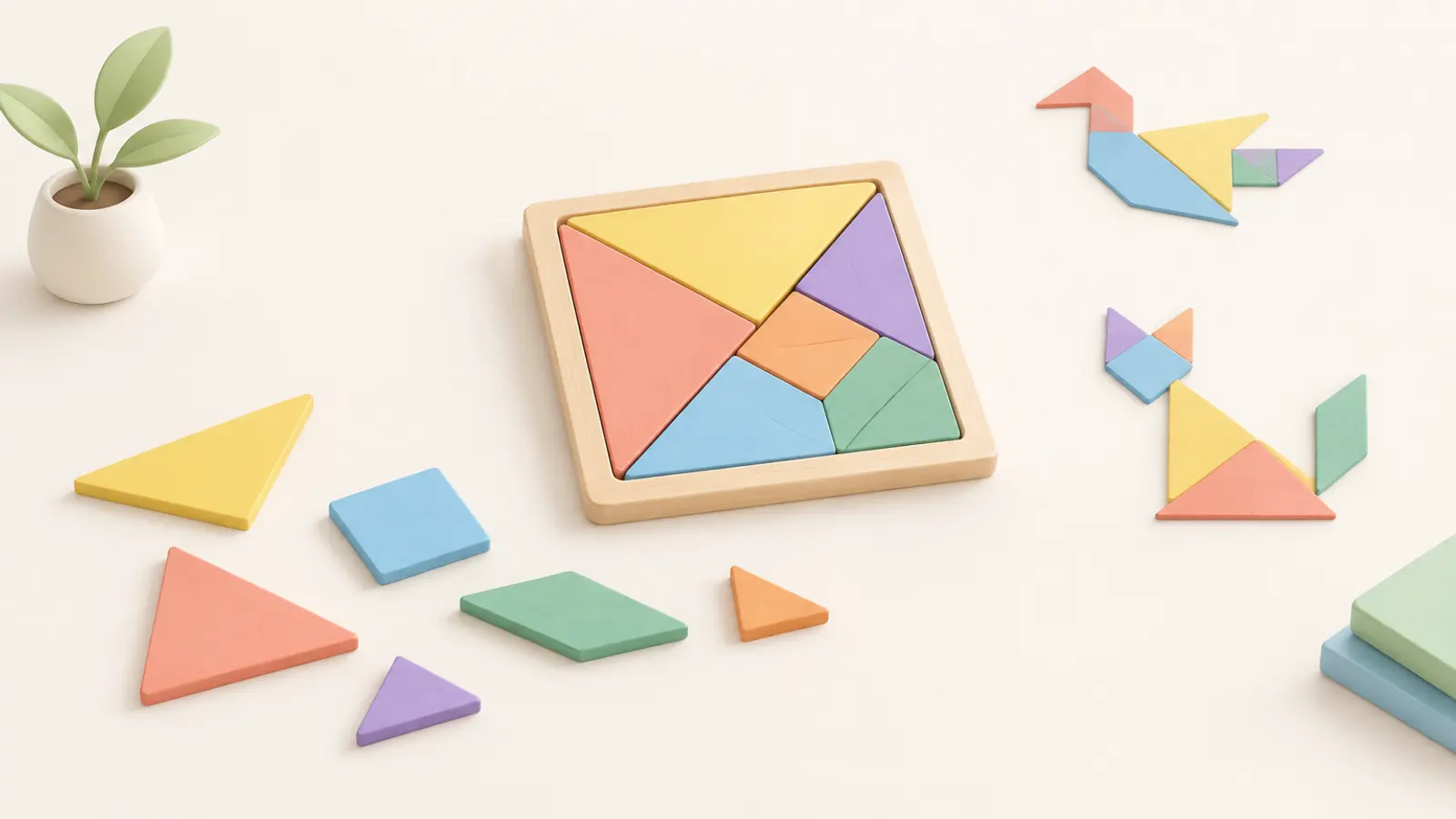
Tangram for Children: The Ultimate Guide to This Educational Puzzle
Discover why tangram puzzles are perfect for children. Learn age-appropriate activities, educational benefits, classroom strategies, and fun challenges.
Jan 19, 2025 11 min

Memory Visual
Memory Match Games for Brain Training: Complete Guide
Discover how memory match games improve cognitive function. Learn strategies, benefits for all ages, and tips to enhance your memory through card matching puzzles.
Jan 18, 2025 10 min
Memory Visual
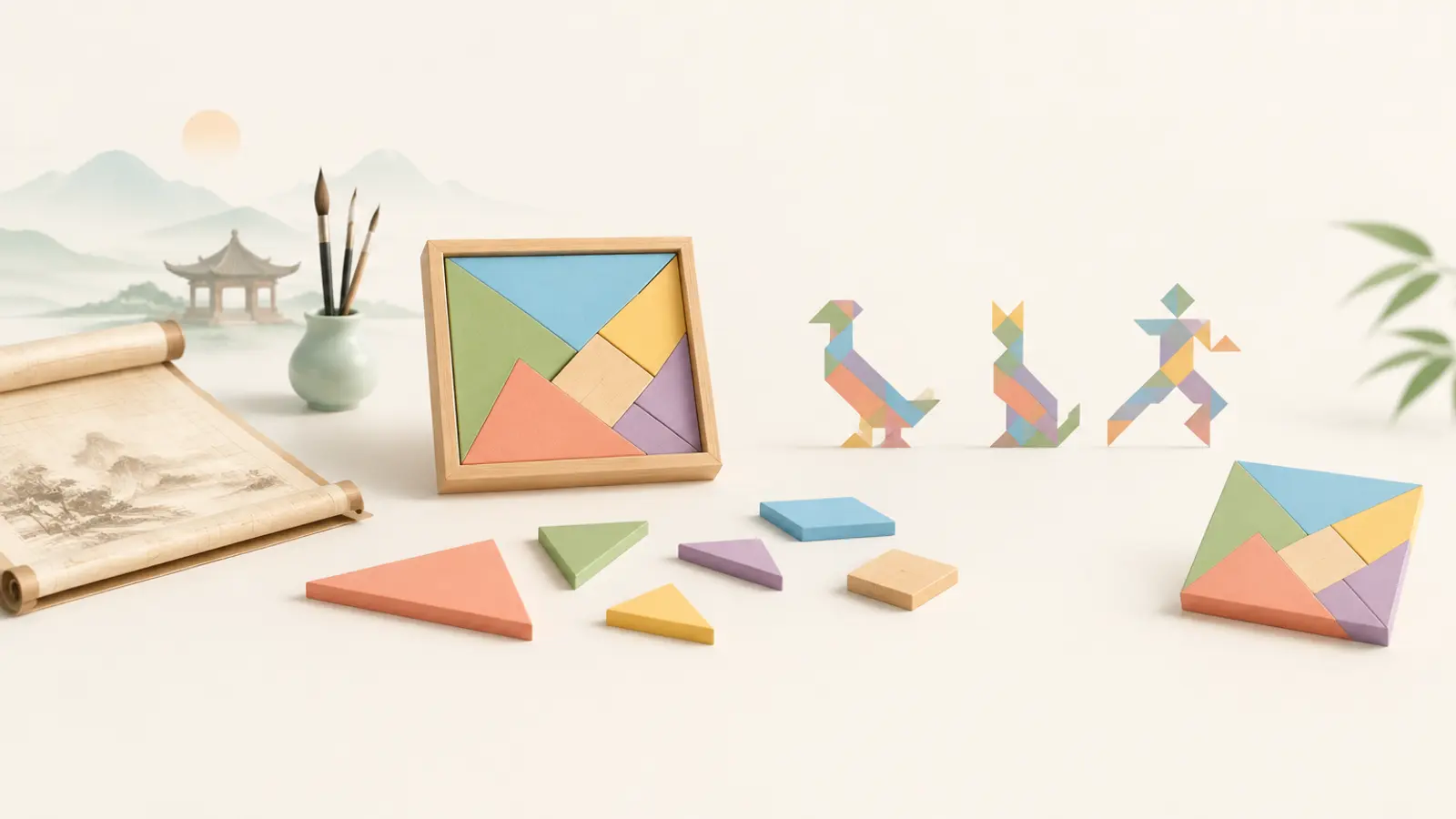
History of Tangram: From Ancient China to Modern Puzzle Phenomenon
Discover the fascinating 1000-year history of tangram puzzles, from mysterious Chinese origins to worldwide craze, and their enduring mathematical legacy.
Jan 19, 2025 11 min
Advertisement