Mastering Matchstick Shapes: The Ultimate Guide to Geometric Puzzles
Discover the history, science, and strategies behind matchstick shapes. Learn how to solve complex geometric match puzzles and improve your spatial reasoning.
By Free To Play Puzzles Editorial Team 10 min read

For over a century, the simple friction match has served as more than just a tool for fire; it has been the foundation for some of the most enduring brain teasers in history. Creating matchstick shapes is a pastime that bridges the gap between simple geometry and complex lateral thinking. Whether you are trying to turn three squares into five or attempting to build four triangles out of six sticks, these puzzles challenge the brain to see beyond the obvious. In this guide, we will explore the rich history, mathematical foundations, and expert strategies for mastering these tactile challenges.
The Sparks of Invention: A Brief History
Matchstick puzzles became a global sensation in the late 19th century. While the modern friction match was invented in 1826 by John Walker, it wasn't until the late 1800s that match companies realized the marketing potential of their packaging. By printing geometric challenges and riddles on the back of matchboxes, companies transformed a household staple into "pocket-sized" entertainment.
As a retro gaming historian, I find it fascinating how these physical puzzles paved the way for the logic games we enjoy today on digital platforms. Long before we had Logic Puzzles on our smartphones, people were sitting in parlors and cafes, rearranging small wooden sticks to solve the latest "matchbox mystery."
The Mathematical Foundation of Matchstick Shapes
At their core, matchstick challenges are scientifically classified as rearrangement puzzles. They aren't just tricks; they are grounded in rigorous geometric principles.
Geometric Logic
Most puzzles focus on the relationship between area and perimeter. When you are asked to move two sticks to create an additional square, you are essentially manipulating the topology of the shape. These puzzles often utilize:
- Symmetry: Many solutions require a balanced, mirrored approach.
- Shared Boundaries: In complex shapes, one matchstick often serves as a "shared wall" for two different polygons.
- Seven-Segment Logic: Many numerical matchstick puzzles use the same "seven-segment display" format found on digital calculators and watches.
The Cognitive Impact
Recent research highlights the educational power of these puzzles. A 2025 study focused on "ethnomathematics-based puzzles" revealed that students engaging with these challenges achieved an N-Gain of 0.68, indicating a high level of improvement in creative thinking compared to a control group's 0.29. Furthermore, research by Verdine et al. (2014) confirms that manipulating physical objects like matchsticks directly improves spatial awareness and executive function.
Advertisement
The Ground Rules of the Game
Before diving into advanced strategies, it is essential to understand the "Universal Laws" of matchstick puzzles. Unless a specific puzzle states otherwise, you must follow these rules:
- No Breaking: You cannot snap a matchstick in half to create two shorter segments.
- No Overlapping: Sticks must lay flat and touch end-to-end; they cannot cross over each other.
- Closed Figures: The resulting geometric shapes must be "closed" (no gaps in the perimeter).
- No Loose Ends: Every single matchstick must be a functional part of the final shape. You cannot have "leftover" sticks sitting to the side.
Strategic Mastery: How to Solve Like a Pro
Solving complex geometric match puzzles requires a shift in perspective. Here are the strategies used by strategic gameplay analysts to crack even the toughest configurations.
1. Work in Sub-Problems
If a puzzle asks you to create five squares from a larger grid, don't try to move everything at once. Identify an "anchor" square that likely won't move, and then see how the remaining sticks can be redistributed around it.
2. The Elimination Strategy
Look at the current configuration and identify which sticks cannot be moved without destroying the core structure. By identifying the "immobile" sticks, you narrow your focus to the "mobile" ones, significantly reducing the number of possible permutations you need to test.
3. Seek Symmetry
Nature and geometry love balance. If you find a move that works for the left side of a shape, there is a high probability that a mirrored move exists for the right side. This is particularly useful in "star" or "hexagon" puzzles.
Real-World Examples and Solutions
The Classic: 6 Sticks, 4 Triangles
This is perhaps the most famous lateral thinking puzzle in history.
- The Challenge: Use 6 matchsticks to create 4 equilateral triangles.
- The Trap: Most people try to lay the sticks flat on the table. In 2D, this is mathematically impossible.
- The Solution: You must think in 3D. By building a tetrahedron (a triangular pyramid), you create four distinct triangular faces using exactly six edges.
The Shared Wall Challenge
- The Challenge: You have a grid of 4 small squares made of 12 sticks. Move 3 sticks to create 3 squares.
- The Strategy: To solve this, you must stop thinking of the squares as independent units. You need to move the outer sticks to create a larger "macro" square that shares walls with two smaller "micro" squares.
The 2025-2026 Year-Shift
A trending challenge for the current year involves a numerical display.
- The Challenge: "Move 1 stick to change 2025 into 2026."
- The Solution: This typically involves taking the vertical stick from the top-right of the "5" and moving it to the bottom-left, transforming the digit into a "6."
Advertisement
Trends for 2025 and 2026
The world of matchstick puzzling is evolving. We are currently seeing a massive shift toward Sustainability and Eco-Puzzles. Modern kits are moving away from plastic replicas and returning to bamboo and recycled wood, offering a more "tactile, organic" feel that enthusiasts crave.
Furthermore, Digital AR (Augmented Reality) is changing how we learn. New apps arriving in 2026 allow users to project matchstick puzzles onto their real-world dining tables using smartphone cameras. This combines the physical benefits of spatial manipulation with the convenience of digital hints and "undo" buttons.
Common Mistakes to Avoid
Even seasoned puzzle solvers can fall into these common traps:
- The "Flat-Land" Trap: As seen in the tetrahedron example, assuming a puzzle is 2D is a major hurdle. If a puzzle seems impossible, try building upward.
- Ignoring Overlapping Edges: Beginners often forget that a single stick can serve two purposes. Always look for ways to make one matchstick do the work of two.
- The IQ Myth: You may see social media posts claiming "Only 1% of people with 130+ IQ can solve this." These are marketing hooks. Puzzling is a skill developed through practice, not a fixed biological limit.
| Mistake | Consequence | How to Fix |
|---|---|---|
| Loose Ends | Invalid Solution | Ensure every stick is part of a closed shape. |
| Breaking Sticks | Cheating | Stick to the original length of the matches. |
| Overlooking 3D | Stagnation | Consider height and depth in your solution. |
Frequently Asked Questions
What are the ground rules for matchstick shapes?
Generally, you cannot break or overlap sticks. The final shape must be a closed geometric figure, and every stick provided in the prompt must be used in the final solution.
How do I solve the "6 sticks, 4 triangles" puzzle?
This is a 3D puzzle. Instead of laying them flat, arrange the sticks into a tetrahedron (a pyramid with a triangular base). This creates four triangles using only six sticks.
Can matchstick puzzles be used for math education?
Absolutely. Teachers use them to illustrate linear sequences, arithmetic operations, and the properties of polygons. They are excellent for teaching students about perimeter and area.
Are there always multiple solutions?
Many puzzle books only provide one answer, but modern "divergent thinking" research encourages finding alternate paths. Many geometric puzzles have two or even three valid configurations.
Conclusion
Mastering matchstick shapes is a journey through history, mathematics, and creative logic. By understanding the core rules and applying strategies like the "Elimination Strategy" and "Sub-Problem" breakdown, you can solve challenges that baffle most people. Whether you are using traditional wooden matches or the latest AR apps, these puzzles remain one of the most effective ways to sharpen your mind.
If you enjoyed this deep dive into physical puzzles, be sure to check out our Matchstick Puzzles Guide for more beginner tips, or challenge your mental arithmetic with our Matchstick Math Puzzles article.
Ready to Test Your Skills?
Explore our full library of logic and math challenges today.
Put it into practice

Keep reading
Physical Puzzles
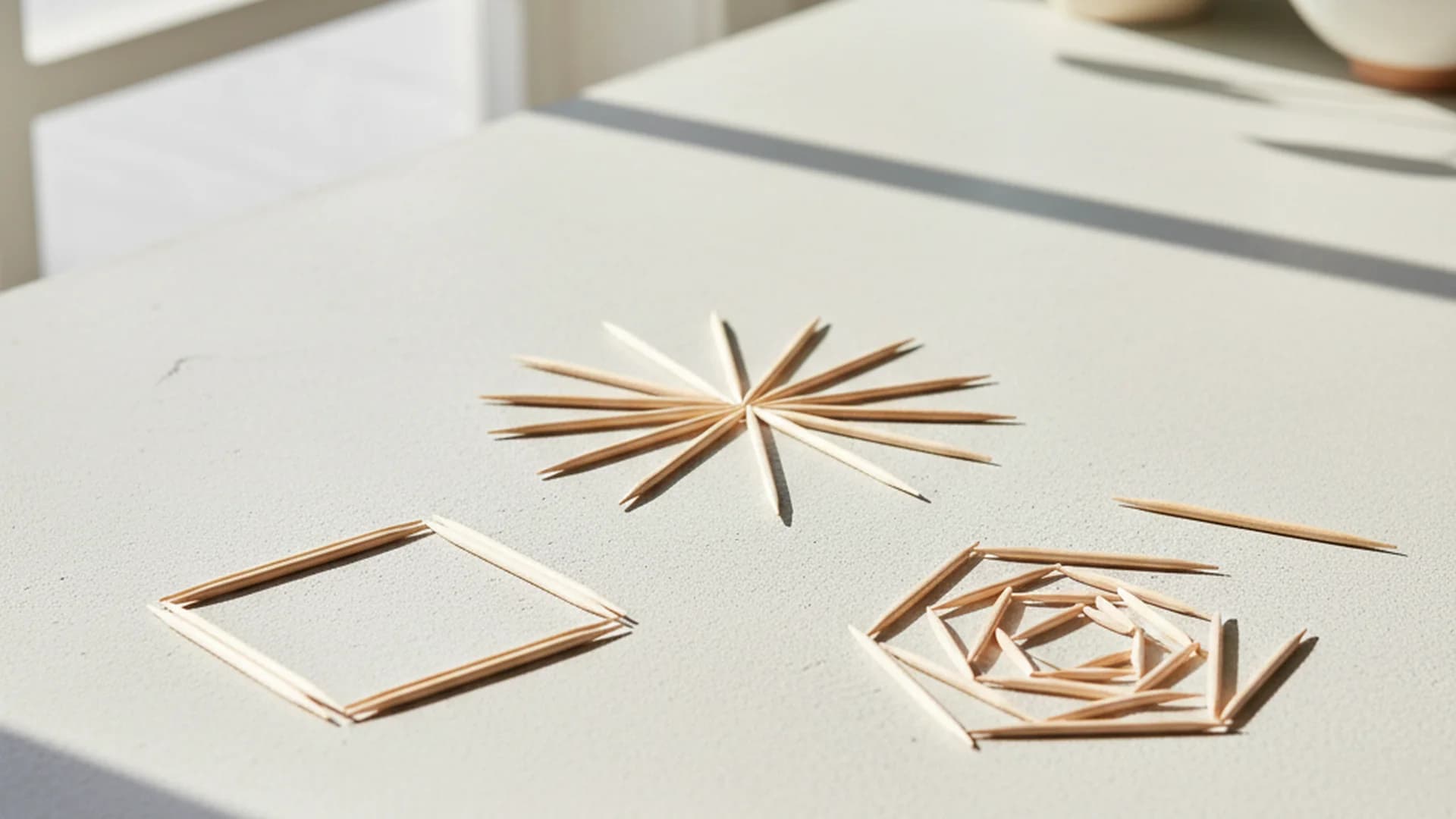
The Ultimate Guide to Toothpick Puzzles: Strategy, Science, and 2025 Trends
Discover the logic and lore of toothpick puzzles. Learn expert strategies, avoid common mistakes, and explore the 2025 digital resurgence of these classic brain teasers.
Mar 10, 2025 10 min
Physical Puzzles
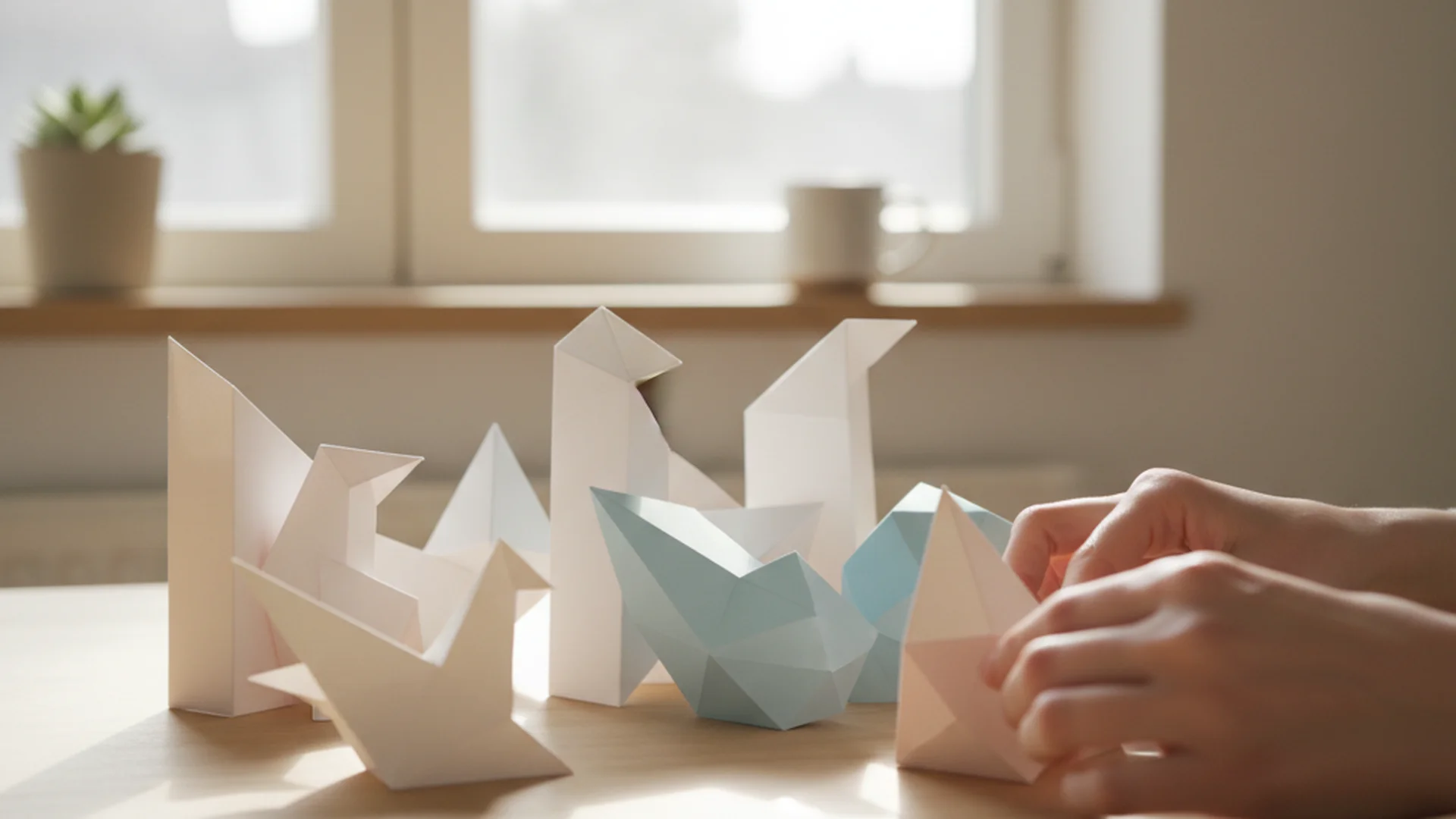
The Science of Paper Folding Puzzles: A Neuroscientist’s Guide to Origami Logic
Explore the cognitive benefits and logic behind paper folding puzzles. Learn expert techniques, trends for 2026, and how these brain teasers boost spatial reasoning.
Jul 25, 2026 12 min
Physical Puzzles
Coin Puzzles Guide: Mastering Logic with Every Flip
Explore the world of coin puzzles, from the classic 12-coin weighing problem to modern 3D challenges. Master brain teasers with our expert guide.
Aug 1, 2026 12 min
Advertisement