Get Better at Crosswords: A Complete 30-Day Improvement Plan
Master the grid with our 30-day plan. Learn how to get better at crosswords using proven strategies, pattern recognition, and expert tips for 2025.
By Free To Play Puzzles Editorial Team 12 min read
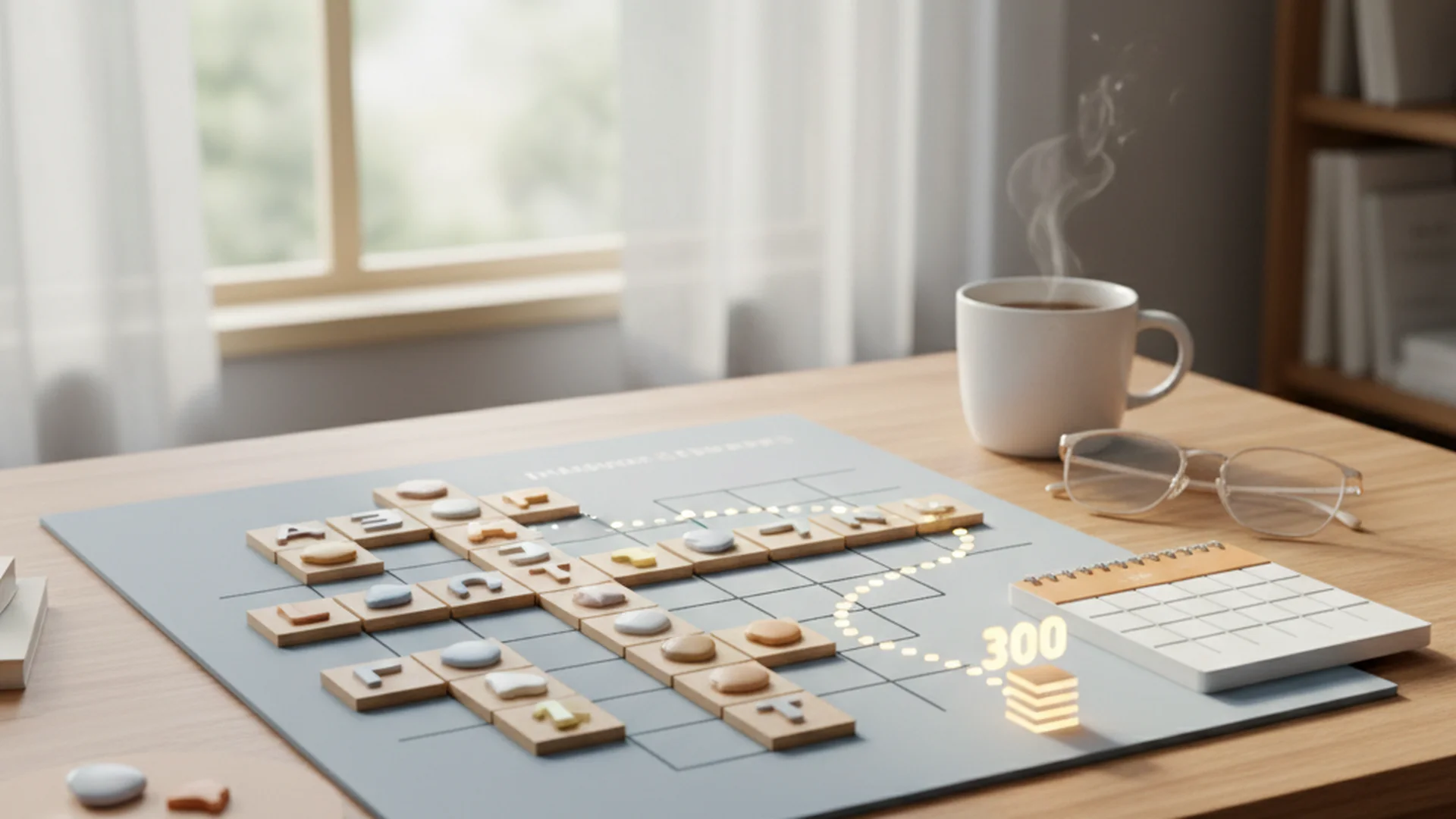
Have you ever looked at a Saturday New York Times crossword and felt like you were staring at a message written in an unbreakable code? You aren't alone. For many, the jump from a "coffee break" puzzle to a professional-grade grid feels insurmountable. However, learning how to get better at crosswords isn't about having a genius-level IQ or an encyclopedic knowledge of 17th-century poetry. It is about understanding the "language" of the grid—a unique blend of lateral thinking, pattern recognition, and specific vocabulary.
In 2025, crosswords have evolved into a cultural phenomenon. With The New York Times surpassing 11.3 million digital subscribers, the "Games" section has become a daily ritual for millions. Beyond the fun, there is a serious biological incentive: a 2024 study in the Journal of Cognitive Enhancement revealed that engaging in these puzzles at least three times a week significantly slows cognitive decline. Furthermore, research from the Cleveland Clinic suggests that regular solving can delay accelerated memory decline by approximately 2.54 years.
Whether you want to shave seconds off your "Mini" time or finally conquer the dreaded Saturday slog, this 30-day plan is designed to systematically improve crossword skills through strategic gameplay analysis.
The Philosophy of the Grid: Why It’s Not an IQ Test
Before we dive into the schedule, we must debunk the most common myth in the puzzling world: that crosswords are a test of intelligence. As a strategic gameplay analyst, I view the crossword as a logic circuit. If you know the inputs (clue types) and the architecture (grid rules), the output (the solve) becomes inevitable.
The Berkeley Crossword Solver (BCS), an AI model, recently achieved "superhuman" performance by using probabilistic inference. It doesn't "know" everything; it simply calculates the most likely word based on intersecting letters and common language patterns. To get better at crosswords, you must learn to think like the BCS. You are building a mental database of "Crosswordese"—short, vowel-heavy words that constructors use to link the more interesting "theme" entries.
Week 1: Building the Foundations (Mondays & Tuesdays)
The first week is about volume and "the language." In the world of major publications, puzzles get progressively harder as the week goes on. Mondays are the easiest, featuring straightforward clues and simple themes.
Daily Action: Conquer the Early Week
Your goal this week is to complete a Monday or Tuesday puzzle every single day. If you don't have a subscription, many free apps offer archives of "Easy" puzzles.
Skill to Master: The "Gimmes"
Don't try to solve 1-Across immediately. Instead, scan the entire list for "Fill-in-the-blank" clues. These are the "gimmes."
- Example: "___ Lisa" (MONA)
- Example: "A ___ of Two Cities" (TALE)
These provide "anchors" in the grid. Once you have MONA, you have four starting letters for the intersecting "Down" clues. This is the "bloom" method—starting from a point of certainty and expanding outward.
Advertisement
Week 2: Memorizing Patterns & Crosswordese
By the second week, you will start to notice the same words appearing over and over. These are not coincidences; they are the "glue" of the crossword world. Because constructors are limited by the black squares in a grid, they often get stuck with three- or four-letter gaps that require specific letter combinations (usually high-vowel words).
The "Personal Crosswordese Dictionary"
Start a notebook or a digital memo. Every time you see a word that you only ever see in a crossword, write it down.
| Word | Clue Category | Why it's common |
|---|---|---|
| OREO | Snack/Cookie | Alternating Vowel-Consonant-Vowel-Vowel |
| ERNE | Bird/Eagle | High-frequency letters (E, R, N) |
| ETUI | Sewing Case | Vowel-heavy (E, T, U, I) |
| ALOE | Plant/Soother | Extremely common vowel combination |
| AGRA | Geography/India | Home of the Taj Mahal |
The Plural Rule
One of the fastest ways to improve crossword skills is to look at the clue's grammar. If the clue is plural (e.g., "Irish boys"), the answer almost certainly ends in 'S' (LADS). You can often fill in the 'S' in the grid before you even know what the rest of the word is.
Week 3: Mastering Lateral Thinking (Wednesdays & Thursdays)
This is where the "fun" begins—and the frustration for the unprepared. Mid-week puzzles introduce themes and wordplay. You are no longer looking for synonyms; you are looking for puns.
The Punctuation Hint
In 2025/2026, the "question mark" is your most important clue. A question mark at the end of a clue indicates that the constructor is using a pun or a non-literal meaning.
- Example: "Flower?" (6 letters). It isn't a rose or a tulip. It’s a RIVER (something that flows).
- Example: "Bread maker?" (5 letters). It’s not a baker; it’s MONEY or a MINT.
The Rebus Square
Thursday puzzles often feature "Rebus" squares, where multiple letters occupy a single box. For example, if the theme is "High Seas," you might find the letters "SEA" squeezed into one square where "C-H-E-L-S-E-A" meets "S-E-A-S-H-E-L-L."
Week 4: Endurance and the "Hard Slog" (Fridays & Saturdays)
Friday and Saturday puzzles are typically "themeless." They rely on long, intersecting phrases and obscure trivia. This is the ultimate test of your vocabulary and your ability to work through sections.
The "Strategic Cheat"
There is a long-standing debate: is looking things up cheating? In the learning phase, looking things up is research. If you are stuck on a 1950s actor name that you simply do not know, look it up. By doing so, you are adding that name to your mental library for the next puzzle.
Taking Brain Breaks
Expert solvers know that the subconscious mind continues to work on the grid even when you aren't looking at it. If you’re stuck, walk away for 15 minutes. The "Aha!" moment often occurs the second you look back at the grid with fresh eyes.
For more foundational tips, check out our How to Solve Crossword Puzzles: Complete Guide.
Advertisement
Modern Trends: Crosswords in 2025-2026
The world of crosswords has changed significantly in the last two years. It's no longer just a pen-and-paper hobby.
- The "Mini" Speed-Running Culture: Puzzles like the NYT Mini have created a competitive scene on social media. Solvers now aim for "Sub-15 second" times, which relies almost entirely on pattern recognition and typing speed rather than deep knowledge.
- AI Analytics: New tools like ReelMind and XW Stats allow you to upload your solve data. These apps will tell you if you are "weak" in Geography or "strong" in Pop Culture, allowing you to focus your study.
- Gen Alpha Slang: To keep the game relevant, 2025 puzzles have seen a massive influx of modern slang. Don't be surprised to see clues for "Side Quest," "Main Character Energy," or "Ghosting."
Common Mistakes to Avoid
Even seasoned players fall into these traps. If you want to get better at crosswords, keep these in mind:
- Rushing the Process: Beginners often quit after five minutes of no progress. Experts know that "marinating" on a clue is part of the experience.
- Ignoring the "Crossers": Many beginners focus only on the "Across" clues. If you can't solve an Across, find an intersecting "Down." Getting just one rare letter like a J, X, or Z can unlock the entire word.
- Thinking It’s Literal: Always assume the constructor is trying to trick you. If a clue seems too simple for a Thursday, it probably is.
- Assuming You Need to Know Everything: You only need to know about 60% of the grid. The other 40% can usually be solved through the intersecting letters (the "crosses").
Tools for Your 30-Day Journey
To help you track your progress, you can use various digital resources. While we focus on the mental aspect, having a structured vocabulary list is invaluable.
| Tool Category | Recommended Resource | Benefit |
|---|---|---|
| Analytics | XW Stats | Tracks your solve speed over time |
| Practice | NYT Games App | Access to decades of archives |
| Word Study | [Crossword Words Testing](/Crossword Words Testing.csv) | Practice common crossword combinations |
| Strategy | 10 Crossword Solving Strategies the Pros Use | Advanced techniques for Fridays |
Frequently Asked Questions
Is it cheating to look up an answer?
In the learning phase, no. Think of it as "training with weights." The more you look up, the more you learn. Eventually, you'll find you need the search engine less and less as your mental "crosswordese" library grows.
How do I deal with "Rebus" squares?
Rebus squares usually follow a theme. If the theme is "Weighty Issues," the rebus might be the word "TON" or "LB" inside a single square. If you find one rebus, look for others—they are usually distributed symmetrically across the grid.
Why are some clues in italics or brackets?
Italics often indicate that the clue is part of a theme or refers to another clue in the puzzle (e.g., "See 24-Across"). Brackets [ ] often denote non-verbal clues or sounds, such as [Sigh] for "ALAS."
How long does it take to get "good" at Saturdays?
With daily practice following this 30-day plan, most solvers can begin to finish Saturday puzzles (with some help) within three to six months. Consistency is more important than raw hours spent in a single day.
What are the best puzzles for beginners?
The NYT Monday, LA Times Monday, and the USA Today crossword are excellent starting points. They use straightforward definitions and minimal wordplay.
Conclusion
Getting better at crosswords is one of the most rewarding cognitive journeys you can undertake. It transforms your daily commute or morning coffee into a strategic exercise that keeps your brain sharp and your vocabulary expanding. By following this 30-day plan—starting with the "gimmes" of Monday and graduating to the lateral-thinking puzzles of the weekend—you are not just solving a grid; you are mastering a language.
Remember, every expert was once a beginner who didn't know that an "ERNE" was a sea eagle. Stick with the plan, use the "bloom" method, and don't be afraid to take those brain breaks.
Ready to Start?
Begin your 30-day crossword challenge today.
Put it into practice
Keep reading
Crosswords
Cryptic Crosswords: A Beginner’s Introduction
Unlock the mystery of cryptic crosswords for beginners. Learn the essential logic, clue types, and expert strategies to solve even the toughest puzzles.
Sep 4, 2026 12 min
Crosswords
Mastering the Grid: The Ultimate Guide to Crosswords for Beginners
Discover the best crosswords for beginners and expert strategies to start solving today. Learn about brain health benefits, modern trends, and tips to master the grid.
Feb 8, 2026 12 min
Crosswords
Mastering Two Speed Crosswords: The Ultimate Guide for Beginners
Learn how two speed crosswords and Everyman puzzles can bridge the gap between quick and cryptic crosswords with expert strategies and tips.
Nov 12, 2025 10 min
Advertisement