Science of the Solved: What Brain Imaging Puzzles Reveal About Neuroplasticity
Explore the latest 2024-2026 research on brain imaging puzzles. Learn how fMRI studies reveal the "Aha!" moment's impact on memory and cognitive aging.
By Free To Play Puzzles Editorial Team 12 min read
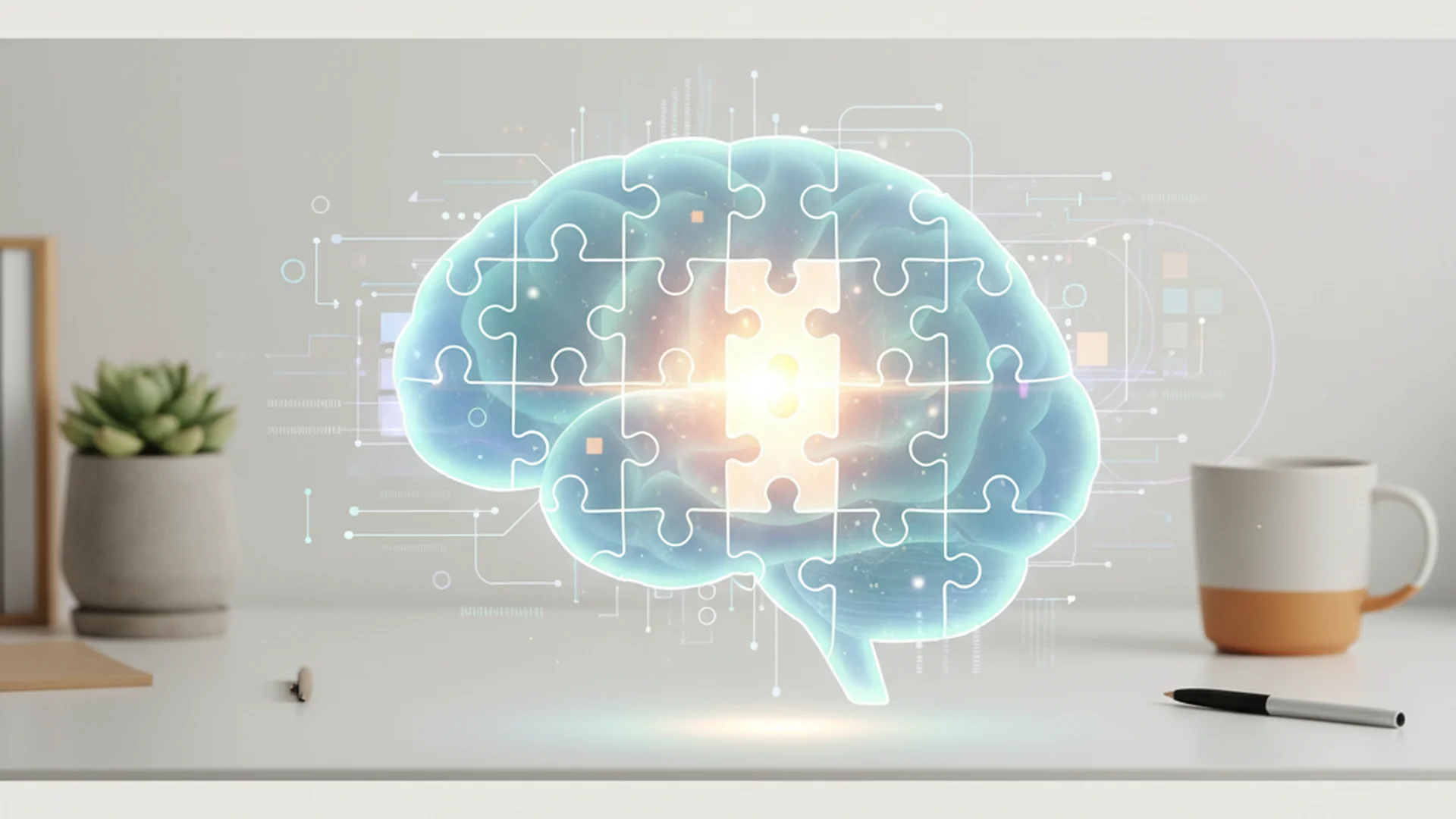
For decades, we have known intuitively that a good challenge keeps the mind sharp. However, as a crossword constructor, I’ve always been fascinated by what actually happens inside the skull when a solver finally cracks a difficult clue. Thanks to recent advancements in brain imaging puzzles research, we no longer have to guess. Between 2024 and 2026, a surge of high-resolution neuroimaging studies has provided a literal window into the "Eureka!" moment, showing us that solving a puzzle is more than just a pastime—it is a physical rebuilding of the brain’s architecture.
From the high-field magnets of the Iseult MRI to the latest AI-driven brain atlases, the science of how we think is being rewritten. These fMRI puzzle studies demonstrate that the brain doesn't just "work harder" during a puzzle; it reorganizes itself to become more efficient, resilient, and cognitively "younger."
The Neuroscience of the "Aha!" Moment
One of the most significant breakthroughs in recent years came from a May 9, 2025, study published in Nature Communications. Researchers used functional Magnetic Resonance Imaging (fMRI) to track the neural signatures of "sudden flashes of insight." This is the moment when the pieces of a logic puzzle finally click into place.
The study revealed that this insight is not just a psychological relief; it is a physiological event. When you experience a "Eureka" moment, the brain significantly strengthens hippocampal activity. Unlike trial-and-error learning, where information is slowly etched into memory, the "Aha!" moment reshapes the brain’s representation of that information instantly. This makes the solution—and the logic used to reach it—significantly easier to remember in the future.
Why Insight Matters More Than Luck
When we solve a puzzle through sheer persistence or random guessing, the brain treats the data as "noise." However, when the solution is reached through a cognitive leap, the brain’s reward centers (the ventral striatum) synchronize with the memory centers (the hippocampus). This synchronization acts like a "save" button, ensuring that the neural pathways formed during the struggle are preserved.
Puzzles as a Shield: Fighting Brain Shrinkage
As we age, the brain naturally loses volume, particularly in the gray matter. However, groundbreaking research from Columbia and Duke University has shown that specific types of mental engagement can slow or even partially reverse this process. In a study involving older adults with mild cognitive impairment, those who engaged in crosswords for 78 weeks showed significantly less brain shrinkage on MRI scans compared to those using generic "brain training" games.
The statistical impact of this is profound. According to the Fisher Center for Alzheimer's Research Foundation, engaging in complex mental activities—including puzzles—is linked to a 46% reduced risk of developing Alzheimer’s disease over a 7-year period.
The UCLA Age-Reversal Study
In 2024, UCLA Health conducted a massive study of 20,000 people aged 50 and older. The findings were startling: participants who frequently completed number games and puzzles performed at cognitive levels typical of individuals eight years younger than their chronological age. This suggests that the brain’s "functional age" is highly plastic and responsive to regular challenge.
Advertisement
The 2025-2026 Technological Frontier
The world of brain imaging puzzles is currently being revolutionized by two major technological shifts: the 11.7T MRI and AI-assisted mapping.
The Iseult MRI and Micro-Activations
The Iseult MRI machine, the world’s most powerful scanner, began producing high-resolution anatomical images in 2024. By 2026, researchers are expected to present the first data on "micro-activations." While standard 3T scanners show broad regions of activity, these ultra-high-field magnets reveal how tiny clusters of neurons cooperate during complex reasoning. This allows scientists to see the "mechanics of thought" at a resolution of 0.2mm.
AI-Assisted Mapping: NextBrain
Released in late 2025, the "NextBrain" atlas uses artificial intelligence to align standard MRI scans with microscopic cellular data. This tool allows researchers to see exactly how puzzles affect specific sub-regions of the hippocampus in living subjects. We are moving away from looking at the brain as a set of large "lobes" and toward viewing it as a highly complex, interconnected web of cellular hubs.
Connectome Caricatures
A new 2025 analysis method for fMRI called "caricaturing" allows scientists to remove "noise"—the standard background activity the brain does just to keep us alive. By stripping away this noise, they can visualize the unique, individualistic ways a person's brain tackles a logic problem. Every brain "solves" differently, and these caricatures are helping doctors create personalized cognitive training research protocols.
| Technology | Benefit to Puzzle Research | Expected Impact |
|---|---|---|
| 11.7T MRI | Reveals micro-activations | Unprecedented detail in logic processing |
| NextBrain | 0.2mm resolution mapping | Precise tracking of hippocampal growth |
| Caricaturing | Filters "neural noise" | Identifying individual solving styles |
Best Practices for Maximum Neuroplasticity
As a crossword constructor, I often see people stick to the same "level" for years. While this is better than no activity, it is not optimal for brain health. To truly benefit from fMRI puzzle studies findings, you must understand how to stimulate neuroplasticity effectively.
1. The "Sweet Spot" Rule
Neurologist Gary Small suggests finding the "sweet spot." A puzzle must be difficult enough to require intense focus but not so difficult that it triggers a stress response. If you are breezing through the Monday crosswords, you aren't building new connections; you are simply reinforcing old ones.
2. The Power of Novelty
Dr. Kellyann Niotis emphasizes that novelty is the primary driver of neuroplasticity. Once you master Sudoku, your brain becomes "efficient" at it, using less energy and creating fewer new synapses. To keep the brain growing, you must switch to a new format, like a word search or a sliding puzzle, to force the brain to map new territory.
3. Creating vs. Solving
One of the most interesting findings from the American Academy of Neurology (2025) is that creating a puzzle provides a much higher tier of cognitive challenge than solving one. When I construct a crossword, I am balancing spatial constraints, vocabulary, and logic simultaneously. This "multi-threaded" thinking is the gold standard for cognitive health.
Common Mistakes to Avoid
Even with the best intentions, many people fall into traps that limit the effectiveness of their mental workouts.
- The "Brain is a Muscle" Metaphor: While common, the brain doesn't "bulk up." Health is measured by connectivity (how well regions communicate) and efficiency (doing more with less energy).
- Neglecting the Physical: The brain is a highly vascular organ. High blood pressure or clogged arteries can negate the benefits of puzzles. As the WHO suggests, puzzles work best when paired with a Mediterranean diet and 30 minutes of daily exercise.
- Over-reliance on Apps: Many apps claim to prevent dementia, but experts warn they often only improve "near transfer." You might get better at the app, but that doesn't always translate to better memory in real life. Diversify your sources with paper puzzles and social games like Connect Four.
Advertisement
Frequently Asked Questions
Does brain training actually make me smarter?
Research indicates that puzzles primarily improve "near transfer" tasks. This means if you practice Sudoku, you will become an expert at Sudoku. While this keeps the brain active, its impact on "far transfer" (general intelligence or unrelated life skills) is still a subject of intense debate among neuroscientists.
Which puzzle is best for my brain?
Different puzzles target different regions. Crosswords are excellent for verbal memory and linguistic retrieval. Sudoku and math puzzles target logical reasoning and pattern recognition. Jigsaws and Tangram focus on visual-spatial reasoning. For the best results, use a variety of types.
How often should I puzzle to see benefits?
Most experts, including those presenting at the 2026 International Conference on Neurology, suggest sessions of 30 minutes, 3–4 times per week. This frequency provides enough "dosage" to trigger neuroplasticity without causing mental fatigue or diminishing returns.
Can fMRI read my thoughts while I solve a puzzle?
No. An fMRI does not read thoughts or specific electrical firings. It measures the "hemodynamic response"—essentially, where the brain is demanding more oxygen and blood flow. While we can see where you are thinking, we cannot see what you are thinking.
Conclusion: The Future of Cognitive Health
The era of brain imaging puzzles has transformed our understanding of the human mind. We now know that every time we struggle with a difficult clue or a complex logic grid, we are doing more than just passing time. We are engaging in a sophisticated process of neural renovation. From the hippocampal strengthening of the "Aha!" moment to the protective effects against brain shrinkage, the evidence is clear: a challenged brain is a resilient brain.
As we look toward the 2026 symposia in London and Atlanta, the bridge between neuroimaging and clinical medicine will only grow stronger. Until then, keep your puzzles challenging, your variety high, and your curiosity peaked.
Ready to Start?
Challenge your brain with our latest collection of interactive games.
Put it into practice
Keep reading
Therapy
Therapeutic Puzzles: Clinical Applications and the Science of Brain Games
Explore the clinical benefits of therapeutic puzzles and brain games. Learn how structured puzzling boosts acetylcholine, improves IQ, and aids occupational therapy.
May 10, 2025 12 min
Brain Health
Brain Training Myths Debunked: What Really Works for Your Mind in 2025?
Explore the science behind brain training myths. Learn why most apps fail at far transfer and discover the 2025 trends that actually improve cognitive health.
Aug 20, 2026 12 min
Science
Puzzle Dosage: Finding the Cognitive Sweet Spot for Brain Health
Learn the ideal puzzle dosage for cognitive health. Explore research on how much brain training is needed to delay dementia and improve fluid intelligence.
Jul 29, 2026 9 min
Advertisement