Wordle vs Word Search: Which Word Game Is Right for You?
Compare Wordle vs word search in this 2025 guide. Discover strategies, cognitive benefits, and the latest trends in the world of competitive word games.
By Free To Play Puzzles Editorial Team 12 min read
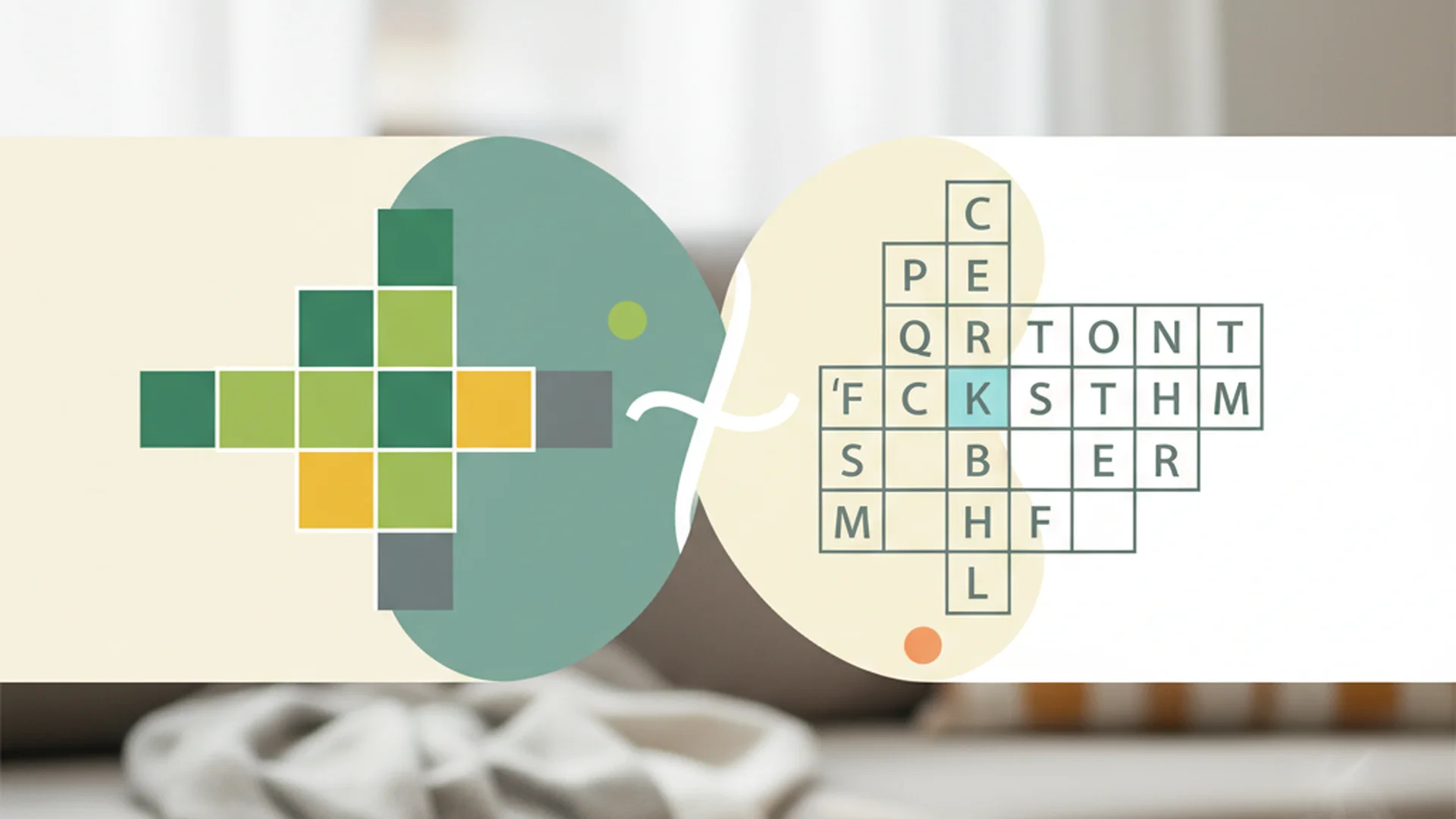
In the landscape of digital and analog puzzles, two titans stand tall: the modern phenomenon of Wordle and the timeless classic, the word search. The wordle vs word search debate has evolved into a fascinating study of how we interact with language.
Whether you are starting your morning with a cup of coffee and the New York Times app or scanning a paperback puzzle book on a flight, you are participating in a global tradition of lexical challenge. While both games fall under the umbrella of word play, they engage entirely different sectors of the brain. In this comprehensive word game comparison, we will break down the mechanics, the strategies, and the 2025 trends that define these two beloved pastimes.
Understanding the Mechanics: Deductive Logic vs. Visual Scanning
To understand the core difference between Wordle and a word search, we have to look at how a player arrives at the solution.
Wordle: The Modern Logic Puzzle
Wordle is essentially a game of "Mastermind" played with letters instead of colored pegs. You have six attempts to guess a hidden five-letter word. The game provides feedback through colored tiles: green for the right letter in the right spot, yellow for the right letter in the wrong spot, and gray for letters not in the word at all.
This is a game of deductive reasoning. You aren't just looking for a word; you are using a process of elimination to narrow down thousands of possibilities into a single solution.
Word Search: The Classic Pattern Recognition
A word search, conversely, is a test of visual perception. You are given a grid of letters and a list of words. Your job is to find those words hidden horizontally, vertically, or diagonally. Unlike Wordle, there is no "guessing." The answers are right in front of you; the challenge lies in filtering out the "noise" of random letters to find the signal.
The Evolution of Word Games in 2025
As we move through 2025, the line between these two formats is beginning to blur. The most notable development has been the rise of Strands, a game launched by the New York Times that has become a breakout hit this year. Strands functions as a thematic, "bending" word search where letters can connect in any direction, bridging the gap between the static word search grid and the brain-teasing challenge of Wordle.
Furthermore, we are seeing heavy AI integration in mobile apps. In 2026, many word search platforms have replaced traditional "show me the word" hints with AI-generated cryptic clues. This turns a visual search into a trivia-based challenge, adding a layer of depth that traditionalists and new players alike find engaging.
Advertisement
Strategic Approaches: How to Win
If you want to play to win, not just for fun, here is how you can optimize your performance in both games.
Expert Wordle Strategies
In Wordle, your first two guesses are your most important. You need to maximize "letter coverage."
- The Best Starting Words: In 2025, data-driven players favor SLATE, CRANE, and ADIEU. These words utilize high-frequency vowels and the most common consonants (S, L, T, R, N).
- The Burner Word Technique: If you are on guess three and have a few yellow letters but are still confused, use a "burner word." This is a word comprised of five entirely new letters. It may not be the answer, but it eliminates a massive portion of the alphabet, making the final guess much easier.
- Letter Frequency: Always remember that E, A, R, T, and O are the most frequent letters in the English language. If you are stuck between two words, lean toward the one using these "heavy hitters."
For more detailed data on openers, see our guide on Best Wordle Starting Words.
Expert Word Search Strategies
While word searches seem simple, speed-runners use specific techniques to clear grids in record time.
- Anchor Letters: Don't look for the whole word. Look for "outlier" letters like Q, Z, X, J, and K. Because these letters appear less frequently in the grid, they act as visual anchors. Once you spot a 'Z', the word "PUZZLE" is usually easy to identify nearby.
- The Systematic Grid Scan: Beginners look randomly. Professionals scan. Start at the top left and move row-by-row for horizontal words, then do the same column-by-column for vertical words.
- The Diagonal Reverse: Advanced puzzles often hide words backward and diagonally. Always train your eyes to scan from the bottom-right toward the top-left—this is the direction most players overlook.
| Feature | Wordle | Word Search |
|---|---|---|
| Core Skill | Deductive Reasoning | Visual Pattern Recognition |
| Daily Format | One puzzle for everyone | Infinite variations |
| Typical Length | 2-5 minutes | 5-15 minutes |
| Social Element | High (Shareable scores) | Low (Usually solo) |
| Difficulty | Escalates per guess | Constant across the grid |
Cognitive Benefits: A Workout for the Mind
A common question is: "Which game is better for my brain?"
The reality is that they offer different types of "cognitive exercise." Wordle focuses on executive function—the ability to plan, remember instructions, and juggle multiple tasks. You have to remember which letters were gray in previous rounds while trying to form new word structures.
Word searches, on the other hand, improve visual search speed and vocabulary acquisition. They are particularly effective for language learners who need to become familiar with the "shape" of words in a new language.
Common Mistakes to Avoid
Even seasoned players fall into traps. Here are the most common errors.
In Wordle:
- Ignoring Gray Letters: Many players, in a rush to guess, will use a letter they already know is "gray" (not in the word). This is a wasted turn.
- Forgetting Double Letters: Players often assume that if a letter turns green, it only appears once. Remember, the word could be "PRESS" or "ABBEY."
- Avoiding Hard Mode: If you find the game too easy, you might be ignoring the "Hard Mode" setting. Hard Mode forces you to use all revealed hints in subsequent guesses, which actually builds better logic discipline.
In Word Search:
- Scanning Only Forward: As mentioned, the "backward diagonal" is the most common place to miss a word.
- Focusing on Short Words First: It is tempting to knock out three-letter words like "CAT" first. However, long words (10+ letters) take up more "real estate" in the grid. Finding them first clears the visual field and makes the smaller words pop out.
- Ignoring the Theme: Most word searches are thematic. If the theme is "Space," and you see the letters "P-L-A-N-E-T," you can find it much faster than if you were just looking for random character strings.
Advertisement
Frequently Asked Questions
Is Wordle harder than a word search?
They test different skills. Wordle is generally considered "harder" because it requires you to generate the words yourself from a blank slate, whereas a word search provides the words for you. Wordle is a game of deduction; word search is a game of observation.
Why is there only one Wordle a day?
This is a deliberate design choice by the original creator, Josh Wardle, and maintained by the New York Times. It prevents player fatigue and creates a sense of community, as everyone across the globe is trying to solve the exact same puzzle at the same time.
Are word searches good for the brain?
Yes, they help with visual search tasks, scanning efficiency, and vocabulary. However, cognitive specialists recommend "novelty." For the best brain health, you should switch between different types of puzzles—like doing a Word Search one day and a Word Scramble the next.
What was the hardest Wordle of 2025?
Statistically, the word "INBOX" (April 19, 2025) caused the largest spike in Google searches for "Wordle hint." Its difficulty stemmed from the "I_BOX" structure, which could have been several other words, leading many players to lose their streaks.
Conclusion: Why We Play
Whether you prefer the high-stakes logic of your daily Wordle streak or the relaxing, meditative scan of a traditional word search, both games fulfill a fundamental human desire for order and achievement. In 2025, we are seeing more ways to play than ever before, with social competitions, AI-enhanced clues, and hybrid games like Strands keeping the genre vibrant.
If you find yourself stuck in a rut with one, try the other. The shift in perspective might be exactly what your brain needs. If you're looking for more ways to improve your daily game, don't miss our Daily Wordle Tips for maintaining your winning streak.
Ready to Play?
Challenge your brain with our selection of word and logic games.
Put it into practice
Keep reading
Word Games
Hangman Game Rules: How to Play the Classic Word Puzzle
Master the essential hangman rules and winning strategies. Learn why short words are harder than long ones and discover 2025 trends like Evil Hangman.
Jan 13, 2026 12 min
Word Games
Word Search Games for Seniors: Brain Health Benefits and Accessibility Tips
Discover how word search puzzles support senior cognitive health, memory, and social connection. Expert tips for accessibility, mental benefits, and enjoyment.
Jan 19, 2025 12 min

Word Games
Master the Grid: The Ultimate NYT Connections Game Strategy for 2025
Level up your NYT Connections game with expert strategies from a neuroscientist. Learn to spot red herrings, master the purple tier, and boost your solve rate.
Oct 12, 2026 12 min
Advertisement