Tetris: Complete Guide to the World’s Most Popular Puzzle
Master the blocks with our Tetris complete guide. Explore history, competitive strategies, T-spins, and the latest 2025 updates in this expert analysis.
By Free To Play Puzzles Editorial Team 25 min read
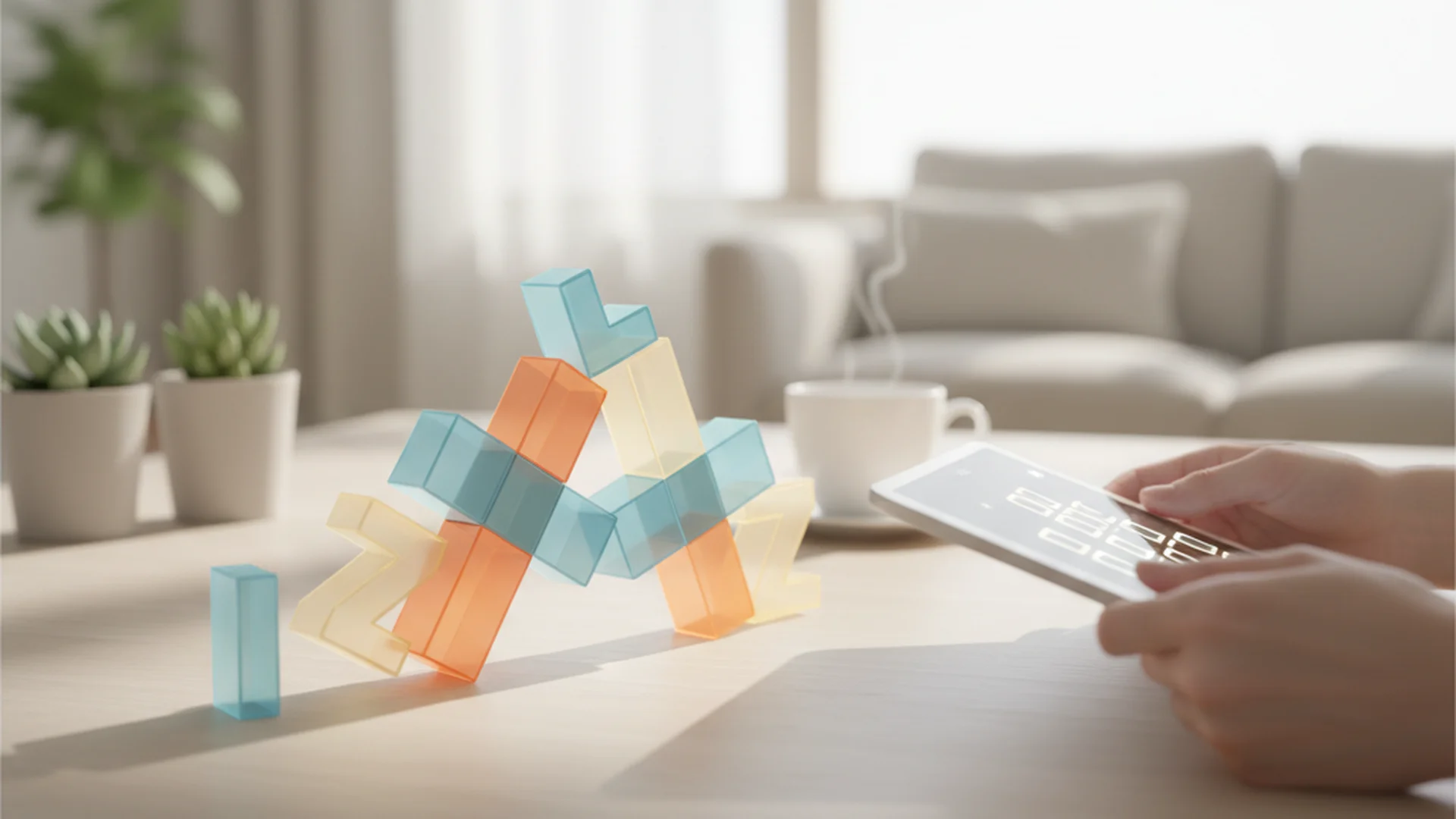
Welcome to the definitive tetris complete guide. No game offers as much depth, history, and neurological benefit as Tetris. From its humble beginnings in a Soviet laboratory to its status as a global esport in 2025, this guide covers tetris everything you need to know to move from a casual player to a Grand Master.
Whether you are looking to understand the complex "Rolling" techniques used in the Classic Tetris World Championship or simply want to improve your high score on our Tetris page, this guide provides the roadmap to mastery.
The Genesis of a Global Phenomenon
Tetris was not born in a high-tech studio. It was created by Alexey Pajitnov in June 1984 on an Electronika 60, a computer that lacked even basic graphics capabilities. Pajitnov, a software engineer at the Soviet Academy of Sciences, used text brackets to represent the blocks.
The name "Tetris" is a portmanteau of "Tetra" (the Greek prefix for four, as every piece consists of four squares) and "Tennis" (Pajitnov’s favorite sport). What started as a simple distraction for Soviet scientists quickly became a worldwide obsession. For a deeper look at the geopolitical battle for the game's rights, see our History of Tetris.
From Game Boy to the Cloud
While the original 1989 Game Boy version remains the best-selling standalone title with 35.8 million copies, the franchise has evolved into a multi-platform giant. As of 2025, the series has surpassed 520 million lifetime sales.
| Version/Platform | Sales Milestone | Significance |
|---|---|---|
| Original Game Boy (1989) | 35.8 Million | Popularized portable gaming |
| Mobile Downloads | 500 Million+ | Most downloaded mobile puzzle |
| Total Franchise | 520 Million+ | Best-selling puzzle game ever |
Understanding the Mechanics: Modern Tetris vs. Classic
If you haven't played since the 1990s, you might find that modern Tetris feels different. This is due to the standardization of the "Guideline" rules which govern how the game behaves.
The 7-Bag Randomizer
In the earliest versions, the game was "memoryless," meaning the computer could give you five "S" pieces in a row purely by chance. Modern Tetris uses the 7-Bag System.
The Tetriminos (The Pieces)
Every piece in Tetris is called a Tetrimino. Understanding their roles is vital for this tetris complete guide:
- I-Piece (Light Blue): The only piece that can clear four lines (a "Tetris").
- O-Piece (Yellow): The square. Stable but can create "caves" if not placed on a flat surface.
- T-Piece (Purple): The most versatile piece for competitive "T-Spins."
- S & Z-Pieces (Green/Red): The "snakes" that often cause players the most trouble.
- J & L-Pieces (Blue/Orange): Essential for filling gaps and building columns.
Advertisement
Advanced Gameplay: Professional Strategies
To reach "Pro" or "X-Rank" in competitive play, you must move beyond simple line clears. You need to master spatial efficiency and piece manipulation.
The 9-0 Stacking Method
The most reliable way to score consistently is 9-0 stacking. This involves building a solid wall 9 columns wide, leaving the far right (or left) column empty. This "well" is reserved exclusively for the I-piece to score a 4-line clear.
The Power of the T-Spin
In modern versus modes, clearing four lines is no longer the strongest move. A T-Spin Double (rotating a T-piece into a tight slot) sends the same amount of "garbage lines" to an opponent as a Tetris but uses fewer pieces and keeps your stack lower.
Finesse: The Secret to Speed
High-level Tetris is about minimizing keystrokes. "Finesse" refers to placing a piece in its optimal position using the fewest button presses possible. Most experts use a "Two-Tap" system where they move a piece to the wall and tap back once, rather than manually tapping the piece across the board.
The Cognitive Science of Tetris
The "Tetris Effect" is fascinating. This phenomenon occurs when players spend so much time with the game that they begin to see blocks in their peripheral vision or imagine how real-world objects—like groceries or bricks—could fit together.
Brain Health and Spatial Reasoning
Playing Tetris has been shown to increase the thickness of the cerebral cortex and improve spatial reasoning. Research published in Molecular Psychiatry even suggests that playing Tetris shortly after a traumatic event can help reduce the frequency of PTSD flashbacks by "competing" for the brain's visual processing resources.
For more on how games impact the mind, read our article on Brain Health and Puzzles: Science of Cognitive Gaming.
The Competitive Scene in 2025–2026
The world of competitive Tetris is currently undergoing a revolution. For years, "Hypertapping" (vibrating your finger to move pieces fast) was the gold standard. Today, "Rolling" has taken over.
The Rise of Rolling
Rolling involves "flicking" the back of the controller into your stationary fingers. This technique has allowed players to reach Level 255 and effectively "crash" the original NES Tetris, a feat once thought humanly impossible.
Upcoming Events
- ARIKA New Title (Q1 2025): A new focus on training and mastery is coming to Steam from the developers of the Grand Master series.
- CTWC 2026: The Classic Tetris World Championship is set for June 5–7, 2026, in Pasadena, CA. This event will likely showcase the next evolution of AI-integrated playstyles.
Advertisement
Common Mistakes to Avoid
Even seasoned arcade veterans fall into these traps. If you want this tetris complete guide to truly level up your game, avoid these habits:
- Stacking Too High, Too Fast: Beginners often prioritize speed over a clean stack. If you create "caves" (holes with blocks above them), you will quickly "Top Out."
- Rotating in One Direction: Only using the 'A' button to rotate clockwise is inefficient. You must learn to use both 'A' and 'B' (Counter-Clockwise) to save time and perform advanced kicks.
- Ignoring the Next Queue: If you only look at the falling piece, you are playing reactively. Pros look at the "Next" queue to plan their stack 3 moves in advance.
- Misinterpreting the Movie: While the 2023 Tetris movie is an entertaining thriller, remember that the KGB car chases were dramatized. The real battle was a fascinating, albeit slower, legal war over licensing.
Frequently Asked Questions
How does the "randomness" work in modern Tetris?
Modern versions use the 7-Bag System. The game puts all seven shapes into a virtual bag, shuffles them, and deals them out. Once the bag is empty, it starts a new one. This prevents "droughts" of specific pieces.
What is a T-Spin, and why is it important?
A T-Spin occurs when you rotate a T-shaped piece into a slot where it shouldn't normally fit right before it locks. It is important because it awards significantly more points and sends more "garbage" to opponents in versus modes.
Can you "beat" Tetris?
Technically, no. In most versions, the game simply gets faster until you lose. However, in the original NES version, players can now reach a "Kill Screen" or use "Rolling" to crash the game, which is considered "beating" it by the community.
What is the "Tetris Effect"?
It is a psychological phenomenon where your brain continues to process the game's logic after you stop playing. You may see falling blocks when you close your eyes or mentally organize real-world objects into grids.
Is Tetris good for brain health?
Yes. Studies indicate that it improves spatial awareness, increases cortical thickness, and can even assist in reducing the impact of traumatic memories if played shortly after a stressful event. You can learn more about these Cognitive Benefits on our dedicated page.
Conclusion: The Path to Grand Master
Tetris is a game of "easy to learn, impossible to master." By understanding the 7-Bag system, mastering your finesse, and maintaining a flat stack, you are already ahead of 90% of casual players. As we look toward the 2026 championships and new AI-assisted trainers, the game continues to prove why it is the most enduring puzzle in history.
If you are looking to branch out into other classic titles, explore our Classic Arcade Games: Ultimate Retro Gaming Guide to see how Tetris compares to other legends of the era.
Ready to Start?
Test your skills and see if you can reach the high score today.
Put it into practice

Keep reading
Arcade Games
The Unstoppable Rise: A Complete History of Tetris from Soviet Labs to Global Phenomenon
Explore the full tetris history, from its 1984 origin in Moscow to the modern "rolling" revolution. Learn who invented Tetris and how it became a global icon.
Sep 25, 2026 12 min

Arcade Games
The Tetris Effect: Why the World’s Most Famous Game Haunts Your Dreams
Discover the psychology behind the Tetris effect. Learn how this phenomenon rewires the brain, reduces PTSD flashbacks, and improves cognitive health.
Dec 8, 2025 12 min
Arcade Games
Tetris Battle Strategies: Master Competitive Play for 2025
Master the ultimate Tetris battle strategy to dominate competitive play. Learn rolling techniques, T-spins, and 2025 professional tactics to win.
Jul 29, 2025 12 min
Advertisement